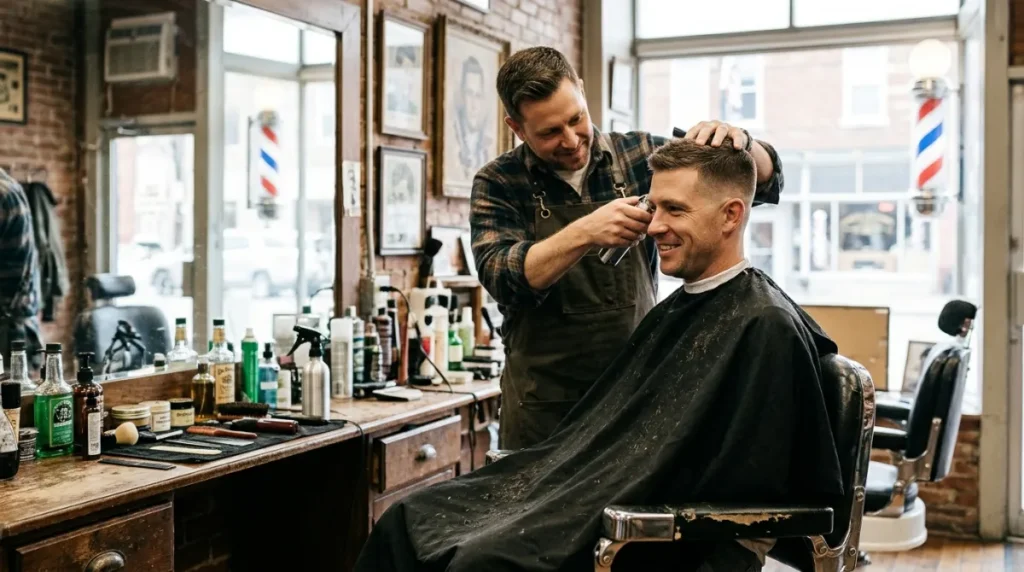
American hairstyles can mean three things: the classic American crew cut, a style that was born in the United States, or simply what people across the US are wearing right now. This guide covers all three, so you can understand the history and also walk into a salon or barbershop knowing exactly what to ask for.
Most guides on American hairstyles pick one side. History pages skip what to order today. Barbershop lists skip women, textured hair and the culture behind the cuts. Here you get both, plus real survey data on what Americans actually prefer state by state.
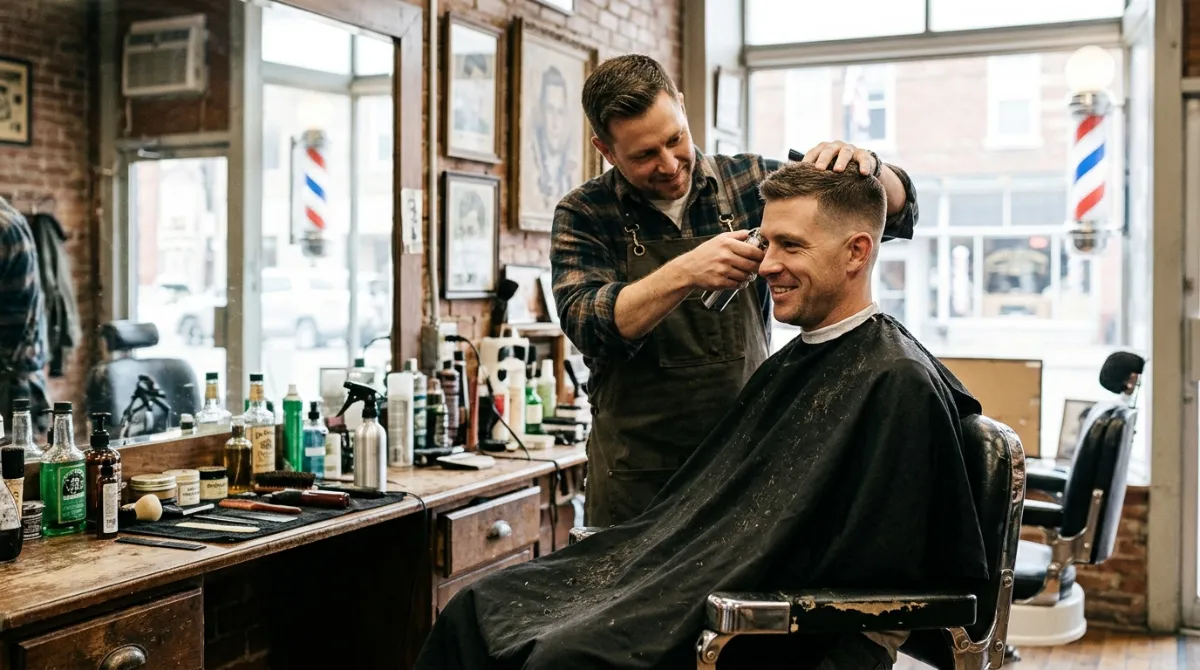
Quick answer: The most iconic of all American hairstyles is the crew cut, a short men’s cut with tapered sides and up to about 2 inches on top that spread from college rowing teams and the Navy. Today, the most popular men’s style in America is the fade, followed by the buzz cut. For women, the bob, curtain bangs, shag-inspired layers and box braids lead the list.
Table of Contents
What Does “American Hairstyle” Mean?
People use the phrase “American hairstyles” in three ways. Knowing which one you mean saves a confusing conversation in the chair.
| Meaning | What people usually want | Example |
|---|---|---|
| The classic American haircut | A clean, short, tapered men’s cut | Crew cut, Ivy League, flat top |
| A style born in the USA | A cut with American roots and history | Ducktail, beehive, Gibson Girl, high-top fade |
| What Americans wear now | Current trends across the country | Fade, buzz cut, bob, curtain bangs, box braids |
Outside the US, especially in Europe and South Asia, “American haircut” or “American fade” usually means a short back and sides blended with clippers and some length on top. In the US itself, people rarely use the phrase. They name the specific cut instead.
The American Crew Cut: The Signature of American Hairstyles
The crew cut is the haircut most people picture when they talk about American hairstyles. It has short, tapered sides and back, with slightly longer hair on top that gets shorter toward the crown.
It became popular in the late 1920s, when Ivy League rowing crews wore it to keep hair out of their eyes on the water (American crew haircut guide). The Navy and the military made it standard, and dictionaries still list it as a cropped men’s haircut that originated in the US (Dictionary.com).
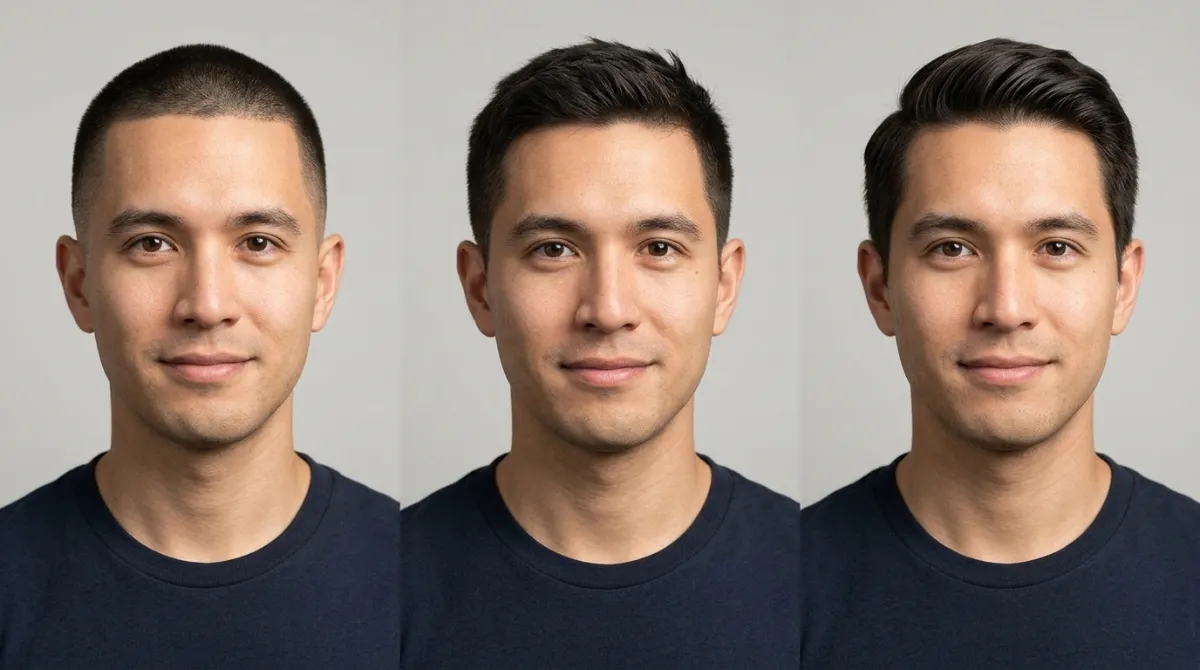
Crew cut variations
| Variation | Top length | Sides | Best for |
|---|---|---|---|
| Short crew | About 1/2 inch | #1–#2 guard | Hot weather, very low effort |
| Classic crew | 1 to 1.5 inches | #2–#3 guard | Office and everyday wear |
| Long crew / Ivy League | Up to 2 inches, side-parted | #3–#4 guard | A polished, professional look |
| Flat top | Top cut flat and level | Short taper | Bold, retro, military style |
| Crew cut with fade | Classic top | Faded to skin or #0.5 | A modern, sharper finish |
A true crew cut keeps the top at no more than about 2 inches. Go longer and most barbers will call it an Ivy League or a short side part.
How to ask your barber for an American crew cut
Barbers cut what you describe, not what you imagine. Use this simple script:
- “I’d like a classic crew cut.”
- “Number 2 on the sides and back, tapered up.” (Pick #1 for shorter, #3 for softer.)
- “Leave about an inch on top, a little longer at the front.”
- “Taper the neckline, not a blocked line.” (A taper grows out more cleanly.)
- Show one photo of the cut on someone with your hair type, not just a model you like.
Guard numbers matter: each clipper guard step adds roughly 1/8 inch, so a #2 guard leaves about 1/4 inch and a #4 guard about 1/2 inch.
American Hairstyles Through History: A 250-Year Timeline
American hairstyles have always followed the country’s big shifts: war, money, music, film and civil rights. With 2026 marking 250 years since 1776, here is the whole story in one table you can scan in a minute.
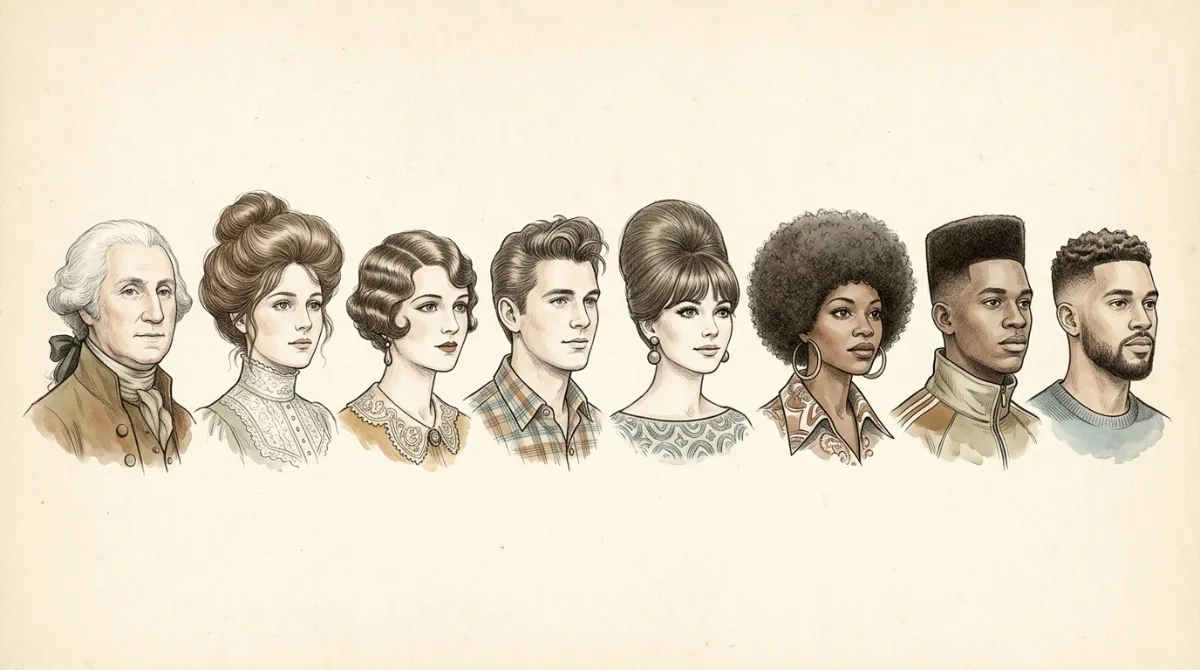
| Era | Women’s signature styles | Men’s signature styles | What drove it |
|---|---|---|---|
| Before 1776 | Long braids, Hopi butterfly whorls | Long braids, roach (Mohawk), shaved heads | Indigenous identity and ceremony |
| 1770s–1790s | Pinned buns under caps | Powdered wigs, ribbon queue | Status, European fashion |
| 1800s | Braided crowns, chignons, ringlets | Side parts, sideburns, beards | Photography, Victorian ideals |
| 1900s | Gibson Girl pompadour updo | Short regular haircut | Magazine illustration |
| 1920s | Blunt bob, finger waves | Slicked-back, center part | Women’s vote, jazz age |
| 1930s | Soft side-parted waves | Short sides, oiled tops | Hollywood studios |
| 1940s | Victory rolls, pin curls | Crew cut, military cuts | World War II, factory safety |
| 1950s | Poodle cut, pageboy | Pompadour, ducktail, flat top | Rock and roll, prosperity |
| 1960s | Beehive, pixie, bouffant | Mop-top, Ivy League | TV, space age, British influence |
| 1970s | Shag, feathered hair, afro | Afro, long hair, sideburns | Civil rights, counterculture |
| 1980s | Big permed hair, Jheri curl | Mullet, high-top fade, Jheri curl | Hip-hop, MTV, excess |
| 1990s | Layered “TV sitcom” cut, curtain bangs | Curtains, frosted tips, Caesar | Grunge, boy bands, sitcoms |
| 2000s | Straightened hair, side bangs | Faux hawk, spiky gel | Flat irons, reality TV |
| 2010s | Balayage, lob, natural hair | Undercut, man bun, skin fade | Instagram, natural hair movement |
| 2020s | Curtain bangs, wolf cut, box braids, bob | Low taper fade, textured crop, modern mullet | TikTok, CROWN Act, comfort |
Want to go deeper on a single decade? See our guides to 1950s men’s hairstyles, 1970s men’s hairstyles and 90s men’s hairstyles.
Three patterns worth knowing
- Styles come back every 30 to 50 years. The 1970s shag returned as the wolf cut, and the 1980s mullet returned with softer blending.
- Practical needs created icons. Victory rolls kept hair away from factory machines in the 1940s, and the crew cut kept rowers’ hair out of their eyes.
- Black American culture shaped mainstream trends. The afro, high-top fade, waves and box braids moved from community barbershops into national fashion.
American Hairstyles That Were Born in the USA
Many “classic” cuts started somewhere else, like the pompadour (France) or the mullet. These styles have genuinely American roots, which makes them the truest answer to “what are American hairstyles.”
| Hairstyle | Origin | Why it matters |
|---|---|---|
| Crew cut | 1920s, Ivy League rowing crews and the US Navy | Became the default American men’s cut for decades |
| Ivy League | 1950s US colleges | A longer, side-parted crew cut still worn in offices |
| Flat top | 1940s–50s US military and civilian barbers | Defined the clean-cut 1950s look |
| Ducktail (DA) | Created by barber Joe Cerello in 1940 (Wikipedia) | The rebel style of early rock and roll |
| Gibson Girl updo | 1890s–1900s, from Charles Dana Gibson’s illustrations | America’s first national beauty ideal |
| Beehive | Chicago stylist Margaret Vinci Heldt, 1960 (Wikipedia) | The defining big-hair look of the 1960s |
| Hopi butterfly whorls | Hopi Nation, worn by unmarried young women (Indian Traders) | One of the oldest styles on the continent |
| Afro (as a political statement) | 1960s–70s Civil Rights and Black Power era | A symbol of pride in natural hair |
| High-top fade | 1980s Black American barbershops and hip-hop | Mother of today’s fade culture |
| Jheri curl | 1970s–80s, named after American chemist Jheri Redding | A glossy, wet-look curl that dominated the 1980s |
Why these American hairstyles still matter in 2026
These cuts are not museum pieces. The crew cut, Ivy League and flat top are still standard barbershop orders. The fade, which grew out of the high-top era, is now the single most popular men’s style in the country. The beehive’s teasing technique still sits under most volume-heavy bridal updos.
The Most Popular Men’s American Hairstyles Today
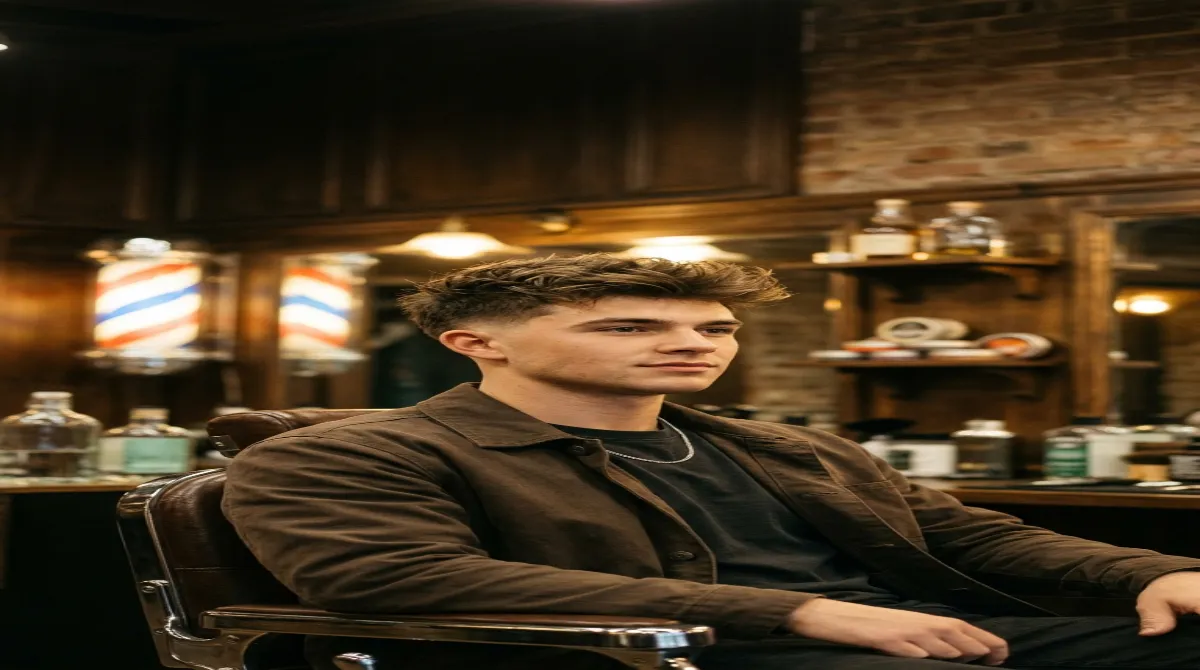
The fade is America’s favorite men’s hairstyle, and the buzz cut is close behind. Together they are the top pick for about 26% of Americans, according to a 2025 Hims survey of 7,100 people across all 50 states (Hims).
| Rank | Hairstyle | Share naming it their favorite |
|---|---|---|
| 1 | Fade | 14% |
| 2 | Buzz cut | 12% |
| 3 | Classic boy cut | 10.5% |
| 5 | Side part | 7% |
| Last | Pompadour | 3% |
Source: Hims / Stacker survey, fielded January 2025 (AOL / Stacker). The published summary did not name the #4 style.
States that break the national trend
Eleven states picked something other than a fade or buzz cut. Vermont stands out: 20% favor long layers, about 2.5 times the national rate, while almost nobody there likes a side part. Side parts remain popular in Hawaii and Alabama, and slicked-back hair is the favorite in North Dakota and Arkansas (Boston 25 News, ABC 17).
Men’s American hairstyles worth asking for in 2026
| Style | Look | Maintenance | Trim every |
|---|---|---|---|
| Low taper fade + textured top | Clean, natural, office-friendly | Medium | 3–4 weeks |
| Mid or high skin fade | Sharp, high contrast | High | 2–3 weeks |
| Buzz cut | Minimal, athletic | Very low | 3–6 weeks |
| Classic crew cut | Timeless, clean-cut | Low | 4–5 weeks |
| Ivy League / side part | Polished, professional | Medium | 4–5 weeks |
| Textured French crop | Modern, short fringe | Medium | 4 weeks |
| Modern mullet | Retro, expressive | Medium | 5–6 weeks |
| Medium flow / long layers | Relaxed, Vermont-style | Low cutting, more styling | 8–10 weeks |
For step-by-step barber instructions, read our full low taper fade guide and our French crop haircut guide.
Fade vs. taper: the difference most guys get wrong
A fade blends down to very short or bare skin, usually from the temple or higher. A taper only shortens gradually at the sideburns and neckline and keeps some hair everywhere. If your workplace is conservative or you want a cut that grows out gracefully, ask for a taper. Not sure how high to go? Compare a low, mid and high fade side by side.
The Gen Z effect
Younger American men are reshaping the barbershop. In the same survey, 24% of Gen Z men planned to spend more on their hair than the year before, compared with 14% of Gen X men (ABC 17 News). That is why textured crops, curtain bangs and modern mullets sit beside the classic fade.
Popular American Hairstyles for Women in 2026
Women’s American hairstyles in 2026 favor movement, soft texture and cuts that air-dry well, rather than stiff, heavily styled looks. Many of the most requested styles are updated versions of cuts from the 1920s, 1970s and 1990s.
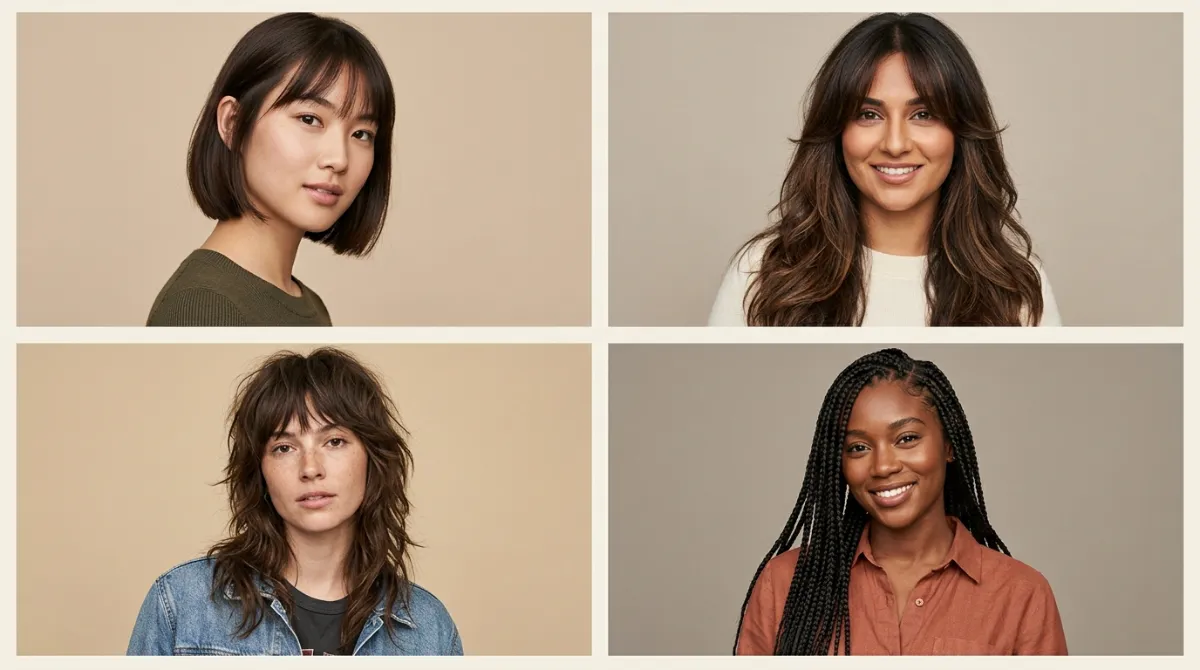
| Style | Roots | Suits | Upkeep |
|---|---|---|---|
| Bob (French, Italian, blunt) | 1920s flapper bob | Fine to medium hair, oval and heart faces | Trim every 6–8 weeks |
| Lob (long bob) | 2010s update of the bob | Almost everyone; easy transition from long hair | Trim every 8–10 weeks |
| Curtain bangs | 1970s feathered fringe | Round, square and long faces | Fringe trim every 3–4 weeks |
| Shag / wolf cut | 1970s shag | Wavy and thick hair | Every 8–10 weeks |
| Long face-framing layers | 1990s TV layered cut | Long and thick hair | Every 10–12 weeks |
| Pixie | 1960s pixie | Fine hair, strong features | Every 4–6 weeks |
| Box braids / knotless braids | African braiding traditions | Natural and textured hair | Reinstall every 6–8 weeks |
| Natural curls / afro | 1970s natural hair movement | Curly and coily hair | Shape every 8–12 weeks |
| Sleek low ponytail | Colonial ribbon queue | Formal and work settings | Styling only |
What the regional search data shows
Women’s preferences vary a lot by region. An All Things Hair analysis found perms were the top style in 33 states, box braids led in 12 states mostly along the East Coast and the South, and balayage colour led in four states including Maine and Massachusetts (All Things Hair). That study is a few years old, so treat it as a pattern, not a 2026 ranking.
Matching a style to your daily routine
- Under 5 minutes a morning: lob, pixie, box braids or a sleek ponytail.
- Comfortable with a round brush: curtain bangs, a blunt bob or long layers.
- Want natural texture to do the work: shag, wolf cut or a curl-specific cut.
For what is coming next, see our forecast of 2027 hair trends for women.
Black American Hairstyles and the CROWN Act
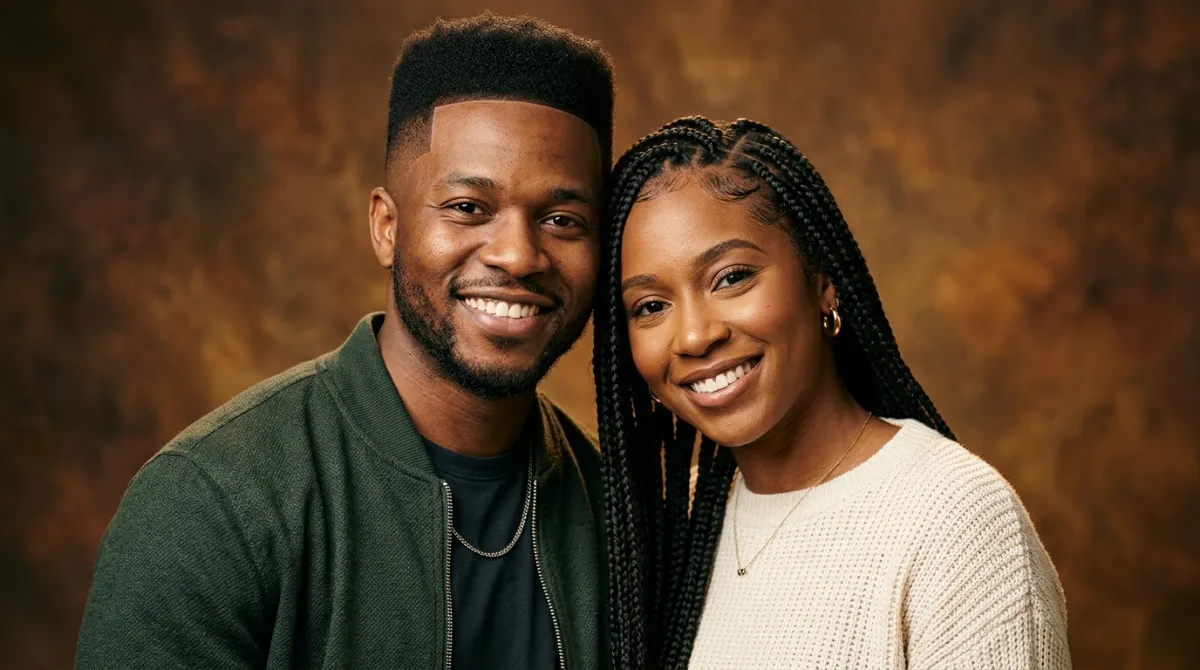
Black American hairstyles are among the most influential in US history, and since 2019 a growing number of states have made it illegal to discriminate against them. That legal shift is something no general guide to American hairstyles explains, yet it changes what people can wear to school and work.
Iconic Black American styles
- Protective styles: box braids, knotless braids, cornrows, twists, bantu knots and locs. They protect the ends, reduce daily manipulation and can last for weeks. (Choosing between the two most popular? Read knotless braids vs. box braids.)
- Natural styles: the afro, twist-outs, wash-and-go curls and tapered natural cuts.
- Barbershop classics: the high-top fade, 360 waves, the Caesar and the temple fade with a sharp line-up.
What the CROWN Act protects
The CROWN Act (Creating a Respectful and Open World for Natural Hair) bans discrimination based on hair texture and protective styles such as braids, locs and twists (National Urban League).
- California passed the first state CROWN Act in 2019 (Good Morning America).
- More than half of US states now have a version of the law. Pennsylvania is the latest statewide addition, taking effect on January 24, 2026 (National Law Review, Babst Calland).
- A federal CROWN Act has been introduced but has not become law, so protection still depends on your state.
If you are choosing a protective style for a new job or school, check your state’s law and the employer’s written grooming policy.
Native American Hairstyles and Their Meaning
The first American hairstyles came from Indigenous nations, and for many of them hair carried meaning about identity, family, mourning and spirituality. There was never one “Native American hairstyle”; each nation had its own traditions.
| Style | Nation / region | Meaning or use |
|---|---|---|
| Long single or double braids | Many Plains nations | Everyday and ceremonial wear for men and women |
| Butterfly (squash blossom) whorls | Hopi | Worn by unmarried young women |
| Chongo (hair bun) | Pueblo, Navajo, Hopi | Still worn by some women in the Southwest |
| Board or bonnet hair | Seminole women, 1800s | Hair fanned into a disc over a frame |
| Roach (“Mohawk”) | Several Eastern and Plains nations | Warrior style; artificial roaches are still worn at powwows |
Sources: Native Languages of the Americas, Indian Traders.
In some nations, men cut their hair only in mourning, which is why long hair still carries deep meaning for many Indigenous people today. If you admire these styles, learn their meaning first, and avoid wearing sacred items like feathers as costume accessories.
Regional American Hairstyles Across the US
America is too big for one look. Climate, culture and local industry all shape what people ask for, which is why survey results change so much from state to state.
| Region | Typical look | Why |
|---|---|---|
| South and Texas | Buzz cuts, crew cuts, low fades; box braids | Heat and humidity reward short, low-effort cuts |
| Northeast cities (New York, Boston) | Sharp fades, blunt bobs, polished side parts | Office and finance culture, strong barbershop scene |
| New England (Vermont) | Long layers and natural, outdoorsy hair | Relaxed lifestyle; Vermont leads the US for long layers |
| West Coast (California) | Lived-in waves, curtain bangs, surfer-length hair | Beach culture, air-dry styling |
| Hawaii and Alabama | Classic side part holds strong | Survey favorite in both states |
| Midwest | Classic boy cut, crew cut, practical layers | Practical, low-fuss preferences |
How to Choose the Right American Hairstyle for You
The right cut fits three things at once: your face shape, your hair type and how much time you will really spend on it. Pick the row that matches you, then cross-check. For more detail, use our men’s haircuts by face shape guide.
| Face shape | Men | Women |
|---|---|---|
| Oval | Almost anything; crew cut, side part | Almost anything; bob, long layers |
| Round | Height on top: quiff, textured crop, high fade | Long layers, side-swept curtain bangs |
| Square | Softer texture: crop, medium flow | Shag, soft waves, wispy fringe |
| Long | Shorter top, fuller sides: buzz, Caesar | Chin-length bob, full bangs |
| Heart | Medium length, side fringe | Lob, chin-length bob |
| Hair type | Works best | Avoid |
|---|---|---|
| Fine or thinning | Buzz, Caesar, textured crop, blunt bob | Very long, one-length styles |
| Thick | Fades, shag, wolf cut, layered lob | Heavy blunt cuts with no layers |
| Wavy | Curtain bangs, shag, medium flow | Cuts that need daily flat-ironing |
| Curly or coily | Tapered natural cut, afro, twists, box braids | Cutting curls dry with straight-hair methods |
Simple maintenance rules
- Book your next appointment before you leave the chair; fades lose their shape fastest.
- Use a product that matches the finish: matte clay for texture, pomade for shine, curl cream for definition. Our best hair styling products for men list breaks this down.
- Wash less often if your hair is dry or curly; every second or third day is common.
- Protect braids and curls at night with a satin pillowcase or bonnet. A simple curly hair routine helps here.
Frequently Asked Questions About American Hairstyles
What is the most American hairstyle?
The crew cut is widely seen as the most American of all American hairstyles. It spread from Ivy League rowing teams in the 1920s and became standard in the US Navy and military. Its clean, tapered shape still defines the “all-American” look, and variations like the Ivy League and flat top remain common barbershop orders.
What is the most popular men’s hairstyle in America right now?
The fade. A 2025 Hims survey of 7,100 Americans found 14% named the fade as their favorite men’s style, followed by the buzz cut at 12%. In 2026, the low taper fade with a textured top is the version barbers hear most often.
What is an “American haircut” outside the US?
In Europe, South Asia and the Middle East, an “American haircut” or “American fade” usually means short, clipper-blended sides with longer hair on top. It is close to a crew cut or a mid fade. Ask for the specific fade height and top length to avoid confusion.
What American hairstyles were invented in the USA?
The crew cut, Ivy League, flat top, ducktail, beehive, Gibson Girl updo, high-top fade and Jheri curl all have American origins. Indigenous styles such as Hopi butterfly whorls and the Pueblo chongo are far older than the United States itself.
What were popular American hairstyles in the 1950s?
Men wore the pompadour, ducktail, flat top and crew cut, usually styled with pomade. Women wore short poodle cuts, pageboys and set curls from weekly salon visits. Rock and roll and Hollywood film spread these American hairstyles well beyond the US.
What are the most popular women’s American hairstyles in 2026?
The bob and lob, curtain bangs, shag and wolf cuts, long face-framing layers and box braids lead the list. The common thread is soft movement and low daily styling, rather than stiff, sprayed hair.
Is it legal to be fired for wearing braids or locs in the US?
It depends on your state. More than half of US states have passed a CROWN Act that bans discrimination based on hair texture and protective styles. Pennsylvania’s law took effect in January 2026. There is no federal CROWN Act yet.
How often should I get an American crew cut trimmed?
Every four to five weeks keeps a classic crew cut sharp. If you add a skin fade, plan on every two to three weeks, because the shortest areas show growth first.
Conclusion: Your Hairstyle Is Part of the American Story
American hairstyles have always mixed practicality, identity and a little rebellion, from Hopi whorls and powdered wigs to the crew cut, the afro and today’s taper fade. The best choice for you is the one that suits your hair type, face shape and real morning routine, not just the trend on your feed.
Ready to pick your own American classic? Save one reference photo on someone with your hair type, then use our low taper fade guide or face shape haircut guide to walk into your next appointment knowing exactly what to ask for.
Save This Guide on Pinterest
Pin this image to your hairstyle board so you can find this guide to American hairstyles again before your next haircut.