

1950s men’s hairstyles split into two camps: short, clean-cut haircuts like the crew cut, flat top, Ivy League and side part, and longer, greased-back rebel styles like the pompadour, ducktail and jelly roll. Almost every one of them was built on the same base — short back and sides, more length on top, and a lot of hair cream.
That split still matters when you sit in a barber’s chair today. Ask for “a 50s haircut” and you could walk out with anything from Neil Armstrong’s butch cut to Elvis’s 5-inch pompadour.
This guide covers 15 real 1950s men’s hairstyles, who wore them, the exact length you need, what to tell your barber, and how to style each one with modern products.
Quick answer — the most popular 1950s men’s hairstyles were:
- Side part (the “regular” haircut)
- Crew cut
- Flat top
- Ivy League (Princeton)
- Pompadour
- Ducktail (D.A.)
- Slicked-back hair
- Quiff
Table of Contents
What defined 1950s men’s hairstyles
Three things shaped 1950s men’s hairstyles: cheap hair cream, the TV, and rock and roll. Together they turned a man’s haircut from a quiet routine into a statement.
- Hair cream ruled. Brylcreem, Vitalis and Wildroot sat on every bathroom shelf. Brylcreem’s “a little dab’ll do ya” TV jingle became one of the most remembered ad lines of the era, and the whole look earned the nickname “greasy kid stuff.”
- Hats were fading. As men stopped wearing a hat every day, the hair itself became the visible part of the outfit — so it got more shape and more height.
- Barbers became stylists. By the 1950s, trend-setting barbers offered dye, perms and even toupees, not just a trim.
- Music and film set the trend. Elvis Presley, James Dean, Little Richard and Tony Curtis made tall, shiny fronts a symbol of youth, while Hollywood leading men kept the neat side part alive.
Clean-cut vs greaser: the two 50s camps
Most 1950s men’s hairstyles were short, tidy cuts. The long, greased styles you see in films were worn by a minority — teenagers, performers and working-class rebels.
| Camp | Typical styles | Who wore them | Finish |
|---|---|---|---|
| Clean-cut | Side part, crew cut, flat top, Ivy League, butch cut | Businessmen, students, servicemen, fathers | Neat, light shine, nothing out of place |
| Greaser / rock and roll (US) | Pompadour, ducktail, slick back, elephant trunk | Teens, musicians, mechanics, actors | High shine, heavy pomade, height in front |
| Teddy Boys (UK) | Quiff, jelly roll, D.A. at the back | Working-class British youth, mid-50s London | Moulded, combed, very groomed |
| Black American styles | Conk, short afro, part line, waves | Musicians, performers, everyday men | Pressed shine (conk) or natural, oiled |
The Teddy Boys took their name from Edwardian-style suits; a 1953 newspaper shortened “Edwardian” to “Teddy,” and the quiff became their trademark. The London Museum’s history of the Teddy boys covers how the look spread across post-war London.
15 classic 1950s men’s hairstyles (with barber instructions)
Each of the 1950s men’s hairstyles below lists the length you need, what to tell your barber, and how to style it at home. Lengths are approximate; your barber will adjust for density and growth pattern.

1. Side part (the “regular” haircut)
The side part was the default 1950s men’s haircut — short back and sides, a clean part, and a slight wave on top. Parents and schools preferred it, and Hollywood stars like Cary Grant and Johnny Carson wore polished versions. If you want the modern take, our gentleman haircut guide shows nine variations.
- Length: 2–3 in on top, tapered sides.
- Ask your barber: “A classic tapered side part, scissor-cut on top, part on my natural side, no hard line.”
- Style it: Comb in a water-based pomade on damp hair, set the part, sweep the top across and slightly back.
2. Crew cut
The 1950s crew cut kept the top short and tapered the sides shorter. It was slightly longer than the WWII GI cut and was worn by students, athletes and actors like Tab Hunter.
- Length: 0.5–1 in on top, #1–#2 guard on the sides.
- Ask your barber: “A crew cut, a bit longer at the front, taper the sides, keep it natural, not a skin fade.”
- Style it: A pea-sized amount of matte paste, pushed up at the front.
3. Ivy League (Princeton)
The Ivy League is a crew cut with enough length at the front to part and comb to the side. It was the college and young-executive cut of the decade.
- Length: 1.5–2.5 in at the front, graduating shorter to the crown; #2–#3 sides.
- Ask your barber: “An Ivy League cut — long enough at the front to side-part, shorter toward the crown.”
- Style it: 1950s men used butch wax; today use a light cream or matte pomade and a side part.
4. Flat top (and flat top boogie)
The flat top cut the top into a level, square platform and was among the most popular cuts of the decade. Actor Aldo Ray wore a classic version. The “boogie” variation combed longer side hair back along the head (called “fenders”).

- Length: 1–1.5 in on top, very short sides.
- Ask your barber: “A flat top, cut level over a comb, short tapered sides.” Choose a barber who has done one — it is a skilled clipper-over-comb cut.
- Style it: Blow-dry upward, then a firm wax or stick to keep the edges square.
5. Butch cut
The butch cut is the same short length all over, with no taper — today it is called a buzz cut. It needed almost no styling, so it suited athletes and servicemen; a young Neil Armstrong wore one in 1956.
- Length: #3–#4 guard all over.
- Ask your barber: “A butch cut — one even guard all over, clean up the neckline.”
- Style it: Nothing. That was the point.
6. Pompadour
The pompadour is the defining greaser and rock and roll style: a tall front swept up and back, short sides, high shine. Elvis Presley, James Dean and Little Richard made it iconic.
- Length: at least 4 in on top at the front; short sides, slightly longer than a fade if you want it authentic.
- Ask your barber: “A classic pompadour — length on top graduating from front to crown, scissor-tapered sides, no skin fade.”
- Style it: See the step-by-step pompadour section below.
7. Quiff
The quiff lifts only the front section, while the rest of the top lies flatter. It was the signature of Britain’s Teddy Boys and a more office-friendly cousin of the pompadour. For a full breakdown of modern variations, see our quiff hairstyle for men guide.
- Length: 3–4 in at the front, 1.5–2 in toward the crown.
- Ask your barber: “A classic quiff — longest at the fringe, shorter toward the crown, tapered sides.”
- Style it: Blow-dry the front up and back, then pomade for shine or clay for a matte modern finish.
8. Ducktail (D.A.)
The ducktail is defined by the back: side hair combed back and meeting in a central line down the back of the head, like a duck’s tail. Philadelphia barber Joe Cirello said he invented the ducktail in 1940; it became a teen rebel trademark in the 1950s.

- Length: 3+ in on the sides and back, so the hair can be swept around.
- Ask your barber: “Leave length on the sides and back for a ducktail; don’t taper the nape short.”
- Style it: Heavy pomade, comb the sides back, then draw a vertical line from crown to nape with the comb’s tail.
9. Slicked-back hair
The slick back combs everything straight back with no part and a wet-look shine. It was the everyday greaser look and needed little more than a comb and a jar of cream.
- Length: 3–5 in on top, short or medium sides.
- Ask your barber: “Even length on top for a slick back, sides tapered but long enough to comb back.”
- Style it: Oil-based or high-shine water-based pomade, comb straight back, finish with a fine-tooth comb.
10. Jelly roll
The jelly roll combs longer side hair up and inward to form a rolling crest on top. Teddy Boys favoured it, and Bobby Rydell wore one in 1959. Unlike a pompadour, the roll pushes down or out over the forehead rather than straight up.
- Length: 4–6 in on top and long sides.
- Ask your barber: “Keep length on the sides and top; I’m rolling it, so remove weight but not length.”
- Style it: Comb each side up toward the centre, meet the sections at the top, and roll the front forward with pomade.
11. Elephant trunk
The elephant trunk is an accent, not a full cut: a loose section of a pompadour or jelly roll is teased down over the forehead. Tony Curtis wore a small one.
- Length: a pompadour or jelly roll with 5+ in at the front.
- Ask your barber: Same as a pompadour, with extra length in the fringe.
- Style it: Build the pompadour, then pull a finger-width section forward and let it hang in a curve.
12. Breaker (the “Hollywood cut”)
The breaker uses longer top hair styled into sleek, defined waves. It was popular on the West Coast, which is why it was also called the Hollywood cut; actor Guy Madison is a good reference.
- Length: 3–4 in on top.
- Ask your barber: “A medium-length top for a wavy side-swept style, tapered sides.”
- Style it: On damp hair, apply cream, comb the hair into an S-wave with your fingers, and let it set before touching.
13. Caesar cut
The Caesar is short all over with a straight, short fringe combed forward. Marlon Brando wore it in Julius Caesar (1953). It works best on thick, straight hair.
- Length: 1–1.5 in on top, short sides.
- Ask your barber: “A Caesar cut — short layers combed forward, straight fringe across the forehead.”
- Style it: A little matte paste, push the hair forward.
14. Conk
The conk was a chemically straightened style worn by many Black American men, then set into a part or pompadour. Nat King Cole wore a neat conk, and Chuck Berry and Little Richard wore tall ones. Original conks used lye, which burned the scalp — today, recreate the shape without the chemicals.
- Modern version: Ask for a short natural cut with a hard part line, or a silk press for a one-off event by a licensed stylist.
- Style it: Brush with a light oil or pomade for shine.
15. Short natural afro
The short, neat afro grew in popularity through the decade as men moved away from painful chemical straightening. Miles Davis wore one in the late 1950s; some men also shaved in a side-part line.
- Length: 0.5–1.5 in on top, shorter on the sides.
- Ask your barber: “A short natural shape, a bit fuller on top, tapered sides, and a part line on my left/right.”
- Style it: Moisturise, brush in one direction, finish with a light hair oil.
Pompadour vs quiff vs jelly roll: the difference
The short answer: a pompadour lifts the whole top up and back, a quiff lifts only the front, and a jelly roll rolls the hair forward and down over the forehead. All three are often mislabelled in photo lists of 1950s men’s hairstyles.
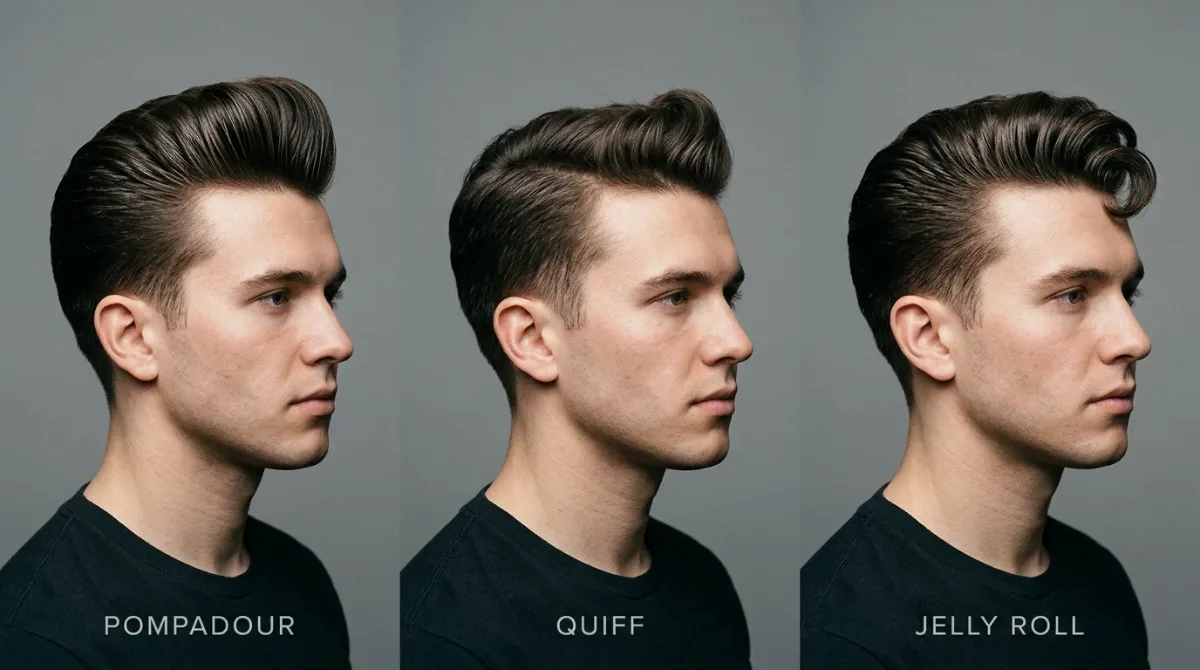
| Style | Where the volume sits | Direction | Min. top length | Effort |
|---|---|---|---|---|
| Pompadour | Whole top, front to crown | Up and back | 4 in | High |
| Quiff | Front section only | Up, slightly back | 3 in | Medium |
| Jelly roll | Crest from both sides | Forward and down | 4–6 in | Very high |
| Elephant trunk | One loose strand on a pomp/roll | Down over forehead | 5 in | Very high |
| Ducktail | Back of the head | Sides swept back to a centre line | 3 in sides | Medium |
Best 1950s men’s hairstyles for your face shape and hair type
When choosing between 1950s men’s hairstyles, pick the style for your hair first, then fine-tune for face shape. A pompadour on fine, straight hair collapses by noon; a flat top on very curly hair won’t sit level without heavy product.
| Face shape | Best 1950s styles | Go easy on |
|---|---|---|
| Oval | Almost anything: pompadour, side part, quiff | Nothing in particular |
| Round | Pompadour, quiff, flat top (height lengthens the face) | Caesar, butch cut (add width) |
| Square | Side part, breaker waves, Ivy League | Very boxy flat top |
| Oblong / long | Side part, Ivy League, Caesar | Tall pompadour, elephant trunk |
| Heart / triangle | Side part, slick back with some fullness at sides | Extreme height with tight sides |
| Hair type | Works well | Struggles |
|---|---|---|
| Thick, straight | Flat top, pompadour, Caesar, jelly roll | Ivy League can puff out without thinning |
| Fine or thinning | Side part, crew cut, butch cut, short Ivy League | Tall pompadour, jelly roll |
| Wavy | Breaker, side part, quiff, ducktail | Flat top |
| Curly | Short pompadour, quiff with texture, crew cut | Slick back with oil pomade (fights the curl) |
| Coily / afro-textured | Short natural with part line, sculpted pompadour shape, flat top | Chemical straightening (skip it) |
| Grey or receding | Side part, crew cut, Ivy League, short slick back | Tall front that exposes the temples |
Products behind 1950s men’s hairstyles vs modern equivalents
Most 1950s men’s hairstyles relied on oil-based creams and waxes that held all day but needed several washes to remove. Modern water-based products give the same shine and hold and rinse out in one shampoo.

| 1950s product | What it did | Modern equivalent | Best for |
|---|---|---|---|
| Brylcreem (hair cream) | Light hold, soft shine, tamed frizz | Brylcreem itself (still sold) or a styling cream | Side part, breaker, Ivy League |
| Oil-based pomade (petrolatum + wax) | Strong hold, wet shine, re-combable all day | Oil-based pomade, or high-hold water-based pomade | Pompadour, ducktail, jelly roll, slick back |
| Butch wax (stick) | Made short hair stand up | Firm wax stick or fibre paste | Flat top, crew cut, Ivy League front |
| Vitalis / Wildroot (hair tonic) | Light grooming, no grease | Grooming tonic or sea-salt spray as pre-styler | Everyday side part |
| Hair oil | Shine and softness for textured hair | Light hair oil or curl cream | Short afro, conk-style shape |
| — (didn’t exist) | Matte volume | Clay or matte paste | Modern quiff, textured pompadour |
Pick by finish: shine = pomade or cream, matte = clay or paste, height = blow-dry first, then any of them.
How to style a 50s pompadour step by step
You need 4+ inches on top, a blow-dryer, a fine-tooth comb, and a pomade. The whole routine takes 5–10 minutes once you have practised it twice.
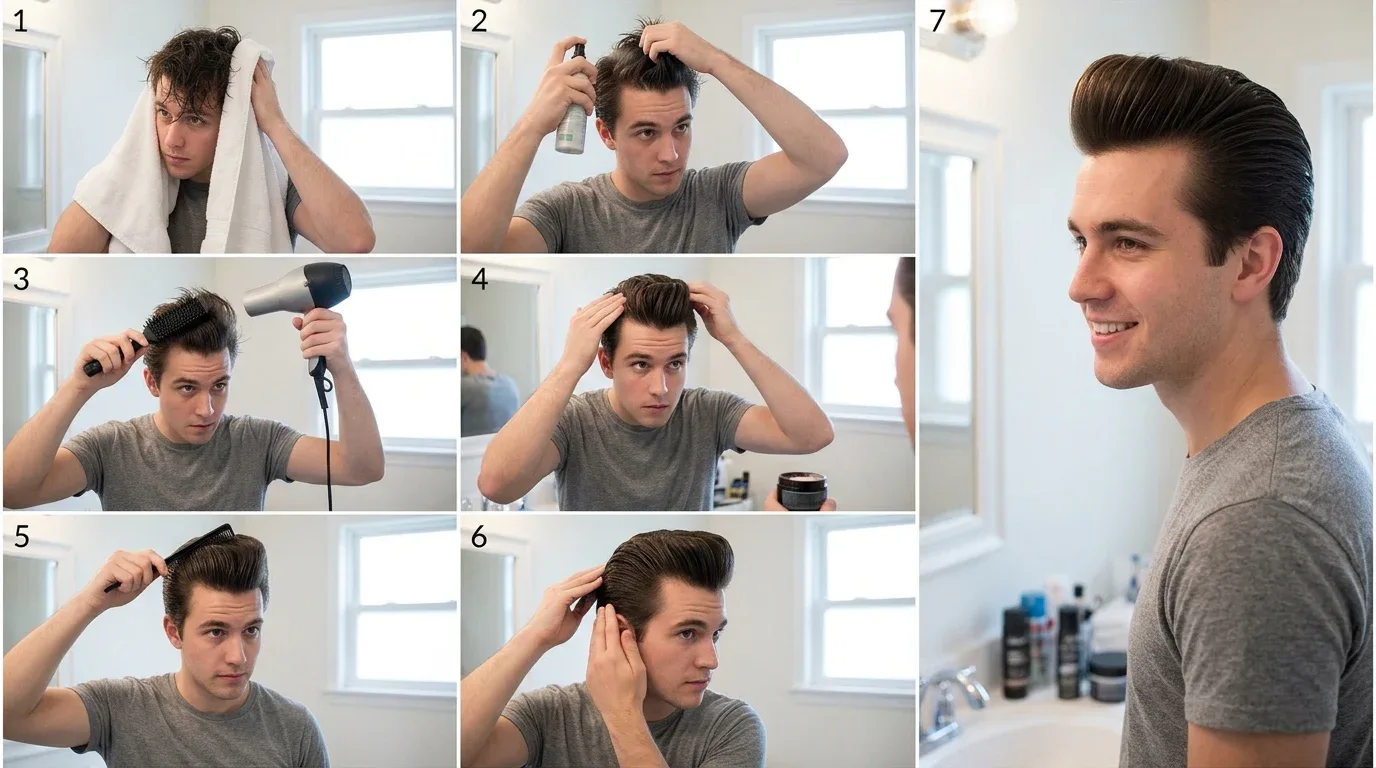
- Start with towel-dried hair. Damp, not dripping — product spreads evenly and the hair is easier to shape.
- Add a pre-styler (optional). A few sprays of sea-salt or volume spray at the roots gives the height a base on fine hair.
- Blow-dry up and back. Use a round or vent brush, lift the front up first, then direct everything back. This step creates 80% of the height.
- Warm the pomade. Rub a fingertip-sized amount between your palms until it melts; cold pomade drags and clumps.
- Work from back to front. Apply to the sides and crown first, the front last, so you don’t weigh the front down.
- Comb the shape. Comb the sides back flat, then comb the front up and back. Push the front slightly forward with your palm to create the curl.
- Refine and set. Clean lines with the fine-tooth comb; add a tiny extra dab for shine. A light hairspray keeps it in place for long nights.
For a ducktail: after step 6, comb both sides around to the back and draw a vertical line from crown to nape with the comb’s tail.
Get the 50s look tonight without a haircut
For a theme party or costume, you can fake most 1950s men’s hairstyles with what you already have, as long as there is about 2 inches on top.
- Short hair (under 2 in): Side part with cream and a sharp comb line — instant Cary Grant.
- Medium hair (2–4 in): Slick everything back with high-shine pomade for a greaser look.
- Longer hair (4+ in): Blow-dry the front up into a pompadour and comb the sides back tight.
- Finish the outfit: white T-shirt or bowling shirt, rolled jeans, leather jacket or a narrow tie.
Maintenance and common mistakes
Most 1950s men’s hairstyles look best with a trim every 2–4 weeks; the sharp outlines are the style.
| Style | Trim every |
|---|---|
| Butch, crew, flat top | 2–3 weeks |
| Side part, Ivy League, Caesar | 3–4 weeks |
| Pompadour, quiff, ducktail, slick back | 3–5 weeks (sides only; leave the top) |
Common mistakes
- Asking for “a 50s haircut.” Name the style and show a photo from the front and side.
- Skin-fading the sides of a pompadour. It looks modern, not 50s. For authentic, ask for a scissor taper.
- Too much product on dry hair. Start with a fingertip amount on damp hair, add more only if needed.
- Not washing out oil pomade. Use a degreasing shampoo, or massage conditioner into dry hair first, then shampoo — oil binds to oil.
- Choosing height for the wrong face. A long face plus a tall pompadour looks even longer.
FAQs
What was the most popular men’s hairstyle in the 1950s?
The tapered side part — the “regular” haircut — was the most common, followed by the crew cut and flat top. The pompadour and ducktail are the most famous, but they were worn mainly by teenagers, performers and greasers, not the average working man.
What is a 1950s greaser haircut called?
There was no single greaser cut. Greasers wore pompadours, ducktails, slick backs and elephant trunks, all held with heavy pomade — the “grease” that gave them their name. The ducktail combined with a pompadour front is the most recognisable greaser combination.
How long does my hair need to be for a 50s pompadour?
Aim for at least 4 inches at the front and about 2–3 inches at the crown. Shorter hair can make a short pompadour or quiff. Growing from a short cut usually takes 3–5 months, so keep trimming only the sides while the top grows.
What hair product did men use in the 1950s?
Men used Brylcreem and other hair creams, oil-based pomades, butch wax for short cuts, and tonics like Vitalis and Wildroot. Today a water-based pomade gives the same shine and hold but rinses out in one wash.
Are 1950s men’s hairstyles still in style?
Yes. The modern pompadour, quiff, side part and Ivy League are direct descendants of 1950s cuts. Today’s versions usually pair them with a fade and a matte finish instead of a full wet shine.
What is the difference between a pompadour and a ducktail?
A pompadour describes the front and top — hair swept up and back. A ducktail describes the back — side hair combed to meet in a centre line. Many 1950s men wore both together.
What did Black men wear in the 1950s?
Many wore the conk, a chemically straightened style shaped into a part or pompadour, as seen on Nat King Cole and Chuck Berry. Others wore a short, neat natural afro, sometimes with a shaved part line, like Miles Davis. The natural styles grew more popular toward 1960.
Conclusion
1950s men’s hairstyles come down to one formula: short sides, a shaped top, and the right product. Choose a clean-cut style like the side part or Ivy League if you want something office-friendly, or a pompadour, quiff or ducktail if you want real rock and roll attitude.
Pick by your hair type first, show your barber a front and side photo, and give a new style two weeks of practice before you judge it.
Next step: Want the most wearable 50s style for today? Read our quiff hairstyle for men guide, then see how far men’s hair travelled in four decades with our 90s men’s hairstyles guide.