

1960s men’s hairstyles started short and finished long. In 1960, most men wore a crew cut, a flat top or a neat Ivy League with a side part. By 1969, many young men had mop tops, Afros or hair past their shoulders.
No decade changed men’s hair faster. This guide covers 14 cuts in the order they appeared, who made each one famous, and the exact words to use with your barber if you want one in 2026.
Table of Contents
How Men’s Hair Changed Through the 1960s
The decade splits into three phases, and each one grew the hair longer. Early 60s hair followed the 1950s rules: short sides, a clean part, and a weekly barber visit.
| Phase | Years | Typical length | Key styles | Main influence |
|---|---|---|---|---|
| Early 60s | 1960–1963 | Short; ears fully visible | Ivy League, crew cut, flat top, side part, pompadour, ducktail, conk | Offices, colleges, the military, 50s rock and roll |
| Mid 60s | 1963–1966 | Over the ears; heavy fringe | Mop top, mod cut, Caesar, surfer hair, mod bowl | The Beatles, London mods, California surf culture |
| Late 60s | 1967–1969 | Collar to shoulder length | Hippie long hair, Afro, shag | Counterculture, the Summer of Love, Black Pride |
The big turn came in February 1964, when the Beatles played The Ed Sullivan Show. After that, hair length became a statement. Schools wrote dress codes against it, and parents argued about it at dinner.
Early 1960s Men’s Hairstyles (1960–1963)
The early 60s were still clean-cut. These styles were short, structured and held in place with wax, cream or oil.
1. The Ivy League (Princeton Cut)
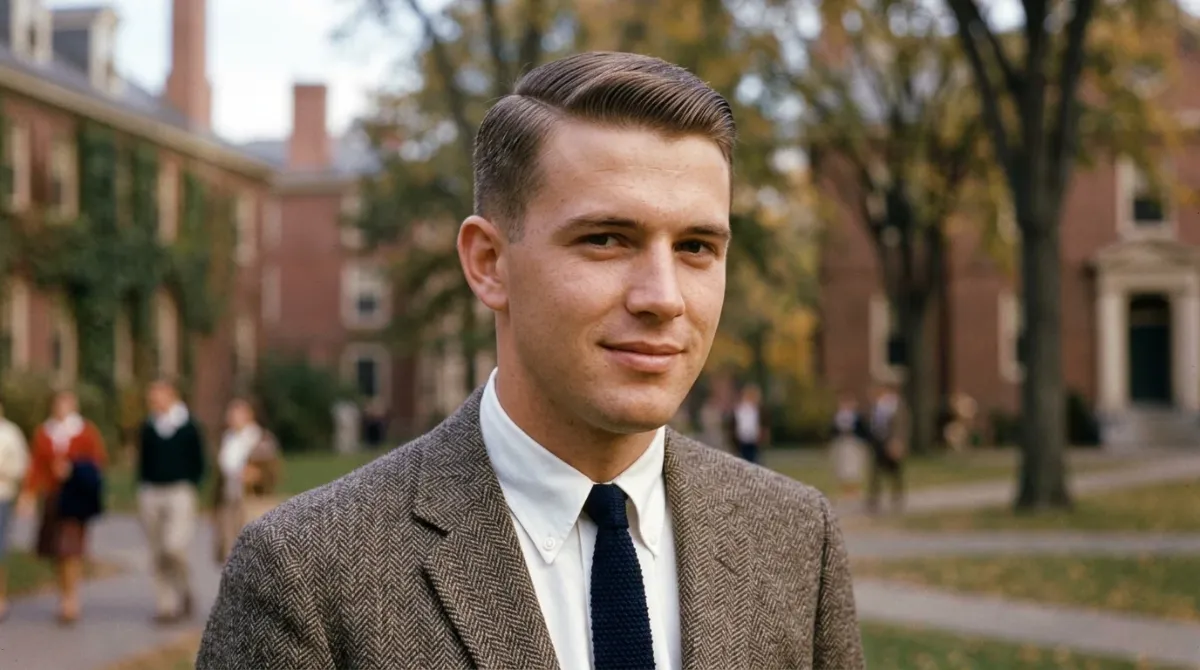
The Ivy League haircut is a crew cut left just long enough on top to part to the side. It was the default cut for college men and young professionals, and John F. Kennedy wore a version of it in office.
- Also called: Princeton, Harvard Clip.
- Then: groomed with butch wax, a stiff hair-control wax.
- Ask your barber for: “A tapered back and sides, about a #2 to #3 at the bottom. Leave 1.5 to 2 inches on top, longest at the front, so I can part it to the side.”
- Modern version: the same cut with a soft matte finish instead of shine.
- Product today: matte clay or light paste.
2. The Crew Cut
The crew cut kept the top very short and brush-like, with the sides tapered even closer. It was everywhere in the early 60s, from university campuses to NASA.

- Ask your barber for: “A #3 or #4 on top, tapered down to a #1 or #2 on the sides. Square the front slightly.”
- Modern version: the textured crew cut, with a little more length at the front.
- Product today: a small amount of matte paste, or none.
- Why it works now: two minutes to style, and it hides thinning on top better than longer cuts.
3. The Flat Top
The flat top stands the top hair straight up and cuts it into a level, boxy surface. Barbers built it freehand with clippers and a comb, which made it a true skill cut. Astronaut Walter Cunningham wore a classic flat top in his 1964 NASA portrait.

- Ask your barber for: “A flat top with a level platform about 1 inch high, square corners, and a tapered back and sides.”
- Hair type: works best on thick, coarse or coily hair that stands up on its own.
- Product today: a firm-hold wax or stick at the front edge to keep it upright.
- Fun fact: some early 60s high schools banned flat tops in their dress codes, along with ducktails and long hair.
4. The Classic Side Part (The Businessman’s Taper)
This was the standard office cut of the early 60s: a hard side part, the top combed across, and short tapered sides. Think of the ad executives in Mad Men, which recreated the look closely.
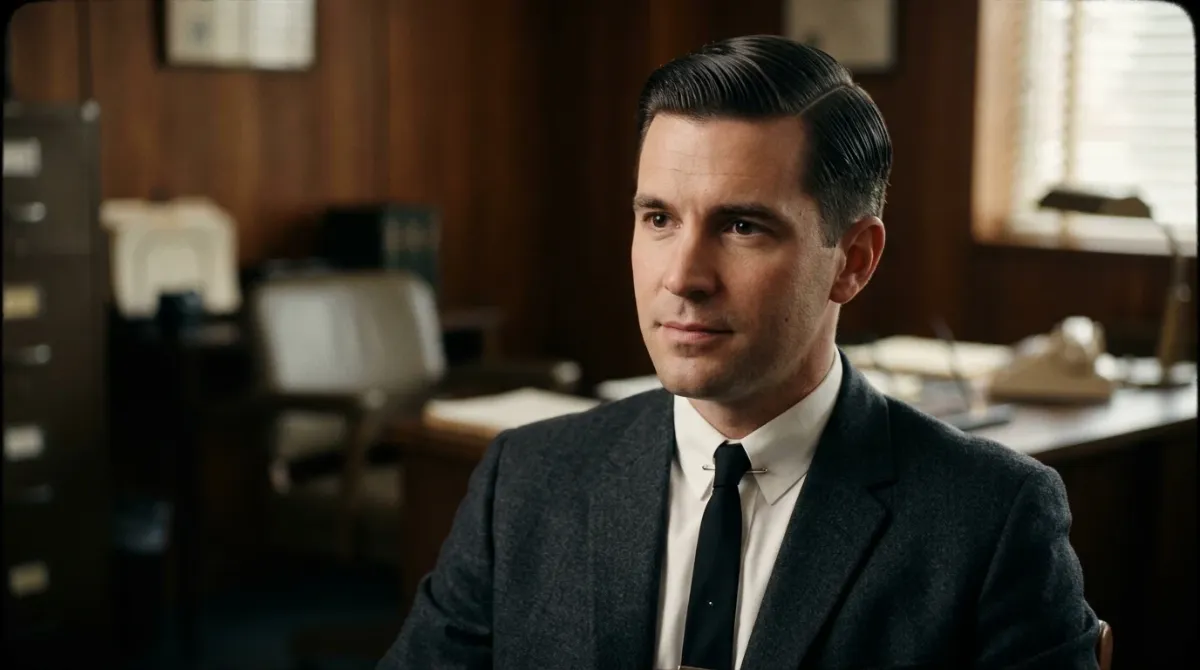
- Ask your barber for: “A scissor taper on the sides, leaving about 3 inches on top. Find my natural part and keep the neckline tapered, not blocked.”
- Modern version: the same shape with a slightly softer part and less shine.
- Product today: a water-based pomade, which gives the period shine but washes out easily.
5. The Pompadour
The pompadour lifts the front high and sweeps it back. Elvis Presley carried his famous version into the 60s after leaving the Army in 1960. By mid-decade, singers such as Roy Orbison wore a lower, more controlled version.

- Ask your barber for: “Leave 4 to 5 inches at the front, graduating shorter toward the crown. Taper the sides to about 1 inch so they can be combed back.”
- Styling: blow-dry the front up and back with a round brush before adding product.
- Product today: a medium-hold water-based pomade for shine, or a clay for a matte finish.
6. The Ducktail (DA)
The ducktail is defined by the back: hair from both sides is combed toward the center, where it meets in a ridge like a duck’s tail. It came from 1950s rock and roll and stayed with “rockers” into the early 60s.

- Ask your barber for: “Leave about 2 inches on the sides and back, enough to comb toward the middle. Keep the front long for a pompadour or a loose curl.”
- Modern version: rare as a full look, but the swept-back sides survive in the modern slick back.
- Product today: an oil-based pomade for a strong hold.
7. The Conk
The conk was a chemically straightened style worn by many African American men from the 1940s into the early 60s. The hair was straightened with a lye-based mix, then slicked back, waved or built into a pompadour. James Brown, Little Richard, Chuck Berry and Nat King Cole all wore it.

The process could burn the scalp, and Malcolm X later wrote about how painful it was. As Black Pride grew through the 60s, the conk faded and natural styles took over.
- Today: do not try a lye conk at home. For a similar sleek look, ask a barber who specializes in textured hair about professional options, or wear a modern wave cut with a durag.
Mid 1960s Men’s Hairstyles (1963–1966)
In the mid 60s, hair grew over the ears and forward over the forehead. The influence moved from American campuses to British bands and London’s mod scene.
8. The Mop Top (The Beatles Haircut)
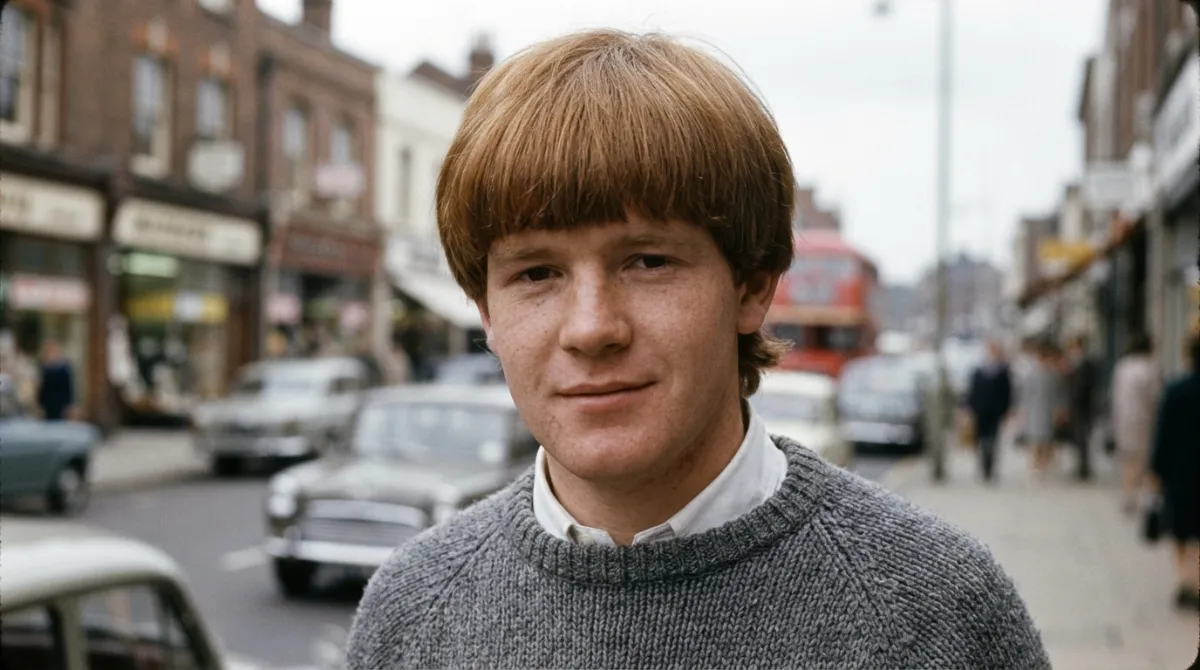
The mop top is a rounded, mid-length cut with a heavy fringe over the eyebrows and hair covering the ears. It is the most famous men’s hairstyle of the decade, but it did not start in a Liverpool barbershop.
The look came from art students in Hamburg, where the Beatles played between 1960 and 1962. Photographer Astrid Kirchherr cut bassist Stuart Sutcliffe’s hair in that style. In October 1961, their friend Jürgen Vollmer cut John Lennon’s and Paul McCartney’s hair the same way in Paris. Drummer Pete Best kept his own style.
When the band reached America in 1964, TIME called their cuts “mushroom haircuts” and Newsweek compared them to sheepdog bangs. McCartney later admitted, “We didn’t start the fashion, but I guess we sort of popularized it.”
- Ask your barber for: “A scissor cut, no clippers. Fringe to the eyebrows, hair just covering the tops of the ears, and a rounded shape with light layers so it isn’t bulky.”
- Grow-out time: about 4 to 6 months from a short cut.
- Modern version: the textured fringe or modern mop top, with more texture and less weight.
- Product today: sea salt spray or a light styling cream. Kirchherr famously washed the Brylcreem out of Sutcliffe’s hair, so heavy product is wrong for this look.
9. The Mod Cut (French Crew and College Cut)
“Mod cut” is not one haircut. It is a family of short, sharp styles worn by London’s mods: neat sides, a defined fringe, and a tailored shape to match their slim suits and Vespas.

- Ask your barber for: “Scissor-cut sides about 1 inch, longer on top at 2 to 3 inches, brushed forward into a short, neat fringe. Tidy around the ears.”
- Modern version: close to today’s French crop, but softer and without a skin fade.
- Product today: light matte cream.
10. The Caesar Cut
The Caesar has short hair all over, with the top brushed forward into a straight, horizontal fringe. It was a low-maintenance option in the 60s, and it still flatters men with a receding hairline.

- Ask your barber for: “About 1 to 1.5 inches on top brushed forward, a short straight fringe, and a #2 taper on the sides.”
- Best for: receding hairlines, fine hair, and long faces.
- Product today: a little matte paste, or none.
11. Surfer Hair
California surf culture gave the 60s a softer, sun-bleached look: a long top swept to one side, with the sides left covering part of the ear. It suited the beach music scene and looked effortless compared to waxed office cuts.

- Ask your barber for: “Leave 4 to 5 inches on top, layered so it sweeps to the side. Sides long enough to cover the top of the ear, and a soft, natural neckline.”
- Product today: sea salt spray, then air-dry.
12. The Mod Bowl Cut
The mod bowl is a cleaner, more graphic version of the mop top: one even length all around, with a blunt fringe. Rolling Stones guitarist Brian Jones wore one of the best-known versions.

- Ask your barber for: “A one-length bowl shape, fringe cut straight at the eyebrows, ears half covered, and the edges blunt rather than layered.”
- Warning: it needs thick, straight hair. On wavy hair it puffs out.
- Product today: a smoothing cream and a blow-dry with a flat brush.
Late 1960s Men’s Hairstyles (1967–1969)
By 1967, long hair was a political signal as much as a style. Students, musicians and activists used it to reject the neat cuts of their fathers.
13. Hippie Long Hair
Hippie hair was less a haircut and more a refusal to get one. Hair passed the collar or reached the shoulders, usually with a center part and natural waves left alone. By the 1967 Summer of Love, long hair and beards had become clear markers of the counterculture, and the stage musical Hair made the look famous worldwide.
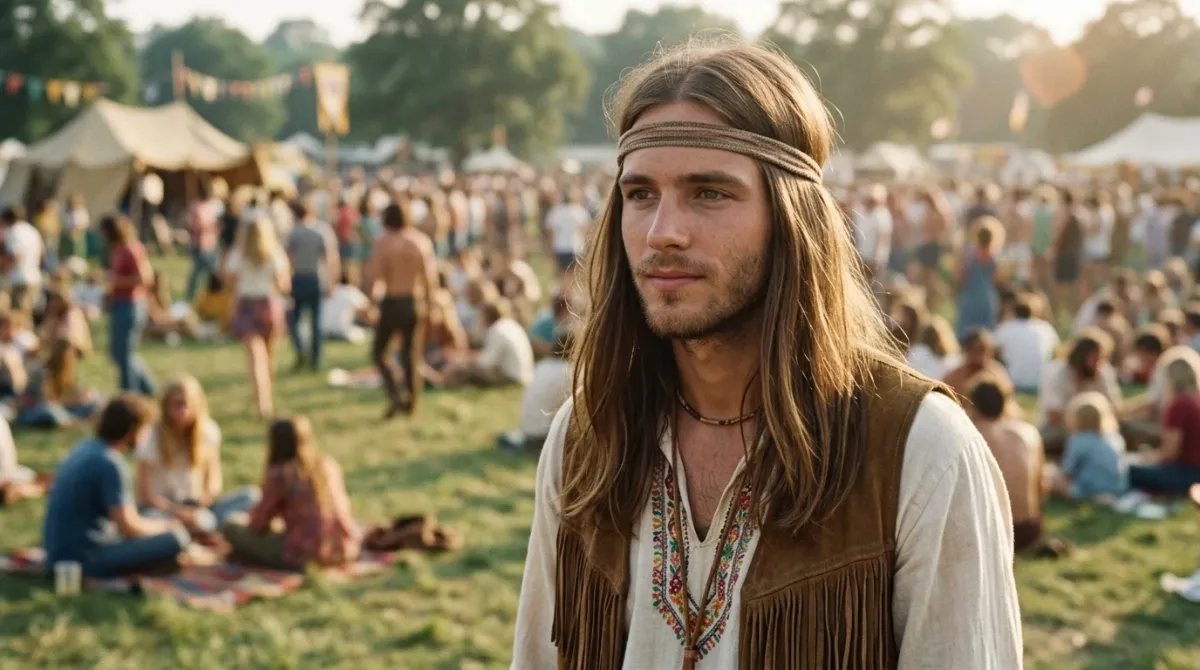
- Ask your barber for: “Just a trim. Remove split ends, add a few long layers to reduce bulk, and keep the length past my collar.”
- Modern version: the long layered cut or modern shag.
- Product today: a leave-in conditioner and a light hair oil on the ends.
14. The Afro
The Afro lets naturally coily hair grow out into a full, rounded shape. In the late 60s it became a symbol of Black Pride and the Black Power movement, replacing the straightened conk. Musicians such as Jimi Hendrix helped spread it into mainstream culture.

- Ask your barber for: “Shape it into a round silhouette, even all over, and line up the edges. Keep the length at about 3 inches” (adjust to your preference).
- Daily care: an Afro pick for volume, plus moisture, because coily hair dries out fast.
- Product today: a leave-in conditioner and a curl cream or butter.
1960s Men’s Facial Hair
Facial hair followed the same path as head hair: clean in 1960, longer by 1969. Early 60s men were almost always clean-shaven, especially at work.
- Early 60s: clean-shaven, with short, neat sideburns.
- Mid 60s: mods and British bands grew their sideburns longer, often to the middle of the ear.
- Late 60s: mustaches and full beards spread with the counterculture. Long sideburns became the bridge into the 1970s look.
To match a 60s cut today, keep the facial hair true to the same phase. A full beard with an Ivy League looks modern, not vintage. If you want a beard anyway, match it to your face with our beard styles by face shape guide.
All 14 1960s Men’s Hairstyles Compared
The easiest 60s cuts to wear today are the Ivy League, crew cut and Caesar. The mop top, mod bowl and hippie hair need the most time to grow and style.
| Style | Peak years | Top length | Sides | Daily effort | Best hair type |
|---|---|---|---|---|---|
| Ivy League | 1958–1964 | 1.5–2 in | Short taper | Low | Straight, wavy, fine |
| Crew cut | 1955–1964 | Under 1 in | Very short | Very low | All types |
| Flat top | 1955–1964 | About 1 in, flat | Very short | Medium | Thick, coarse, coily |
| Classic side part | 1955–1965 | About 3 in | Scissor taper | Low | Straight, wavy |
| Pompadour | 1955–1963 | 4–5 in front | Medium | High | Thick, wavy |
| Ducktail | 1955–1962 | 3–4 in | Long, combed back | High | Thick, straight |
| Conk | 1940s–1963 | Varies | Varies | Very high | Coily (chemical) |
| Mop top | 1963–1966 | Eyebrow fringe | Over the ears | Medium | Thick, straight |
| Mod cut | 1962–1966 | 2–3 in | About 1 in | Low | Straight, wavy |
| Caesar | 1960–1969 | 1–1.5 in | Short | Very low | Fine, thinning |
| Surfer hair | 1962–1967 | 4–5 in | Half over ears | Low | Wavy, straight |
| Mod bowl | 1964–1967 | One length | Over the ears | Medium | Thick, straight |
| Hippie long hair | 1967–1969 | Collar to shoulder | Long | Low | Wavy, curly |
| Afro | 1966–1969 | 2–6 in | Same as top | Medium | Coily, kinky |
Which 60s Haircut Suits Your Face and Hair Type?
Pick a cut that balances your face shape: add height to a round face, and add width or a fringe to a long face. Oval faces can wear any of the 14. For a deeper breakdown, see our guide to men’s haircuts for your face shape.
| Face shape or hair need | Best 60s cuts | Cuts to avoid |
|---|---|---|
| Oval | Any | None |
| Round | Pompadour, flat top, Ivy League with height | Mop top, mod bowl (they add width) |
| Square | Mop top, side part, crew cut, surfer hair | Flat top (doubles the angles) |
| Long or oblong | Caesar, mop top, mod cut (fringes shorten the face) | Pompadour, flat top (add height) |
| Heart or triangle | Side part, surfer hair, hippie long hair | Very short sides with a tall top |
| Receding hairline | Caesar, crew cut, mod cut | Pompadour, slick back (expose the temples) |
| Fine or thin hair | Crew cut, Caesar, Ivy League | Mop top, mod bowl, long hair |
| Coily hair | Afro, flat top, crew cut | Mod bowl, ducktail |
1960s Hair Products vs Modern Equivalents
Most 60s men used greasy creams, oils and waxes that gave a wet shine. Modern water-based and matte products give the same shapes with less mess. Our roundup of the best hair styling products for men covers current picks.

| Then (1960s) | What it did | Modern equivalent | Best for |
|---|---|---|---|
| Brylcreem and hair creams | Light hold, wet shine | Styling cream | Side part, Ivy League |
| Butch wax | Stiff hold for short tops | Firm wax or stick | Flat top, crew cut front |
| Petroleum or oil-based pomade | Strong hold, high shine | Water-based pomade | Pompadour, ducktail |
| Hair tonic | Light control, scent | Grooming tonic or pre-styler | Any short cut |
| Nothing (natural, washed hair) | Soft movement | Sea salt spray or light cream | Mop top, surfer hair, mod bowl |
| Afro pick and oils | Volume and moisture | Pick plus leave-in and curl cream | Afro |
| Lye-based conk relaxer | Chemical straightening | Not recommended; see a textured-hair specialist | Conk look |
How to Get an Authentic 1960s Haircut Today
The single biggest giveaway of a fake 60s cut is a skin fade. Barbers in the 60s used scissor-over-comb and clipper tapers, so the sides were short but never bald.
- Bring a period photo. Show a real 1960s photo, not a modern “retro” one. Modern versions often add fades and undercuts.
- Ask for a taper, not a fade. Say “no skin, keep some length at the bottom.” A #1 or #2 is usually the shortest point.
- Choose the right neckline. Short early 60s cuts used a tapered neckline. Mop tops and long styles had a natural, soft neckline.
- Ask for scissors on longer cuts. Mop tops, mod bowls and surfer hair look heavy and wrong when clipper-cut.
- Plan your grow-out. From a short cut, expect about 4 to 6 months for a mop top and over a year for hippie length.
- Match the product to the era. Shine for early 60s cuts, little or no product for mid and late 60s cuts.
FAQs About 1960s Men’s Hairstyles
What were the most popular men’s hairstyles in the 1960s?
The most popular were the Ivy League, crew cut and classic side part in the early 60s, the Beatles mop top and mod cut in the mid 60s, and long hippie hair and the Afro by the late 60s. Short, neat cuts stayed the most common choice for working men throughout the decade, even as young men grew their hair longer.
What is the Beatles haircut called?
It is called the mop top, or simply the Beatle cut. It is a rounded, mid-length style with a heavy fringe over the eyebrows and hair covering the ears. The Beatles picked it up from art-student friends in Hamburg and Paris in 1961, then made it famous worldwide after their 1964 US television debut.
What hair products did men use in the 1960s?
Early 60s men used hair creams such as Brylcreem, oil-based pomades, butch wax for short tops, and hair tonics. These gave a wet, shiny finish. Mid and late 60s styles like the mop top and long hippie hair used little or no product, which was part of their rebellious, natural look.
Did men have long hair in the 1960s?
Yes, but mainly in the second half of the decade. Hair started covering the ears around 1963 to 1964 with the mop top. By 1967 to 1969, many young men wore hair to the collar or shoulders. Older men, office workers and the military mostly kept short cuts throughout.
What is a 1960s mod haircut for men?
A mod haircut is a family of short, sharp styles from early 60s London, including the French crew and college cut. It has neat, short sides, a slightly longer top, and a defined fringe brushed forward. It was designed to match the mods’ tailored suits and clean style.
What were 1960s Black men’s hairstyles?
In the early 60s, many Black men wore the conk, a chemically straightened style, or short natural cuts. As Black Pride and the Black Power movement grew in the second half of the decade, the Afro became the defining style. Short flat tops and crew cuts on natural hair were also common.
Are 1960s hairstyles still in style in 2026?
Yes. The Ivy League, crew cut, Caesar and side part never really left barbershops. Textured fringes and modern mop tops borrow directly from the mid 60s. The main difference today is a matte finish instead of shine, and sometimes a fade on the sides.
Conclusion
1960s men’s hairstyles tell the story of a decade in about ten years of growth: from the neat Ivy League to the mop top, then to the Afro and shoulder-length hair. For an easy everyday cut, start with the Ivy League, crew cut or Caesar. For a statement, grow into a mop top or surfer hair.
Next in the series: see how these styles turned into shags, feathered hair and big perms in our guide to 1970s men’s hairstyles, or jump ahead to 1980s men’s hairstyles.