
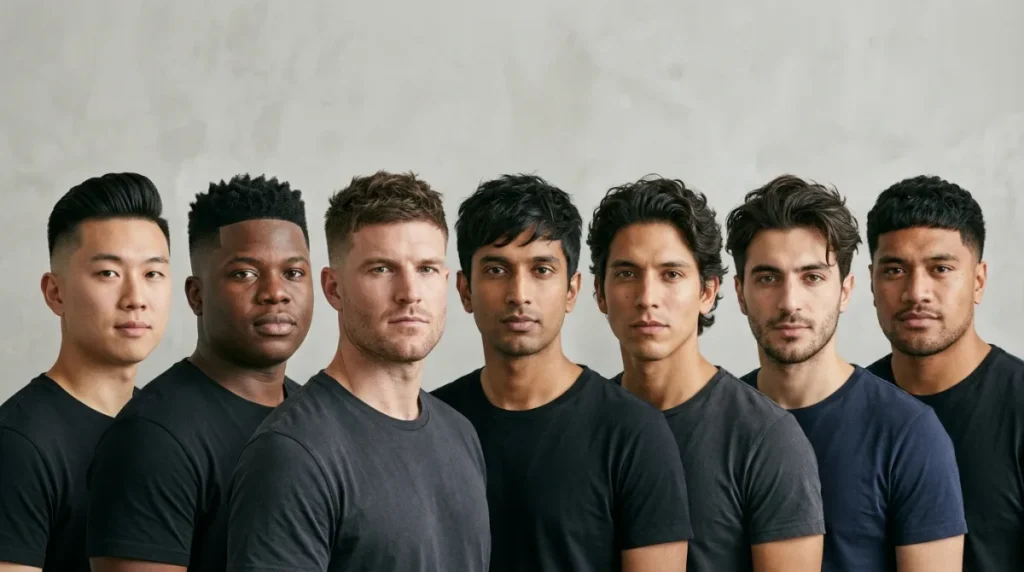
The best men’s haircuts for your face shape follow one idea: put hair where your face is narrow and take it away where your face is wide. Round faces need height. Long faces need width. Square faces need very little help.
This guide covers all seven face shapes. It shows you how to measure yours in two minutes, which cuts to ask for, which to skip, and how hair type, hairline and beard change the answer.
In a hurry? Start with the table.
| Face shape | Your goal | Ask for | Skip |
|---|---|---|---|
| Oval | Keep the balance you have | Textured crop, side part, quiff, buzz cut | Heavy fringe that hides the forehead |
| Round | Add height, slim the sides | Quiff, pompadour, faux hawk, high fade | Buzz cuts, bowl shapes, full sides |
| Square | Show the jaw | Crew cut, short textured crop, side part, slick back | Long, soft styles that hide the jaw |
| Oblong / rectangle | Add width, cut height | Side-swept fringe, low taper, medium length on the sides | Tall quiffs with skin-tight sides |
| Diamond | Widen forehead and chin | Textured fringe, messy medium length, low taper | High skin fades, tight slick backs |
| Heart | Soften the forehead, fill the chin | Side-swept fringe, medium textured top, scissor-cut sides | Tall volume with shaved sides |
| Triangle | Add width up top | Textured quiff, fuller sides, longer layered top | Buzz cuts, very short tops |
In this guide
How to find your face shape in 2 minutes
You need four measurements and a phone camera. Push your hair off your forehead, stand in even light, and take a straight-on photo at arm’s length or further. Close-up selfies stretch the middle of the face and make it look rounder than it is.
Measure these four lines with a soft tape, or on the photo itself:
- Forehead: across the widest point, usually halfway between brows and hairline.
- Cheekbones: from the outer edge of one cheekbone to the other, just below the eyes.
- Jawline: from the corner of the jaw below one ear to the corner below the other.
- Face length: from the center of your hairline to the bottom of your chin.

If your hairline has moved back, measure length from where it used to sit. The top crease of your forehead when you raise your eyebrows is a good marker.
Match your numbers to a shape
Two questions settle it: which line is longest, and how sharp is your jaw?
| If this is true | And your jaw is | Your shape is |
|---|---|---|
| Length is clearly the biggest number; forehead, cheekbones and jaw are close to each other | Rounded | Oval |
| Length is clearly the biggest number; the sides of the face run straight | Square or straight | Oblong / rectangle |
| Length and cheekbones are close; face is as wide as it is long | Soft, no corners | Round |
| Length, forehead, cheekbones and jaw are all close | Sharp corners | Square |
| Cheekbones are widest; forehead and jaw are both narrower | Narrow, pointed chin | Diamond |
| Forehead is widest; face narrows toward the chin | Narrow, pointed chin | Heart |
| Jaw is widest; forehead is the narrowest line | Wide and strong | Triangle |
A rough check: divide face length by cheekbone width. Under about 1.3 points to round or square. Around 1.3 to 1.5 points to oval, heart or diamond. Above about 1.5 points to oblong. Treat this as a rule of thumb, not a standard.
What if you sit between two shapes?
Most men do. Pick the shape that matches your longest line, then note your second trait. A “square-oblong” face follows the oblong advice on height and the square advice on the jaw. Your barber only needs to know two things: where you want more hair, and where you want less.
The one rule behind every recommendation
Every face-shape recommendation aims at the same target: an outline that reads close to oval. Hair adds size wherever it sits. So you add hair where your face is narrow and remove it where your face is wide.
Once you know that, you can judge any haircut yourself, including ones that are not in this guide. A barber has five levers to work with:
| Lever | What it does | Who needs it most |
|---|---|---|
| Height on top | Makes the face look longer and slimmer | Round, triangle |
| Width at the sides | Makes the face look shorter and wider | Oblong, diamond |
| Fringe | Shortens the face and covers forehead width | Oblong, heart, diamond |
| Parting | A side part adds an angle; a center part adds a vertical line | Round (side), oval (either) |
| Fade height | Controls where the sides stop being skin and start being hair | Everyone; see the fade table below |
Two shapes are exceptions. Oval is already balanced, so the job is to not upset it. Square is the shape most cuts try to imitate, so the job is to show it off.
Best men’s haircuts for your face shape
Each shape below gets the same four things: the goal, the cuts that reach it, the cuts that work against it, and one line to say in the chair.
Oval face
Oval faces suit almost every men’s haircut, because the proportions are already balanced. Your only job is to keep the forehead visible and avoid adding bulk that makes the face look round.

- Best cuts: textured crop, classic side part, short quiff, crew cut, buzz cut, slick back, medium-length flow.
- Skip: a heavy, straight fringe that sits on the brows. It hides a third of the face and makes an oval read as round.
- Say this: “Short and tidy on the sides, enough length on top to push up or to the side, and keep it off my forehead.”
Since face shape will not narrow your options, let hair type and upkeep decide. Jump to the hair type table below.
Round face
Round faces look best with height on top and tight sides. Height adds length, tight sides remove width, and together they create the angles a round face lacks.

- Best cuts: quiff, pompadour, faux hawk, spiky textured top, side part with a hard line, flat top. Pair any of them with a mid or high fade.
- Skip: buzz cuts and one-length crew cuts, which copy the roundness. Skip full sides and fringes cut straight across.
- Say this: “High fade on the sides, at least two to three inches on top, and style it up and off the face.”
A side part is the low-effort option. The diagonal line breaks up the circle without daily blow-drying.
Square face
Square faces carry short, sharp haircuts better than any other shape. The jaw is the feature, so the haircut should stay out of its way.

- Best cuts: crew cut, high-and-tight, short textured crop, side part, slick back, buzz cut with a fade.
- Skip: long, layered styles that fall over the jaw. Skip very boxy flat tops if your face already looks blocky.
- Say this: “Keep it short and clean, square off the corners at the temples, and leave the top neat.”
Want a softer look? Keep an inch or two of messy texture on top. It rounds off the corners without hiding the jaw.
Oblong or rectangle face (long face)
Long faces need width at the sides and less height on top. The common mistake is the most popular cut in the barbershop: a tall quiff with a skin fade, which stretches a long face even further.

- Best cuts: side-swept fringe, French crop, textured crop worn forward, classic side part with scissor-cut sides, medium-length layered styles, low taper.
- Skip: tall pompadours, high skin fades, slicked-back hair with shaved sides, and long hair worn dead straight.
- Say this: “Low taper, leave some weight on the sides, keep the top flatter, and let the front fall forward.”
This shape has the most detail to get right, so it has its own set of guides:
- Full list of cuts with photos: haircuts for men with a long face
- Strong, straight jaw with extra length: oblong face hairstyles for men
- Hair that falls flat and adds no width: long face and straight hair styles for men
- Facial hair that shortens the face: best beard for a long face
Diamond face
Diamond faces need width at the forehead and the chin, because the cheekbones already carry all of it. Shaving the sides to the skin makes the cheekbones stick out more.

- Best cuts: textured fringe, messy medium-length top, side-swept layers, longer scissor-cut sides, low taper, shoulder-length hair tucked behind the ears.
- Skip: high skin fades, tight slick backs, and anything that adds volume right at cheekbone level.
- Say this: “Scissors on the sides, not clippers. Keep some length around the temples and give me a textured fringe.”
Heart face
Heart faces need a softer forehead and more weight near the chin. The forehead is the widest line, so volume stacked on top with bare sides turns the face into a point.

- Best cuts: side-swept fringe, medium textured quiff worn loose, side part with length, mid-length layered cuts, low or mid taper.
- Skip: tall pompadours with shaved sides, tight slick backs that show the whole forehead.
- Say this: “Medium length on top, swept across the forehead, and a low taper so the sides do not go too tight.”
A beard does half the work here. See the beard table below.
Triangle face
Triangle faces need width and volume above the ears to match a wide jaw. Short tops make the jaw look heavier, so length on top is not optional.

- Best cuts: textured quiff, longer layered top, side part with volume, fringe swept to the side, fuller scissor-cut sides.
- Skip: buzz cuts, crew cuts, and high fades that strip the temples.
- Say this: “Leave the sides fuller around the temples, taper only at the bottom, and keep three inches or more on top.”
Which fade height suits your face shape?
Fade height changes the width of your head more than the style on top does. A high fade removes width from the ears up. A low fade or taper keeps it. Pick the height first, then the style.
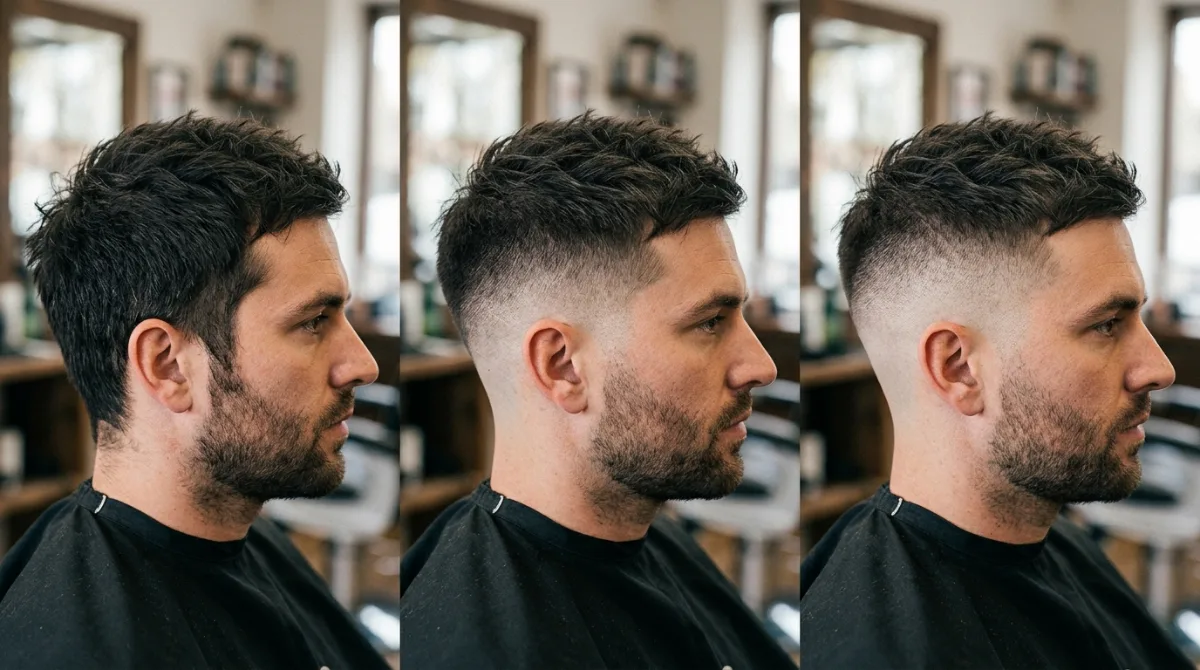
| Face shape | Best fade | Why |
|---|---|---|
| Oval | Any | Nothing to correct; choose by taste and upkeep |
| Round | Mid or high, skin optional | Slims the sides and makes the top look taller |
| Square | Mid or high | Keeps the outline sharp and shows the jaw corners |
| Oblong / rectangle | Low fade or taper | Keeps side weight so the face does not look longer |
| Diamond | Low taper, scissor-cut sides | Leaves hair at the temples to balance the cheekbones |
| Heart | Low or mid taper | Tight sides make a wide forehead look wider |
| Triangle | Low taper only | Hair at the temples offsets a wide jaw |
Upkeep matters too. A skin fade looks sharp for about two weeks. A low taper grows out cleanly for four to six.
How hair type changes the answer
Face shape tells you where the hair should sit. Hair type tells you whether it will stay there. A quiff is the right call for a round face, but fine, straight hair will not hold one past lunch without product and a blow dryer.
| Hair type | What it does well | What it fights | Adjust the plan like this |
|---|---|---|---|
| Straight, fine | Clean parts, sharp lines | Height and volume | Keep the top shorter, cut texture in, use a matte clay or powder |
| Straight, thick | Holds any shape | Sticks out at the sides when short | Ask for the sides to be thinned or tapered, not left blunt |
| Wavy | Natural width and movement | Sleek, flat styles | Great for oblong and diamond faces; grow the sides a little |
| Curly | Built-in height and volume | Staying flat or narrow | Round faces: curls on top, tight sides. Long faces: let curls sit wide |
| Coily | Holds a shaped outline | Length that hangs down | The outline is the haircut: taller shape for round, wider shape for long |
| Thinning | Short, even lengths | Long tops that separate | Go shorter all over; contrast between long top and bare scalp shows more |
Curly and coily hair shrink as they dry. Ask your barber to shape the cut dry, or to leave extra length on wet hair.
Whatever your hair type, healthy hair holds a cut better than dry or damaged hair. The American Academy of Dermatology’s healthy hair tips cover the washing and conditioning basics.
Features that override face shape
Face shape is the starting point, not the full picture. Five other features can change the right answer, and your barber sees all of them before the cape goes on.
Receding hairline
A receding hairline makes the face read longer, so treat it like a step toward oblong. Skip slick backs and tall quiffs that expose the temples. A short textured crop pushed forward, a crew cut, or a buzz cut with a fade all hide the corners or make them irrelevant.
Large or small forehead
A fringe is the only tool that changes forehead size. A textured fringe that reaches mid-forehead shortens a tall forehead without looking heavy. A small forehead needs the opposite: hair up and off the face to show more skin.
Should you get a fringe?
A fringe suits you if you can tick at least two of these:
- Your face is oblong, heart or diamond.
- Your forehead is taller than the width of four fingers.
- Your hair is straight or wavy and grows forward without a strong cowlick at the front.
- You are fine with a trim every three to four weeks.
Round faces can still wear one, as long as it is short, choppy and pushed to the side.
Head shape, ears and cowlicks
A flat back of the head needs more length left at the crown. Ears that stick out look smaller with scissor-cut sides than with a skin fade. Cowlicks decide which way your hair parts, so let the barber follow them.
Glasses
Thick frames add width at eye level. If you wear them every day, keep the sides tidy so hair and frames do not stack up, and tell your barber to cut with your glasses in mind.
The right beard for your face shape
A beard follows the same rule as a haircut: add where the face is narrow, trim where it is wide. It is also the only way to change the bottom half of your outline, which makes it the strongest tool for heart, diamond and round faces.
| Face shape | Beard that works | Keep it |
|---|---|---|
| Oval | Almost any: stubble, short boxed beard, full beard | Even all round |
| Round | Short on the cheeks, longer at the chin | Angled at the cheek line to cut in an edge |
| Square | Stubble or a short beard that follows the jaw | Tight, so the jaw stays visible |
| Oblong / rectangle | Fuller on the sides, short at the chin | Off the chin; a long goatee adds length |
| Diamond | Full beard that widens the jaw | Trimmed at the cheekbones |
| Heart | Medium to full beard with weight at the chin and jaw | Fuller low down, lighter on the cheeks |
| Triangle | Stubble or a very short beard | Short on the sides so the jaw does not gain width |
Long faces have the most to gain and lose here. The full breakdown is in our guide to the best beard for a long face.
What to tell your barber
“Something that suits my face” gives a barber nothing to work with. Give four details instead: the sides, the top, the front, and how much effort you will put in each morning.
Use this script and fill in the brackets:
- “My face is [shape], so I want [more height / more width / to show the jaw].”
- “On the sides, a [low / mid / high] [taper / fade], starting at a number [1 / 2 / 3].”
- “On top, leave about [number] inches, with [texture / a side part / a fringe].”
- “I spend [no time / two minutes / five minutes] on it in the morning.”
- “Please avoid [too much height / tight sides / a heavy fringe].”
Guard numbers remove the guesswork on length:
| Guard | Length |
|---|---|
| 1 | 1/8 inch (3 mm) |
| 2 | 1/4 inch (6 mm) |
| 3 | 3/8 inch (10 mm) |
| 4 | 1/2 inch (13 mm) |

Bring two photos: one of the cut you want and one of a cut you did not like. Choose a reference with your hair type and a similar face. A photo of a man with thick wavy hair is no use if yours is fine and straight.
5 mistakes men make with face-shape haircuts
Most bad haircuts come from one of these five errors, not from picking the wrong style name.
- Copying the trend instead of the proportions. The high skin fade with a tall top suits round faces. On a long or diamond face it makes things worse.
- Judging shape from a selfie. A phone held close widens the nose and cheeks. Measure, or shoot from further back.
- Ignoring hair type. The right cut for your face still fails if your hair cannot hold it.
- Changing hair and beard at the same time. Change one, live with it for two weeks, then adjust the other. You will see what each one does.
- Overcorrecting. You are aiming for balance, not a different face. A round face with a small amount of height looks better than one with a four-inch tower.
FAQs
What is the best haircut for my face shape?
The best haircut adds hair where your face is narrow and removes it where your face is wide. Round faces suit height with tight sides. Long faces suit width with a flatter top. Square faces suit short, sharp cuts. Oval faces suit almost anything. Diamond, heart and triangle faces suit fuller sides and a fringe or textured top.
How do I know my face shape as a man?
Measure four lines: forehead width, cheekbone width, jaw width and face length. The longest line and the sharpness of your jaw give the answer. Length longest with a rounded jaw is oval. Length longest with straight sides is oblong. Equal width and length is round or square. Widest cheekbones is diamond, widest forehead is heart, widest jaw is triangle.
What is the most attractive face shape for men?
No single shape is the most attractive. Square and oval faces are often called ideal because they are the easiest to cut for, not because other shapes look worse. A haircut that balances your own proportions does more for your appearance than the shape you started with.
What haircut makes a round face look slimmer?
A cut with height on top and short sides makes a round face look slimmer. A quiff, pompadour or textured spiky top with a mid or high fade adds length and removes width. A side part adds an angle. Avoid buzz cuts and full, rounded sides, which repeat the shape of the face.
Which haircuts should men with long faces avoid?
Men with long faces should avoid tall pompadours, high skin fades, and slicked-back hair with shaved sides. Each one adds height or removes width, which makes the face look longer. Choose a side-swept fringe, a textured crop or a low taper with fuller sides instead.
Does face shape matter if I have a buzz cut?
Yes. A buzz cut removes every lever except fade height, so your face shape shows fully. It suits oval and square faces best. Round faces look rounder and long faces look longer. A fade on the sides and a short beard give some of the shape back.
Can my face shape change over time?
Bone structure stays the same, but the visible outline shifts. Weight gain softens the jaw and pushes a face toward round. Weight loss and a receding hairline push it toward oblong. Re-measure every few years, or whenever your usual haircut stops looking right.
The short version
Measure your face, name your shape, and remember one rule: add hair where you are narrow, remove it where you are wide. Then check the plan against your hair type, your hairline and your beard before you book.
If your face is long or oblong, your next read is our full guide to haircuts for men with a long face.
Take the barber script from this page with you. Five clear sentences will get you a better haircut than any photo of a celebrity.
Pingback: Hair Trends 2027 for Men: 12 Short Cuts Barbers Expect
Pingback: Wolf Cut for Men: 7-Point Fit Test & Easy Barber Script
Pingback: Medium Length Hairstyles for Men: 24 Best Cuts + How to Pick
Pingback: How to Cut Men's Long Hair at Home: 3 Easy Methods