

Updated: October 2026
A wolf cut for men suits you if you have medium-to-thick hair, at least chin-length growth (or a plan to get there), and a full crown. It is a riskier choice if your crown is thinning, your hair is very fine and flat, or you hate spending three minutes on styling.
The men’s wolf cut sits between a shag and a mullet: a short, choppy crown for volume, longer hair at the back, and layers that blend the two with no hard step. That blend is exactly why it goes wrong so often. Say “wolf cut” with no detail and one barber hears “mullet”, another hears “shag”, and you walk out with a helmet.
This guide fixes both halves of the problem. First, a quick scorecard to see if a men’s wolf cut fits your hair, hairline and lifestyle. Then a word-for-word script, zone by zone, so your barber cuts the version you pictured.
Quick answers
- Best hair: thick or wavy hair; curly works with a shrinkage plan; straight works with crown texture cut in.
- Length needed: about chin length at the front and collar length at the back for a classic version; 3 to 4 inches on top for a short men’s wolf cut.
- Upkeep: a trim every 6 to 8 weeks; 3 to 5 minutes of styling each morning.
- Biggest mistake: asking by name only. Describe the top, sides, back, fringe and ends separately.

Table of Contents
What is a wolf cut for men?
A wolf cut for men is a layered haircut with a short, choppy crown, longer hair at the back and sides, and blended layers in between, so there is no hard line like a classic mullet. The name comes from the rough, fur-like texture the layers create.
The men’s wolf cut grew out of K-pop styling and went viral on TikTok during the lockdown years, when millions of men were already growing their hair out. For men, it usually looks rougher and more textured than the women’s version, and it pairs naturally with a taper, a beard or a messy fringe.
Three parts define it:
- The crown: the shortest layers, cut to stand up and give volume.
- The back (nape): kept longer, touching or covering the collar.
- The blend: layers run from the crown down to the back and sides, so the shape flows instead of stepping.
If any one of these is missing, you have a different haircut. Short crown without length at the back is a textured crop. Long back with tight sides and no crown layers is a mullet.
Wolf cut vs mullet vs shag vs shaggy mullet
The men’s wolf cut is the most blended of the four: the shag keeps layers soft and even, the mullet keeps a hard short-front/long-back contrast, and the shaggy mullet sits between the mullet and the wolf cut.

| Cut | Top | Sides | Back | Overall look | Choose it if |
|---|---|---|---|---|---|
| Wolf cut | Short, choppy crown layers | Layered, kept fairly long | Long and layered | Messy, wild, blended | You want volume up top and length at the back, with no hard step |
| Shag | Soft, even layers | Layered | Feathered ends | Softer, 70s rock | You want movement without the long-back shape |
| Classic / modern mullet | Shorter, often neat | Short or faded | Clearly longer | Strong contrast | You want the “business in front” look to read clearly |
| Shaggy mullet | Textured, piecey | Short to medium | Long, choppy | Mullet with texture | You want a mullet that looks lived-in, not sharp |
| Burst fade mullet | Textured | Fade curving around the ear | Long tail | Sharp, sporty | You want a clean fade but keep the mullet tail |
Still choosing? Compare the men’s wolf cut with our shaggy mullet guide if you want more contrast at the back, or the burst fade mullet hairstyles if you want cleaner sides.
Who suits a wolf cut for men? The 7-point scorecard
A men’s wolf cut suits you if you score 5 or more on the checklist below. Give yourself one point for each “yes”. Below 4, choose a softer version (long layered wolf cut or a shag) or a different cut.
| # | Question | Yes = 1 point | Why it matters |
|---|---|---|---|
| 1 | Is your hair medium to thick? | Thick, average or coarse hair | Layers remove weight; fine hair has little to remove and can look sparse |
| 2 | Does your hair have any bend or wave? | Wavy, curly, or straight with some body | Texture shows the layers without much product |
| 3 | Is your crown full (no visible scalp under bright light)? | Yes | The crown is cut shortest; thinning there gets exposed |
| 4 | Is your hair at least chin length at the front, or are you willing to grow it? | Yes | Too short and the barber cannot cut layers that blend |
| 5 | Can you spend 3 to 5 minutes styling most mornings? | Yes | A wolf cut needs product to look intentional, not unwashed |
| 6 | Does your job or school allow longer, messy hair? | Yes | A long back is hard to hide in conservative dress codes |
| 7 | Can you book a trim every 6 to 8 weeks? | Yes | The crown and fringe lose shape fast |
Men-specific factors most guides skip
- Cowlick at the crown: usually fine. The crown is cut short and textured, so a barber can cut with the cowlick’s direction.
- Cowlick at the front hairline: ask for a longer, heavier fringe or a middle part. A short fringe will stand straight up.
- Beard: a beard or stubble balances the volume and makes the cut look more masculine. Clean-shaven works too, but the cut reads softer.
- Caps and helmets: a cap flattens the crown. If you wear one daily, ask for a longer crown and carry texture powder.
- Gym or sweat: sweat flattens crown volume. Wavy and curly hair recover better than straight hair.
- Glasses: keep the side layers long enough to fall behind the arms, not on top of them.
Wolf cut for men by hair type
Wavy and thick hair are the easiest match for a wolf cut for men; curly hair is excellent with a shrinkage plan; straight and fine hair need specific instructions.
| Hair type | Fit | What to ask for | Watch out for |
|---|---|---|---|
| Wavy | Best | Layers from the temples down; cut close to how it dries | Over-thinning, which causes frizz |
| Thick, straight (common in Asian and South Asian hair) | Very good | Remove bulk inside the shape (point cutting or razor), texture the crown | A puffy “helmet” if bulk is left at the sides |
| Curly | Very good | Cut dry or check the shape dry; leave extra length for shrinkage | A triangle shape if the sides are not layered |
| Coily / Afro-textured | Good, adapted | Rounded top, tapered sides and nape, shape the outline instead of choppy layers | Copying a straight-hair photo |
| Fine, straight | Possible, careful | Soft blended layers, keep the ends blunt, fewer short pieces | Wispy ends and a flat crown |
| Thinning on the crown | Not recommended | See the hairline section below | Exposed scalp at the crown |
Wolf cut for men by face shape
Face shape does not decide whether you can wear a men’s wolf cut; it decides where the shortest pieces and the volume should sit. For a deeper breakdown, see our guide to men’s haircuts for your face shape.
| Face shape | Best wolf cut direction | Why |
|---|---|---|
| Oval | Any version: classic, short, long, curly | Balanced proportions handle most shapes |
| Round | Height at the crown, longer face-framing pieces, side or middle part | Adds vertical length, avoids width at the cheeks |
| Square | Soft, wispy layers and a textured fringe | Softens a strong jaw without hiding it |
| Oblong / long | Brow-length fringe, more width at the sides, less crown height | Extra height would make the face look longer |
| Diamond | Fringe to soften the forehead, fullness at the jaw | Balances wide cheekbones |
| Heart / triangle | Fuller back and sides near the jaw, curtain fringe | Adds width lower down |
One rule covers most mistakes: if your face is long, skip the tall crown and the middle part; if your face is round, skip heavy volume at the sides.
Men’s wolf cut with a receding hairline or thinning hair
A wolf cut for men can work with a receding hairline at the temples, but it is a poor choice if your crown is thinning. Top-ranking articles disagree on this because they treat “thinning hair” as one problem. It is two different problems.
- Temple recession (M-shaped hairline): often works. A textured fringe and longer side layers cover the corners, and the volume draws the eye up and back. Ask for the fringe to fall forward or to the side, not swept back.
- Crown thinning (spot at the back of the top): usually does not work. The wolf cut puts its shortest, most separated layers exactly at the crown, so scalp shows through. Choose a longer shag or a textured crop instead.
- Diffuse thinning (all over): go for the long layered wolf cut with blunt ends and use texture powder at the roots, or pick a shorter cut.

This matters for a big share of readers. A population study of 1,005 men aged 30 to 50 found 58% had male pattern hair loss. Quick self-test: take a photo of your crown from above under a bright light. If scalp is clearly visible, tell your barber before the cut, not after. If a men’s wolf cut is out, our guide to hairstyles for balding men covers cuts built for thinning hair.
How long does your hair need to be for a wolf cut?
For a classic wolf cut for men, you need roughly chin-length hair at the front and collar-length hair at the back. A short men’s wolf cut can be done with 3 to 4 inches (7 to 10 cm) on top and a little extra length at the nape.
Hair grows about 1 cm per month, according to Cleveland Clinic. So if you are starting from a fade, the real question is not “can I get a wolf cut?” but “how many months until I can?”
Grow-out plan: from a fade to a wolf cut
This is the timeline most guides skip. Growth speed varies, so treat the months as a rough guide.
- Month 0 (fade with 2 to 3 inches on top): Tell your barber you are growing into a men’s wolf cut. From now on: no fade, no clippers on the sides or back, only clean-up around the ears.
- Months 1 to 2: Sides and back gain 1 to 2 cm. This looks untidy. Keep the back untouched; only tidy the ears and neckline edges.
- Months 3 to 4 (hair over the ears): The awkward phase. Ask for a “baby wolf cut”: texture the crown, shape the fringe, leave all the back length.
- Months 5 to 7 (back near the collar): Enough length for a short-to-classic wolf cut with real layers.
- Month 8 and beyond: You can go for a long wolf cut with layers past the jaw.
The golden rule of the grow-out: the barber can always cut the top shorter, but nobody can add length to the back. Protect the nape.
Types of wolf cut for men
The right version depends on your length, texture and how much attention you want. Here are the eight versions of the men’s wolf cut that barbers get asked for most, from the safest to the boldest.

| Type | What it looks like | Length needed | Best for | Office-friendly? |
|---|---|---|---|---|
| Short wolf cut | Choppy crown, textured fringe, nape slightly longer | 3 to 4 in on top | First-timers, warm climates | Yes |
| Wolf cut with low taper | Classic shape, sides cleaned up behind the ears | Chin length on top | Men who want a neater edge | Yes |
| Classic (medium) wolf cut | Short crown, layers to the collar | Chin length front, collar back | Thick or wavy hair | Mostly |
| Korean / Asian wolf cut | Soft, straight, face-framing fringe, smooth layers | Chin length | Straight, thick hair | Mostly |
| Middle part wolf cut | Center part, layers curling out at the temples | Chin length or longer | Wavy hair, oval faces | Mostly |
| Curly wolf cut | Rounded, layered curls, curls at the nape | Extra length for shrinkage | Curly hair | Depends |
| Long wolf cut | Layers past the jaw, lifted crown | Shoulder area | Thick hair, beards | Less |
| Wolf cut mullet (wolf mullet) | Tight sides, layered crown, long tail | Long back | Bold styles, fade fans | No |
Want the taper version? Our low taper fade guide explains how low the taper should sit. If you like the last row, you are close to mullet territory. See the shaggy mullet for a rougher take or the burst fade mullet for a sharper one.
How to ask for a wolf cut (word-for-word barber script)
Do not ask for a men’s wolf cut by name only. Say “wolf cut”, then describe five zones: top, fringe, sides, back and ends, and show photos from the front, side and back.
Step 1: Bring three photos, plus one “not this”
Show front, side and back views of one cut on hair similar to yours. The side view matters most, because that is where the layers show. Add one photo of what you do not want, such as a mullet with shaved sides.

Step 2: Use this script
Copy this, then change the parts in brackets:
“I want a [short / classic / long] wolf cut. On top, choppy textured layers, shortest at the crown, about [2 to 3 inches], so it stands up. Fringe [textured to the brows / curtain fringe / long to the cheekbones]. Keep the sides layered over the ears [or: just a low taper behind the ears, nothing above]. Keep the length at the back to [the collar], and only clean the edges of the neckline. Point-cut or texture the ends, but don’t over-thin them. Blend the crown into the back so there’s no step.”
Tip: Save this script to your phone before your appointment.
Pro tip: Book a full scissor-cut appointment for your first wolf cut, not a quick express slot. Layering the crown and blending it into the back takes longer than a clipper cut, and a rushed blend is where most helmet shapes come from.
Step 3: Say these extras if they apply
- Fine hair: “Keep the ends blunt and the perimeter full. Fewer short layers, please.”
- Thick straight hair: “Remove bulk from inside the sides so it doesn’t puff out.”
- Curly hair: “Can you check the shape dry? I need extra length for shrinkage.”
- Cowlick at the front: “Keep the fringe heavy enough to sit down.”
- Work dress code: “Keep it neat enough to tuck behind my ears.”
Phrases to avoid when you ask for a wolf cut
| Avoid saying | What the barber may hear | Say instead |
|---|---|---|
| “Short on the sides” | Mullet with clippered sides | “Layered sides, or a low taper only” |
| “Just tidy up the back” | Cut off your nape length | “Keep the back length, clean the edges only” |
| “Thin it out” | Thinning shears everywhere, wispy ends | “Remove bulk inside, keep the ends solid” |
| “Take a bit off everywhere” | An even trim with no layers | “Shorter crown, longer back” |
Before the scissors start, ask: “Can you show me where the shortest crown layer and the fringe will land?” Ten seconds of pointing saves months of grow-out.
Barber or stylist? It matters less than skill with scissors and a razor. Check the shop’s Instagram for layered, longer cuts. If every photo is a skin fade, keep looking.
How to style a wolf cut for men in 5 minutes
A wolf cut for men needs a little product to look intentional: a texturizer on damp hair, a rough-dry, and a light matte finish.
- Prep (30 seconds): Towel-dry until damp. Spray sea salt spray (straight or wavy hair) or work in curl cream (curly hair).
- Dry (2 to 3 minutes): Blow-dry on low speed and medium heat with your fingers, not a brush. Lift the crown roots upward, then let them fall. Push the sides back slightly.
- Lift (30 seconds): If the crown is flat, shake a little texture powder into the roots and ruffle.
- Define (1 minute): Rub a pea-sized amount of matte clay or paste between your palms. Twist and pinch the ends, especially the fringe and the nape.
- Finish: Scrunch the back. In humid weather, add a light anti-frizz spray or cream.
| Hair type | Pre-styler | Finisher | Skip |
|---|---|---|---|
| Straight, thick | Sea salt spray | Matte clay | Heavy gel |
| Straight, fine | Volumizing mousse | Texture powder | Wax and oils |
| Wavy | Sea salt spray | Light cream | Brushing when dry |
| Curly | Curl cream or leave-in | Diffuser + light gel | Brushes, heavy clay |
| Coily | Leave-in conditioner | Curl sponge or defining cream | Drying products |
Air-drying works on wavy and curly hair. Straight hair usually needs the blow-dry, or the crown sits flat by noon. For more undone looks that use the same products, browse our messy hairstyles for men.
Fixing a wolf cut that went wrong
Most bad wolf cuts can be fixed at the next appointment; the only problem that needs patience is length cut off the back or fringe.
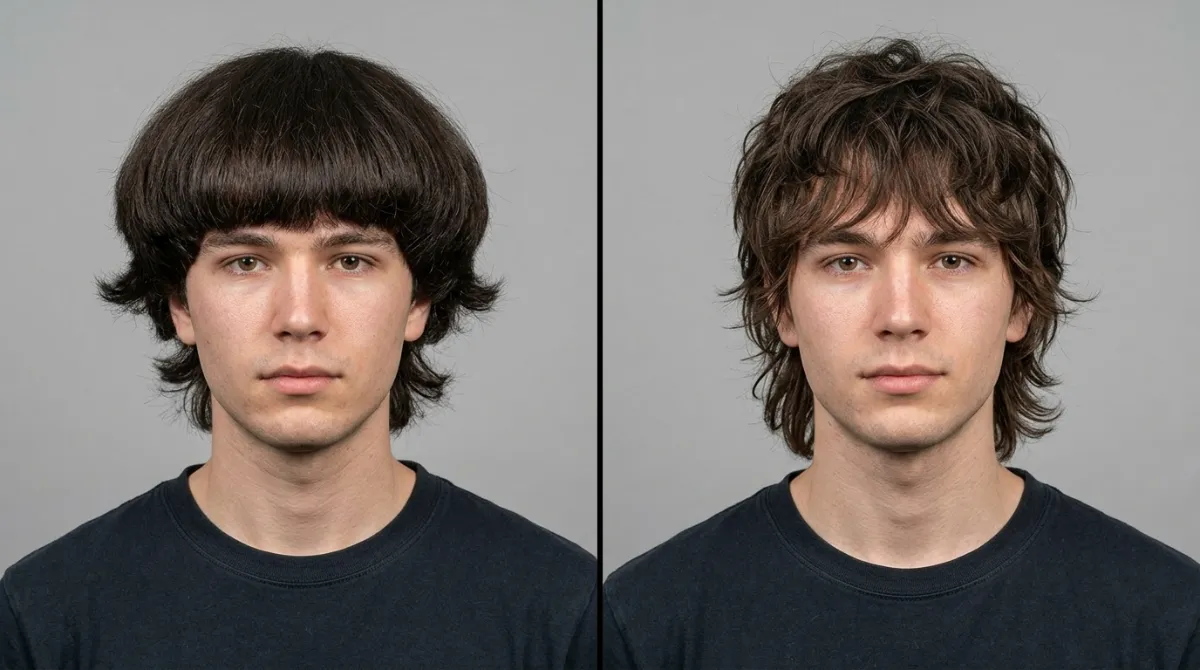
| Problem | Likely cause | Fix |
|---|---|---|
| Helmet or mushroom shape | Bulk left at the sides; crown cut round | Ask to remove weight from inside the sides and point-cut the outline |
| Triangle shape (curly hair) | Sides not layered; cut wet | Layer the sides and shape it dry |
| Flat crown | Crown layers too long; no texture | Shorten the crown slightly, use texture powder |
| Looks like a plain mullet | Sides clippered too short | Let the sides grow 4 to 6 weeks, then blend |
| Step between top and back | Layers not connected | Ask to blend the crown into the back |
| Wispy, see-through ends | Over-thinned | Trim the ends blunt; no more thinning shears |
| Fringe too short | Cut on wet, straight hair | Wait; it grows about 1 cm a month. Style it messy and forward meanwhile |
Wolf cut maintenance and growing it out
Book a men’s wolf cut trim every 6 to 8 weeks for short versions and every 8 to 10 weeks for long ones. Ask for crown and fringe shaping; the back can go longer between visits.
When you are ready to move on, you have three exits:
- Longer hair (flow or shag): ask the barber to trim only the back edges and leave the crown alone. After a few months, the layers even out into a longer shag.
- Mullet: tighten the sides with a taper or a burst fade and keep the tail. This is the fastest change, often one visit.
- Short textured crop: cut the back up to match the top, then add a low or mid fade. One visit, no awkward phase.
Wolf cut for men: FAQs
Does a men’s wolf cut suit every man?
No. It suits men with medium-to-thick hair, a full crown, and the patience for a few minutes of styling. Men with a thinning crown or very fine, flat hair usually look better in a long shag or a textured crop. Use the 7-point scorecard above: 5 or more means go ahead.
Is a wolf cut the same as a mullet?
No. A mullet has a clear contrast: short front and sides, long back. A wolf cut blends the two with layers all over and keeps the sides longer. A “wolf mullet” is a hybrid with tight sides and a layered crown.
Can I get a wolf cut with short hair?
Yes, if you have 3 to 4 inches on top and a little length at the nape. This is the short men’s wolf cut. If your sides are faded, you will need about 3 to 4 months of growth before the sides can be layered.
Is a wolf cut good for a receding hairline?
It can be. Temple recession is easy to soften with a textured fringe that falls forward. Crown thinning is the real problem, because the crown is cut shortest. Check your crown in a bright overhead photo before booking.
How do I ask for a wolf cut at a barber shop?
Say “wolf cut”, then describe each zone: choppy, short crown; your fringe style; layered sides or a low taper; back length kept to the collar; textured, not over-thinned ends. Show front, side and back photos.
Is a wolf cut professional enough for the office?
The short wolf cut and the wolf cut with a low taper usually are. Style them with a little cream instead of clay for a smoother finish. The long wolf cut and the wolf mullet are harder to wear in conservative workplaces.
How often do I need to trim a wolf cut?
Every 6 to 8 weeks for short and classic versions, every 8 to 10 weeks for long ones. The crown and fringe lose shape first, so ask for those to be refreshed and the back left mostly alone.
Does a wolf cut work on straight hair?
Yes, but straight hair needs texture cut into the crown and a sea salt spray or powder to show the layers. Thick, straight hair also needs bulk removed from inside the sides, or the shape puffs out like a helmet.
The bottom line
A wolf cut for men works when three things line up: enough hair (especially at the crown), enough length (chin at the front, collar at the back), and a barber who hears five zones instead of two words. Get those right and it is one of the few cuts that looks better the messier it gets.
Score yourself on the men’s wolf cut checklist, pick your version from the types table, and take the script and three photos to your next appointment.
Want more contrast at the back? Read our shaggy mullet guide next, or see the burst fade mullet hairstyles if you prefer clean, curved sides.
Pingback: Medium Length Hairstyles for Men: 24 Best Cuts + How to Pick