
The shaggy mullet is the mullet for people who don’t want a costume. It keeps the famous short-front, long-back shape, but swaps the hard step between the two for choppy, blended layers that move when you do. The result looks lived-in on day one and even better on day three.
It’s also easy to get wrong. Ask for “a mullet” and you might walk out with a 1987 hockey haircut. Ask for “a shag” and you may get no length in the back at all. This guide fixes that.
Below you’ll find 15 shaggy mullet styles for men and women, a face-shape table, a side-by-side comparison with the wolf cut and the classic shag, the exact words to use in the barber’s chair, and a plan for growing it out if you change your mind.
What Is a Shaggy Mullet?
A shaggy mullet is a haircut that combines the short front and longer back of a mullet with the heavy, feathered layering of a 1970s shag. The top is choppy and textured, the sides are short or tapered, and the back is left longer so it falls past the neck with soft, uneven ends.
Think of it as a mullet with the edges sanded off. A classic mullet has a clear break between the short and long sections. A shaggy mullet hides that break inside layers, so the whole head looks like one connected, slightly messy shape.
The cut first peaked in the 1970s and 80s with rock musicians, faded out, and came back hard in the early 2020s. It has stayed popular because it works on straight, wavy and curly hair and needs very little daily styling.
The three zones of a shaggy mullet
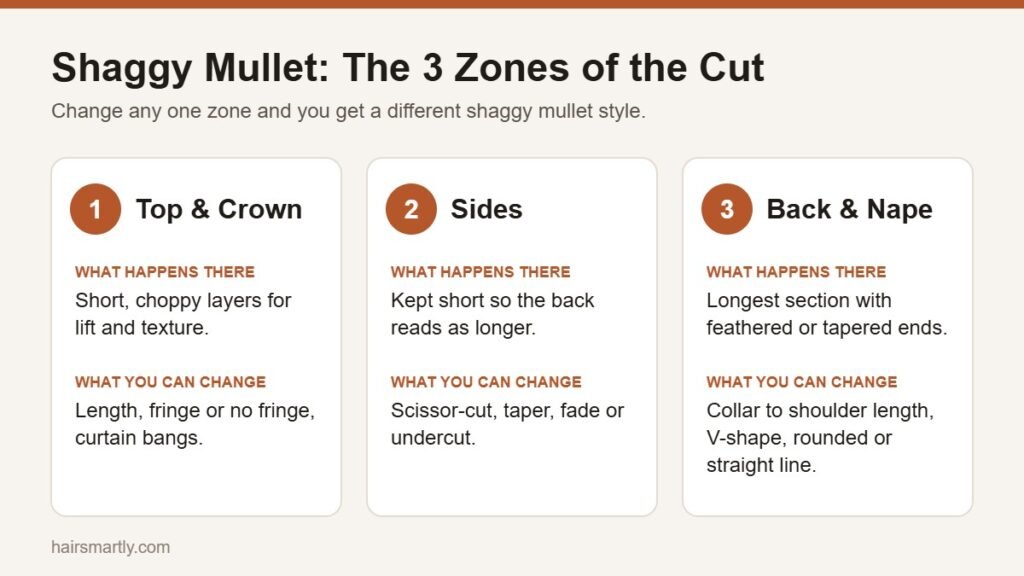
Every version of this cut is built from the same three zones. Changing any one of them gives you a different style.
| Zone | What happens there | What you can change |
|---|---|---|
| Top and crown | Short, choppy layers for lift and texture | Length, fringe or no fringe, curtain bangs |
| Sides | Kept short so the back reads as longer | Scissor-cut, taper, fade, undercut |
| Back and nape | Longest section, feathered or tapered ends | Length (collar to shoulders), V-shape, rounded or straight line |

Top 15 Shaggy Mullet Hairstyles for 2026
All 15 styles share the same base: textured top, shorter sides, longer back. What changes is the texture, the fringe, the side treatment and how long you let the back grow. Each one below tells you who it suits and what to say to your barber.
1. Shaggy Modern Mullet

The easiest entry point if you’ve never had a mullet. Layers are feathered all over, the crown stays light, and the back tapers into a soft tail instead of a blunt edge. From the front it reads as a messy medium cut; the mullet only shows from the side.
Best for: medium to thick hair that holds shape without going flat. Oval, square and oblong faces. Ask your barber: “Soft mullet, feathered layers through the top, tapered back, nothing blunt.”
2. Shaggy Wavy Mullet

Waves already give you movement, so this version cuts layers to follow them rather than fight them. The top looks tousled, the back flips out a little at the ends, and the whole thing has a beachy, air-dried feel.
Best for: natural 2A to 2C waves. Ask your barber: “Cut it dry or check the wave pattern before you layer, and keep weight out of the back.”
3. Shaggy Curly Mullet

Curls stack volume on their own, which makes the crown round and full while the back falls into loose coils. Because the curls do the styling, this is one of the lowest-effort versions on the list.
Best for: 3A to 4A curls, round and diamond faces. Ask your barber: “Curl-by-curl or dry cut if you can, short enough on top to show shape, keep the back long.”
4. Shaggy Layered Mullet
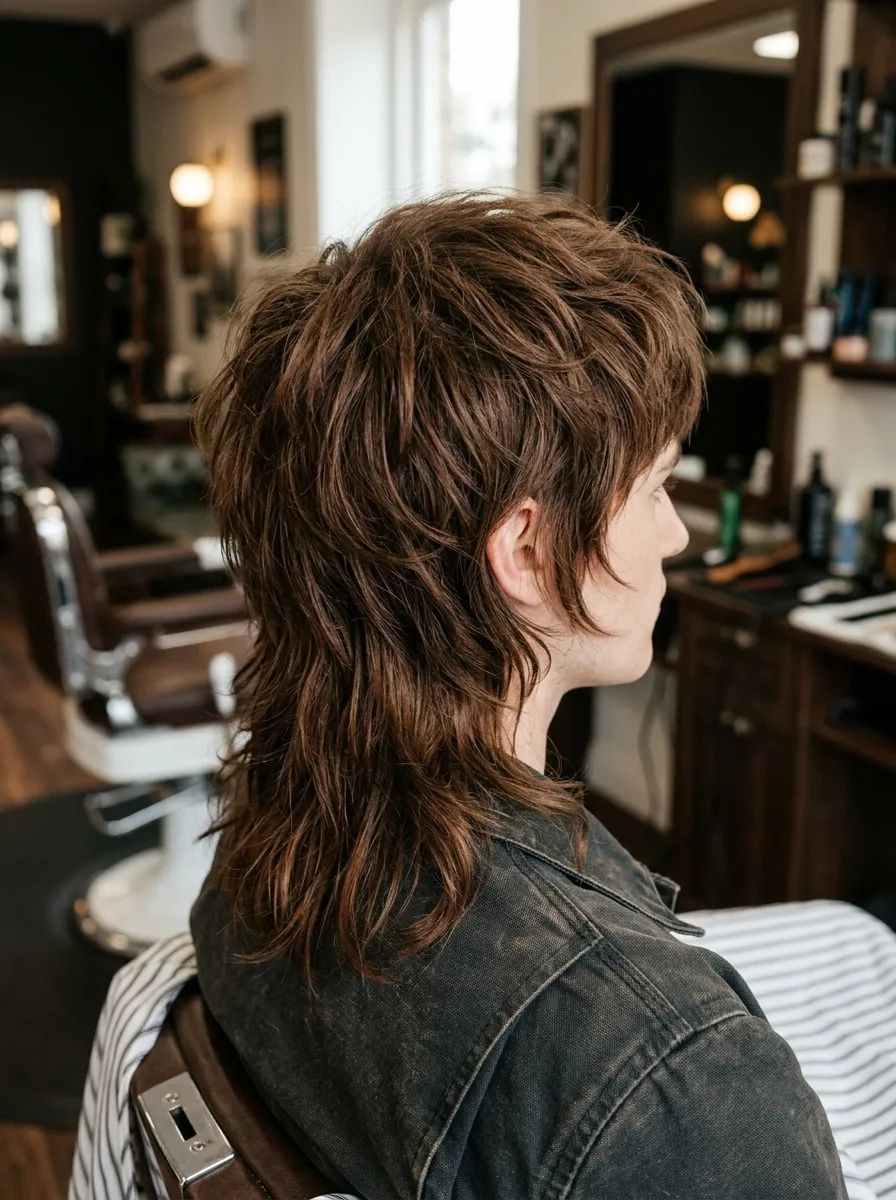
The most layered version. Your stylist stacks several layer lengths through the crown, sides and back, which removes bulk from thick hair while keeping the overall shape full.
Best for: very thick or coarse hair that puffs out with a basic cut. Ask your barber: “Heavy internal layering and debulking, lots of variation in length.”
5. Short Shaggy Mullet

All the attitude, less commitment. The back only goes a couple of inches past the collar, so it passes in most offices and grows out quickly if you hate it.
Best for: first-timers, fine to medium hair, heart and rectangular faces. Ask your barber: “Short mullet, back just past the collar, choppy on top.”
6. Shaggy Wolf Mullet
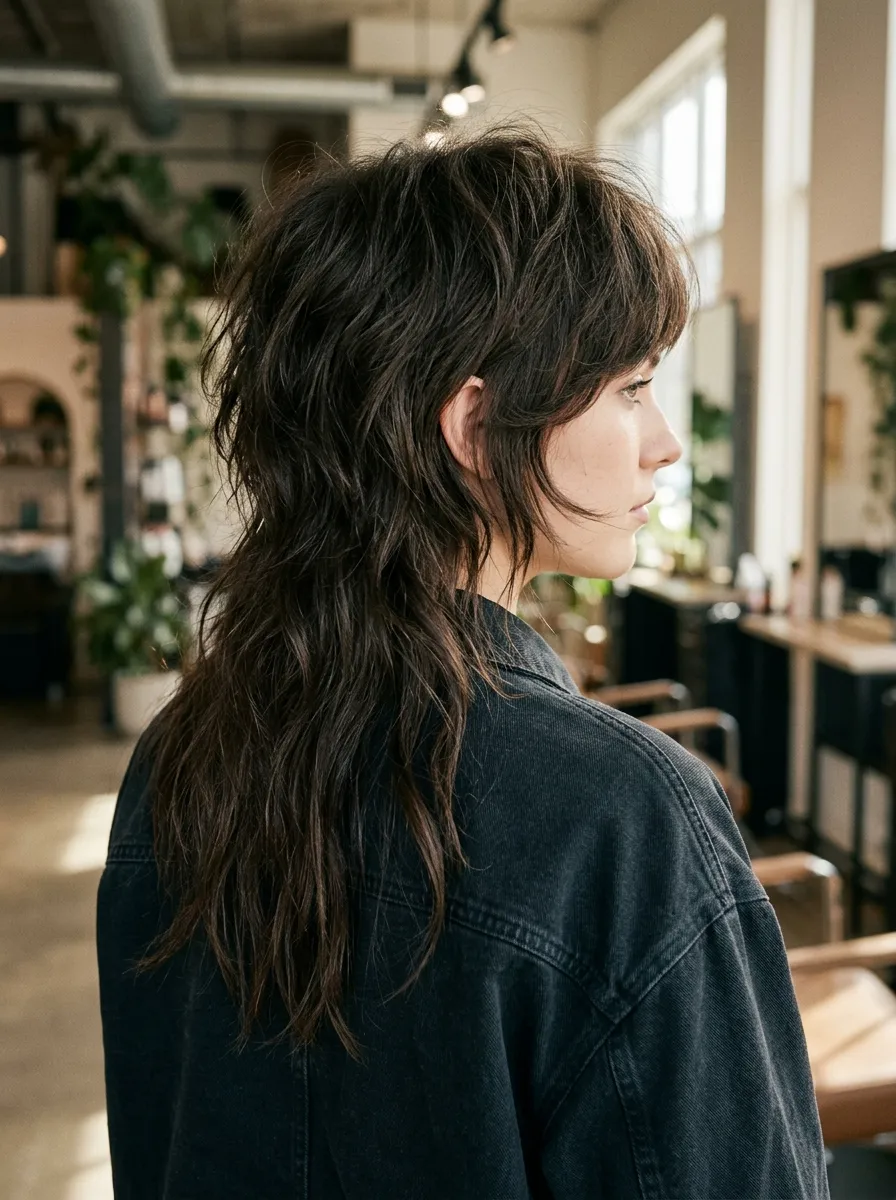
Where the shag, the wolf cut and the mullet meet. It’s heavily layered, intentionally messy and usually paired with curtain bangs. It looks best unbrushed, which is exactly why people love it.
Best for: thick, wavy hair and people who hate styling. Ask your barber: “Wolf cut shape with a clearer mullet back, curtain bangs blending into the sides.”
7. Shaggy Fringe Mullet
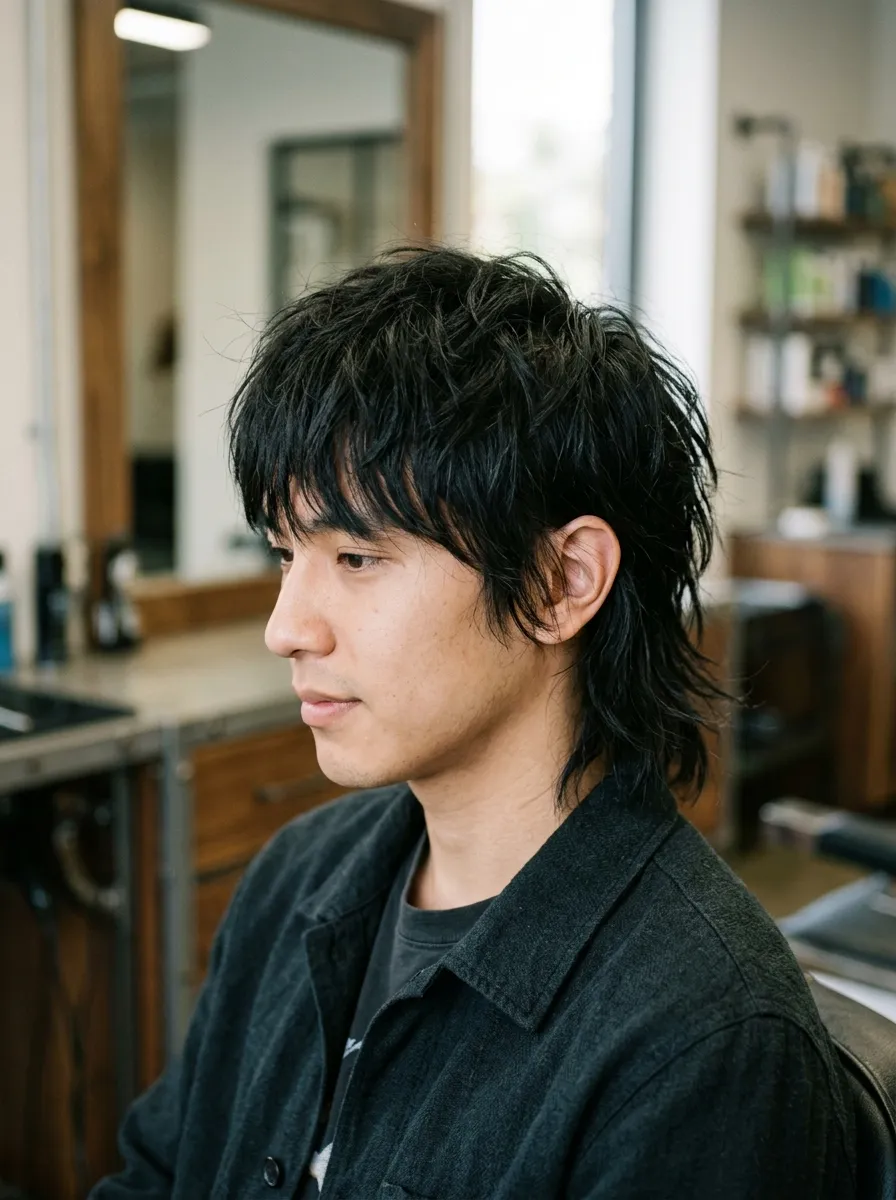
Adding a curtain fringe or a short micro fringe moves the focus to your eyes and cheekbones. The mullet body stays the same; the front does the talking.
Best for: long foreheads, oval and oblong faces, straight or wavy hair. Ask your barber: “Curtain fringe that hits around the cheekbone and blends into the side layers.”
8. Shaggy V Back Mullet
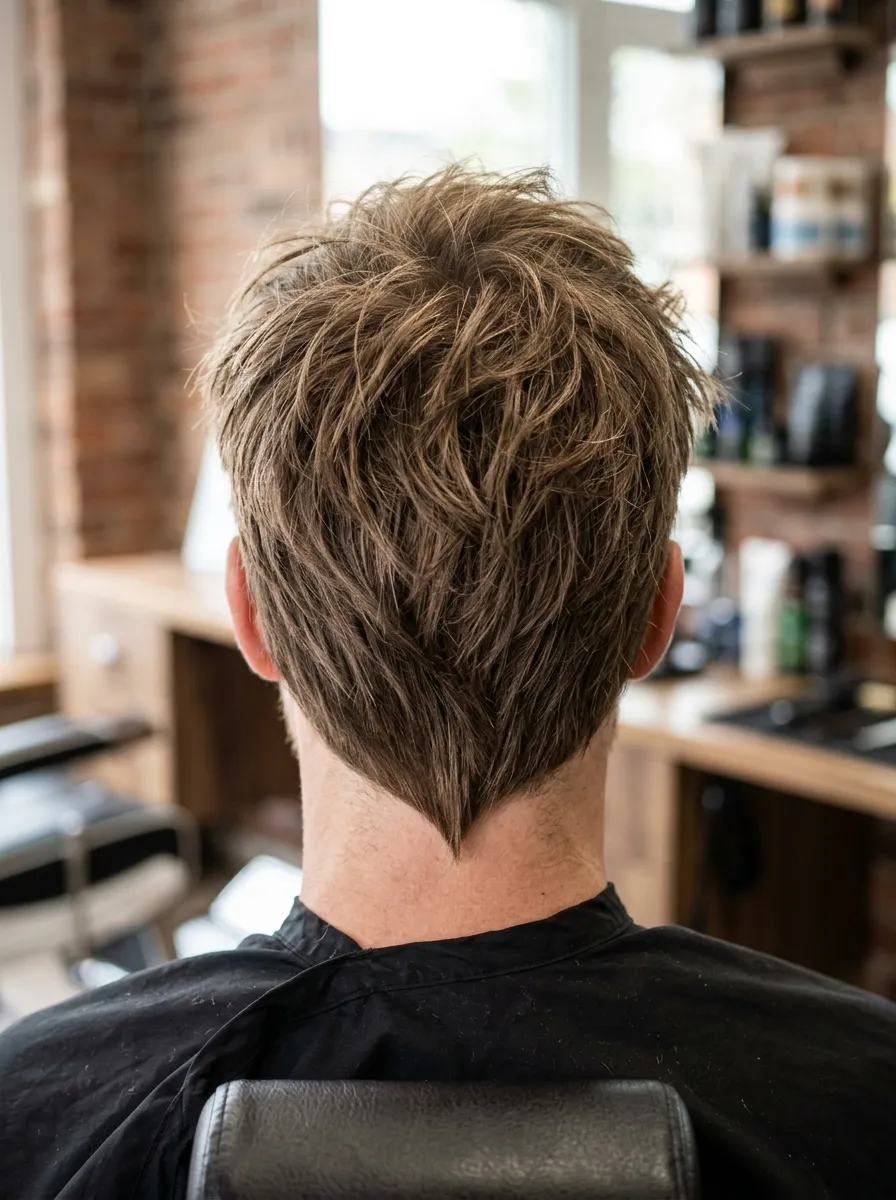
The back is cut into a V at the nape instead of a straight or rounded line. You get a sharp outline under a loose, shaggy top, which is a nice contrast from behind.
Best for: straight hair that shows a clean line. Ask your barber: “Point the back into a V, keep the top loose and choppy.”
9. Modern Shaggy Mullet for Men

Built to look intentional rather than scruffy. The top stays shaggy, the sides are tighter, often with a low taper, and the back is kept moderate. It’s the version most likely to survive a job interview.
Best for: all hair types, anyone who needs a tidy option. Ask your barber: “Shaggy top, low taper on the sides, blended back, not too long.”
10. Shaggy Straight Mullet

Straight hair shows every line, so texture has to come from the cut itself. Razor or point cutting on the ends stops it from looking heavy or blunt.
Best for: fine to medium straight hair. Ask your barber: “Razor or point cut the ends, texture on top, no blunt lines.”
11. Shaggy Burst Fade Mullet

A burst fade curves around the ear and leaves length at the neck, which makes it a natural partner for the mullet back. Clean skin around the ears, chaos on top.
Best for: round and square faces, anyone who wants maximum contrast. Ask your barber: “Burst fade around the ears, keep the back length, shaggy top.” Plan on touch-ups every 2 to 3 weeks.
12. Shaggy Mullet with Undercut
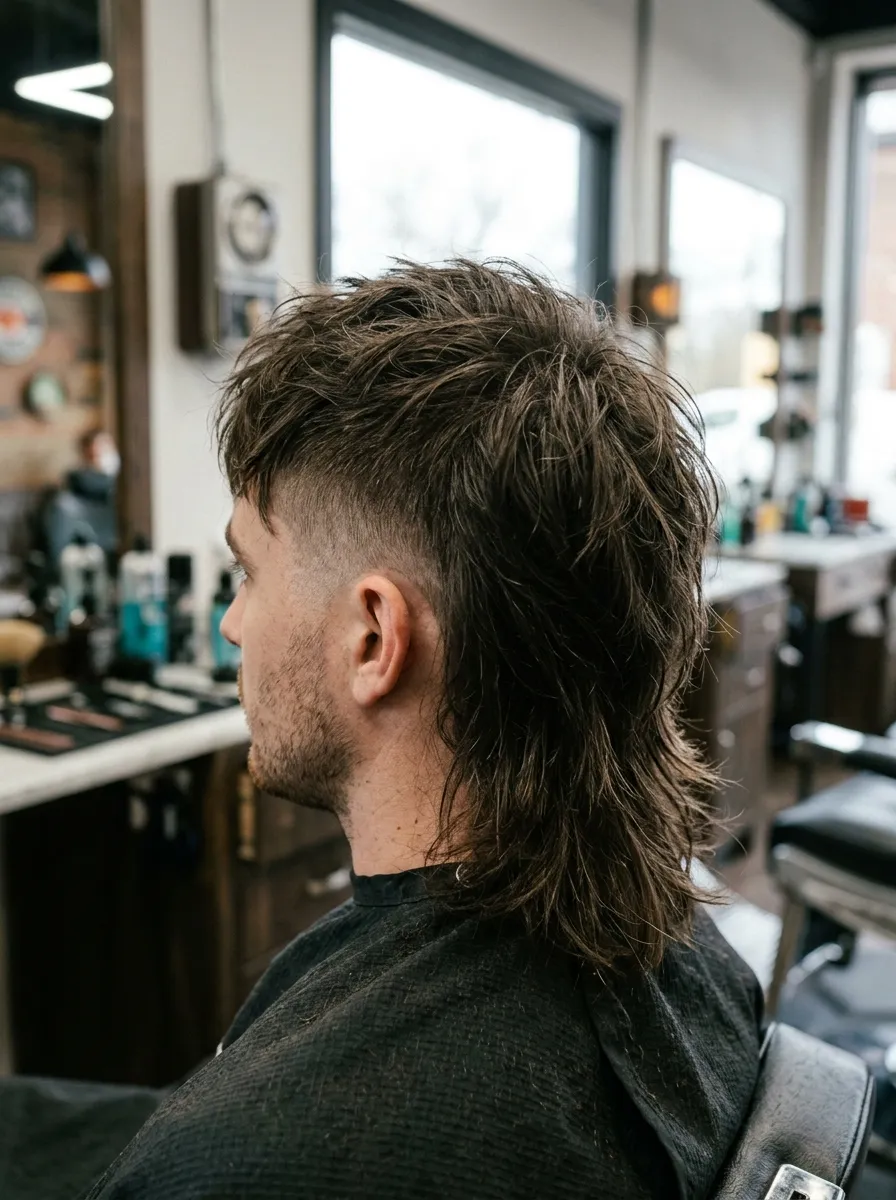
The sides and lower back are clipped short under the longer hair, so the top and the tail sit on a clean base. It feels lighter in hot weather and gives a stronger outline than a scissor-cut side.
Best for: very thick hair and strong jawlines. Ask your barber: “Disconnected undercut on the sides, leave the top and back long enough to fall over it.”
13. Shaggy Pixie Mullet (Women)

A short, choppy pixie on top and around the face with a longer, wispy nape. It’s cut to be almost self-styling: rough-dry, a little salt spray, done.
Best for: fine to medium hair, oval and heart faces, people who wear their hair down. Ask your barber: “Pixie length on top and sides, feathered nape left longer, wispy fringe.”
14. Long Shaggy Mullet (the Shullet)

Often called a “shullet”, this is a shag on longer hair with a clearly shorter crown and face-framing layers. The mullet contrast is softer, so it suits people who want the vibe without a dramatic short top.
Best for: shoulder-length or longer hair, women and men growing hair out. Ask your barber: “Keep my length at the back, short choppy crown, curtain bangs, lots of face-framing.”
15. Shaggy Mullet for Thin or Fine Hair

Fine hair can look stringy in a heavily layered cut. This version uses fewer, longer layers on top and keeps weight at the ends of the back so it looks fuller, not see-through.
Best for: fine or thinning hair. Ask your barber: “Minimal thinning, fewer longer layers, keep weight at the ends, no razor on the back.”
Quick Comparison Table
Use this to shortlist two or three styles before you book. Trim intervals are typical ranges; your hair’s growth speed will move them a little.
| Style | Best hair type | Best face shapes | Maintenance | Trim every |
|---|---|---|---|---|
| Shaggy Modern Mullet | Medium to thick | Oval, square, oblong | Low | 6 to 8 weeks |
| Shaggy Wavy Mullet | Wavy | Oval, square | Low | 6 to 8 weeks |
| Shaggy Curly Mullet | Curly, coily | Round, diamond | Low | 8 to 10 weeks |
| Shaggy Layered Mullet | Thick, coarse | Oval, angular | Medium | 6 weeks |
| Short Shaggy Mullet | All types | Heart, rectangular | Low | 4 to 6 weeks |
| Shaggy Wolf Mullet | Thick, wavy | Oval, heart | Medium | 6 to 8 weeks |
| Shaggy Fringe Mullet | Straight, wavy | Oval, oblong | Medium | Fringe 3 to 4 weeks |
| Shaggy V Back Mullet | Straight | Oval, square | Medium | 5 to 6 weeks |
| Modern Shaggy Mullet (Men) | All types | Most shapes | Low | 4 to 6 weeks |
| Shaggy Straight Mullet | Fine to medium straight | Oval, round | Medium | 5 to 6 weeks |
| Shaggy Burst Fade Mullet | All types | Round, square | High | Fade 2 to 3 weeks |
| Shaggy Mullet with Undercut | Very thick | Square, strong jaw | Medium | Sides 3 to 4 weeks |
| Shaggy Pixie Mullet | Fine to medium | Oval, heart | Medium | 4 to 6 weeks |
| Long Shaggy Mullet (Shullet) | Medium to thick, long | Most shapes | Low | 8 to 10 weeks |
| Shaggy Mullet for Thin Hair | Fine, thinning | Oval, round | Low | 6 weeks |
Styling a Shaggy Mullet
The goal is “I woke up like this”, not “I spent 20 minutes on this.” Most shaggy mullets need two products at most and your hands, not a brush.
- Spray sea salt spray or texture spray into damp hair for grip and body.
- Rough-dry with your fingers, or diffuse if you have waves or curls.
- Work a pea-sized amount of matte clay or paste through dry ends to split the layers into pieces.
- Scrunch waves and curls; brushing them out flattens the texture you paid for.
- Let the back air-dry when you can. Heat on the longest section is the main cause of frizz.
A 5-minute daily routine
- Minute 1: Mist the top with water or a refresher spray to wake up yesterday’s texture.
- Minute 2: Add sea salt spray to the crown and fringe only.
- Minutes 3 to 4: Blow-dry on medium heat, pushing the top forward and the sides back with your fingers.
- Minute 5: Rub a small amount of clay between your palms, twist a few pieces on top, and leave the back alone.
Superior Layers of a Shaggy Mullet
Layering is the difference between a shaggy mullet and a plain, dated one. Several layer depths through the crown, sides and back do three jobs: they remove bulk from thick hair, add lift to fine hair and create the soft, feathered movement the style is known for.
The tool matters as much as the length. Ask for point cutting or razor work on the ends rather than blunt scissor lines. Point cutting chips into the ends so each piece finishes slightly uneven, which is what makes the cut look grown-in instead of freshly chopped.
One caution: razors can fray fine or very curly hair. If your hair is either, ask for point cutting or slide cutting with scissors instead.
Best Products for a Shaggy Mullet
Match the product to your hair type, not to the style name. The wrong product is the fastest way to make a good cut look greasy or flat.
| Hair type | Prep (damp hair) | Finish (dry hair) | Avoid |
|---|---|---|---|
| Fine or thin | Volumizing mousse or light salt spray | Texture powder | Heavy pomade, oils |
| Straight, medium | Sea salt spray | Matte clay or paste | Wet-look gel |
| Thick or coarse | Light leave-in cream | Fiber paste or clay | Only salt spray (too dry) |
| Wavy | Salt spray or curl mousse | Light cream on ends | Brushing when dry |
| Curly or coily | Leave-in conditioner + curl cream | Light gel, scrunched out | Silicone-heavy serums, dry brushing |
Easy Shaggy Mullet Care
This cut stays popular partly because upkeep is simple. Stick to these five habits and it will keep its shape between visits.
- Trim every 6 to 8 weeks. Faded or undercut sides need a clean-up every 2 to 4 weeks.
- Wash 2 to 3 times a week. Daily shampoo strips the natural oils that help texture hold.
- Condition the back. The longest section gets split ends first; a light leave-in on the ends helps.
- Keep heavy oils off the top. They flatten the crown layers.
- Brush only before washing. Between washes, finger-comb so you don’t break up the texture.
Which Shaggy Mullet Suits Your Face Shape?
The rule is simple: add height where your face is wide, add width where it’s long. The top and fringe control height; the sides and back control width.

| Face shape | Go for | Skip | Best styles from this list |
|---|---|---|---|
| Oval | Almost anything | Very heavy fringe that hides your features | Modern, Wolf, Fringe, V Back |
| Round | Height on top, tight sides | Full, puffy sides | Burst Fade, Modern Men, Curly (short sides) |
| Square | Soft texture to break the jaw line | Hard, blunt lines everywhere | Wavy, Wolf, Curly |
| Oblong / long | Width at the sides, a fringe | Extra height on top | Fringe, Shullet, Wavy |
| Heart | Fuller back and nape to balance the chin | Very short, tight back | Short Shaggy, Pixie Mullet, Shullet |
| Diamond | Fringe to widen the forehead | Slicked-back top | Curly, Fringe |
Not sure of your face shape? Pull your hair back, take a straight-on photo and compare the width of your forehead, cheekbones and jaw. The widest point tells you most of what you need.
Shaggy Mullet vs Wolf Cut vs Shag vs Classic Mullet
These four cuts get mixed up constantly, and barbers interpret them differently. The key difference is how connected the short and long sections are.
| Cut | Top | Sides | Back | Connection between lengths | Vibe |
|---|---|---|---|---|---|
| Classic mullet | Short | Short | Long | Disconnected, obvious step | Retro, bold |
| Shag | Layered, fringe | Full, face-framing | Layered, even-ish | Fully connected | Soft, 70s |
| Wolf cut | Short choppy crown | Wispy, face-hugging | Medium, textured | Mostly connected | Messy, TikTok era |
| Shaggy mullet | Choppy layers | Short or tapered | Clearly longer | Blended, but the long back is obvious | Edgy but wearable |
In short: if you want the back to look noticeably longer, say mullet. If you want it all to flow as one shape, say shag. The shaggy mullet sits between the two, closer to the mullet end.
What to Tell Your Barber (Copy-Paste Script)
Most bad mullets come from vague instructions. Save this script to your phone, fill in the brackets and show it along with two or three photos.
“I’d like a shaggy mullet. Keep [2 to 3 / 3 to 4] inches on top with choppy, textured layers. Sides [scissor-cut short / low taper / burst fade], blended into the layers, no hard line. Leave the back about [collar / shoulder] length with feathered ends. Please point cut or razor the ends instead of blunt cutting. [Add curtain bangs to the cheekbone / no fringe.]”
A few tips that make the appointment go better:
- Bring real-life photos, not studio shots. Street-style or candid photos show how the cut looks when it isn’t blow-dried by a pro.
- Show the back view too. Most inspiration photos are front-on, which hides the part that makes it a mullet.
- Say what you don’t want. “No blunt line at the neck” is more useful than another adjective.
- Start longer. You can always take more off at a follow-up trim; you can’t put it back.
Common Shaggy Mullet Mistakes
A few errors cause most of the regrets. Avoid these and you’re most of the way there.
- Cutting the back too early. You need at least 2 to 3 inches past the collar for the shaggy version to read properly. Short hair usually needs a couple of months of growth first.
- Over-thinning fine hair. Too much texturizing makes fine hair look sparse. Fewer, longer layers work better.
- A hard line between sides and back. That’s a classic mullet. Ask for blending.
- Too much product. Shaggy cuts collapse under heavy pomade. Start with less than you think.
- Skipping side maintenance. Faded or undercut sides grow out fast and make the whole cut look untidy.
- Brushing curls dry. It turns defined curls into a frizzy cloud.
Is a Shaggy Mullet Right for You?
For most people, yes, but not everyone. It works best if you like wearing your hair down and don’t mind a little mess.
It’s a great fit if you want low daily styling, have medium to thick hair, and work somewhere that accepts creative haircuts.
Think twice if you tie your hair up most days. The layers are short enough that pieces slip out of ponytails and buns. The same goes if you want a sleek, polished look every day, or if your fine hair already struggles to hold volume. The thin-hair version above is your best bet in that case.
How to Grow Out a Shaggy Mullet
Growing out is easier than with a classic mullet because the layers are already blended. Expect roughly 4 to 6 months to reach an even medium length, as hair grows about half an inch a month.
- Stop cutting the back. Only trim split ends.
- Let the sides and top catch up. Ask your barber to tidy the sides without taking length.
- Reshape at month 2 to 3. Turn it into a wolf cut or a shag while everything evens out.
- Blend the last step. Once the top reaches the nape length, cut a soft layered medium style or a long shag.
Shaggy Mullet FAQs
What is the difference between a shaggy mullet and a regular mullet?
A regular mullet has a clear, disconnected step between the short front and the long back. A shaggy mullet blends that step with choppy, feathered layers, so it looks softer and more modern. The long back is still visible, just not as abrupt.
How long does my hair need to be for a shaggy mullet?
Aim for at least 3 to 4 inches on top and enough at the back to fall 2 to 3 inches past your collar. Shorter hair can get a short shaggy mullet, but the back will need a few months of growth to show the shape properly.
Does a shaggy mullet work on thin hair?
Yes, with a lighter touch. Ask for fewer, longer layers, minimal thinning, and weight kept at the ends. Style with texture powder or mousse instead of heavy products, which flatten fine hair.
Can women get a shaggy mullet?
Absolutely. The pixie mullet and the long shaggy mullet (often called a shullet) are two of the most popular women’s versions. Both suit people who wear their hair down more than they tie it up.
Is a shaggy mullet professional enough for work?
The short shaggy mullet and the modern men’s version with a low taper usually pass in most workplaces. Keep the back moderate, the sides tidy and the top textured rather than wild.
How often should I trim a shaggy mullet?
Every 6 to 8 weeks for most versions. If you have a fade or undercut, clean up the sides every 2 to 4 weeks, and trim a fringe every 3 to 4 weeks so it doesn’t fall into your eyes.
How much does a shaggy mullet cost?
Prices vary a lot by city and salon, so check local menus. As a rough guide, expect a standard barbershop cut price at a barber and a higher “restyle” price at a salon for the first appointment, since a big change takes longer. Follow-up trims are usually charged at the regular rate.
Is the shaggy mullet still in style in 2026?
Yes. It has moved from trend to a regular request at barbershops and salons. The softer, more blended versions, like the modern and wavy shaggy mullet, are the ones people are asking for most.
Conclusion
The shaggy mullet has lasted because it adapts to almost anyone. Waves, curls, straight hair, a bold fade or a soft fringe: there’s a version for your hair type and your personality.
Pick two or three styles from the comparison table, check them against your face shape, and take the barber script with you. Get the layering right, start a little longer than you think, and you’ll end up with a low-effort cut that still turns heads.
Want more ideas before your appointment? Read our guide to burst fade mullet hairstyles or browse more men’s and women’s hairstyle ideas.
Pingback: Wolf Cut for Men: 7-Point Fit Test & Easy Barber Script
Pingback: Silky Hair Men: 12 Haircuts That Actually Hold (With Photos)