
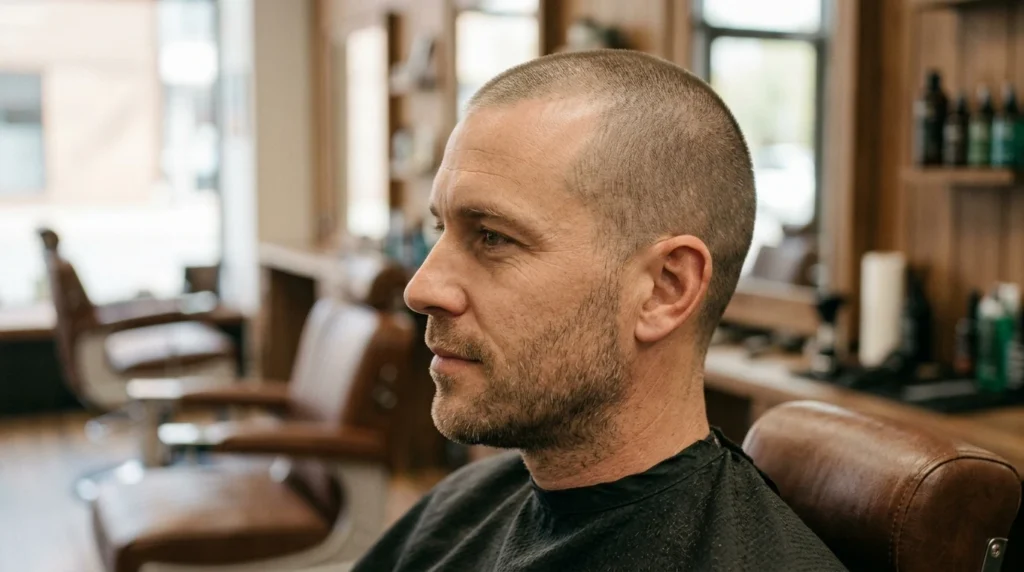
The best hairstyles for balding men are short, textured cuts with tight sides: the buzz cut, crew cut, textured crop, high and tight, and the clean shave. They work because they shrink the difference between where your hair is thick and where it is thin.
That difference is the whole game. Most guides hand you a gallery of 40 haircuts and leave you to guess. This one starts with where you are losing hair, then gives you the cut, the clipper guard number, and the exact words to say in the barber’s chair.
You are also in large company. In a population study of 1,005 men, 58% of those aged 30 to 50 showed male pattern hair loss, and the rate rose with every age band.
Quick answer by thinning pattern
| Where you are thinning | Best cut | Guard on top |
|---|---|---|
| Receding temples, good density on top | Textured crop or crew cut | Scissor cut, or #6 to #8 |
| Thinning crown (bald spot) | Short buzz or high and tight | #2 to #4 |
| Thin all over, scalp showing | Even buzz cut | #2 or #3 |
| Bald on top, hair on the sides | #1 buzz or clean shave | #0 to #1 |
In this guide
The contrast rule: why some cuts work on thinning hair
A haircut hides balding when it lowers contrast between dense areas and sparse ones. Thick sides next to a thin top make the top look thinner. Take the sides down and the top looks fuller without a single new hair.
Three things raise or lower that contrast:
- Length. Long thin hair clumps into strands and opens gaps of scalp. Short hair stands up and covers more evenly.
- Side density. The sides and back are usually the last to thin. Fading them down brings them closer to the top.
- Hair and scalp colour. Dark hair on pale skin shows every gap, so go shorter. Fair or grey hair on fair skin, or dark hair on dark skin, hides thinning better and can stay a guard or two longer.
Every cut below is just a different way of applying this rule.
Find your thinning pattern first
Pick your cut by pattern, not by a photo of someone with different hair. Barbers and dermatologists describe male pattern baldness with the Norwood scale, which runs from stage 1 (no visible loss) to stage 7 (a band of hair around the sides and back only).
| Norwood stage | What you see in the mirror | Cuts that suit it |
|---|---|---|
| 1 to 2 | Slight temple recession, mature hairline | Almost anything: textured crop, side part, quiff, Ivy League |
| 3 | Deep M-shaped hairline | Textured crop, French crop, crew cut, brushed-forward fringe |
| 3 vertex to 4 | Receding front plus a thinning crown | Crew cut, high and tight, #3 or #4 buzz |
| 5 | Front and crown patches nearly joined | #2 or #3 buzz with a skin fade |
| 6 to 7 | Bald on top, hair on sides and back | #1 buzz, stubble shave, or clean shave |

Not sure where your crown stands? Take a phone photo of the top of your head under a bright ceiling light with dry hair. That is how other people see it, and it is the photo to show your barber.
One exception: if the hair is falling out in round patches, shedding suddenly, or the scalp is itchy or sore, that is not pattern baldness. See a doctor before you change your haircut.
12 best hairstyles for balding men
These twelve cuts cover every stage, from a first receding corner to a fully bald crown. Use the table to shortlist two, then read those two in detail.
| Cut | Best for | Top length | Barber visit |
|---|---|---|---|
| Short buzz cut | Crown thinning, diffuse thinning | #2 to #4 | Every 2 to 3 weeks |
| Long buzz cut | Early thinning, first-time buzz | #6 to #8 | Every 3 to 4 weeks |
| Crew cut | Receding hairline with a decent top | 1 to 2 cm, shorter at the back | Every 3 to 4 weeks |
| High and tight | Receding temples plus crown | #2 to #4 top, skin sides | Every 2 weeks |
| Textured crop | M-shaped hairline, fine hair | 3 to 5 cm | Every 4 weeks |
| French crop | High or uneven hairline | 3 to 5 cm with a fringe | Every 4 weeks |
| Caesar cut | Receding front, straight hair | 2 to 3 cm, short fringe | Every 3 to 4 weeks |
| Ivy League | Mild recession, office setting | 2 to 4 cm front, shorter back | Every 4 weeks |
| Tapered side part | Even thinning, still has length | 4 to 5 cm | Every 4 to 5 weeks |
| Short quiff | Temples receding, strong forelock | 4 to 6 cm at the front | Every 4 weeks |
| Skin fade, short top | Thick sides, thin top | Any short top | Every 2 weeks |
| Clean or stubble shave | Bald on top | #0 or razor | Every 2 to 7 days |
1. Short buzz cut (#2 to #4)
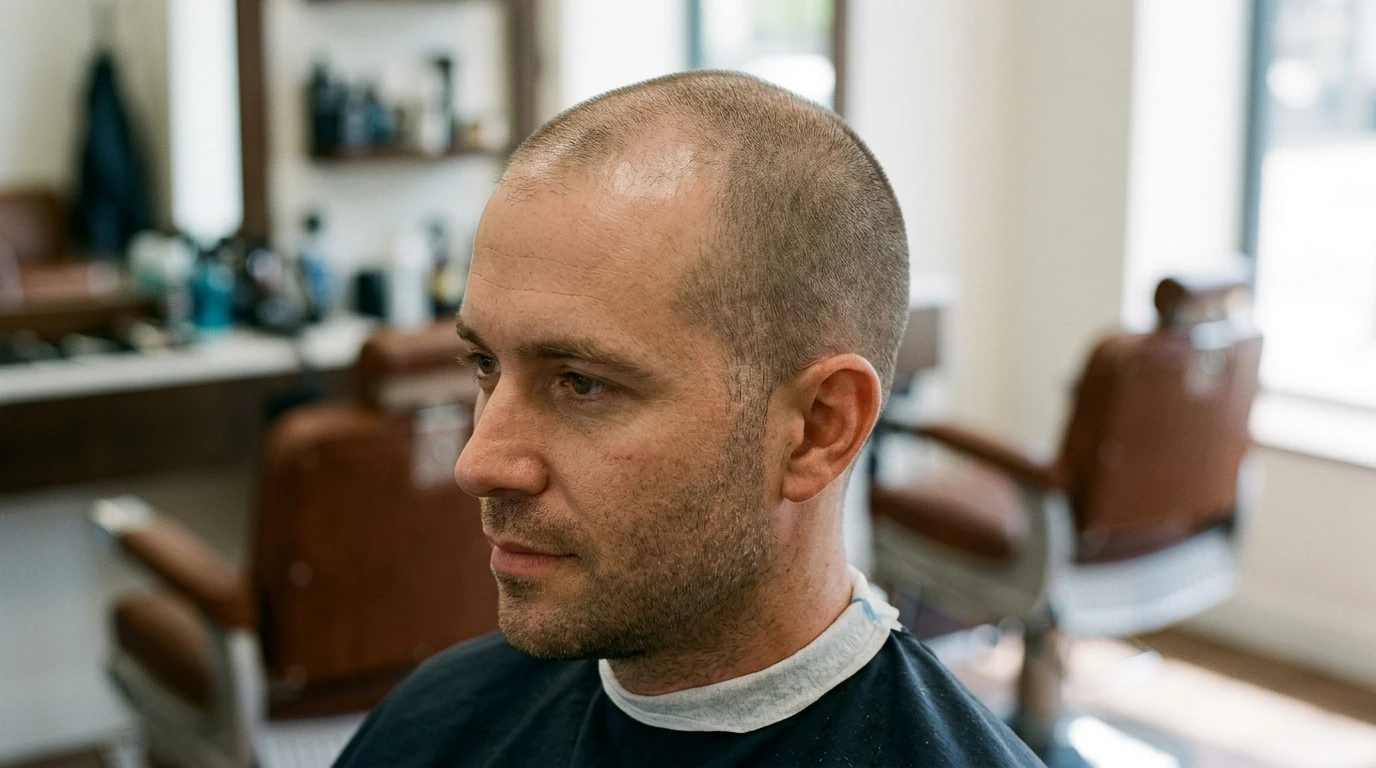
The short buzz is the most reliable cut for a thinning crown or thin hair all over. One guard length across the whole head removes the contrast that gives a bald spot away.
A 2 guard buzz cut leaves 6 mm and suits Norwood 4 and 5. If your crown is only starting to thin, a #3 or #4 keeps more cover. Ask for a taper at the neck so it does not look home-made.
2. Long buzz cut (#6 to #8)
The long buzz is the safe first step if you are nervous about going short. It keeps 19 to 25 mm of hair, so it reads as a short haircut, not a shaved head.
A 6 guard buzz cut works for light, even thinning. An 8 guard buzz cut leaves a full inch and suits a receding hairline with a solid crown. Skip both if scalp shows through the top under bright light, because length will only expose it.
3. Crew cut

The crew cut keeps the front slightly longer than the crown and fades the sides. That shape puts your thickest hair at the front and lets the thinner crown sit short and unnoticed.
Ask for a #2 or #3 on the sides, scissor cut on top, graduated shorter toward the back.
4. High and tight

The high and tight takes the sides to skin well above the temples and leaves a short patch on top. Because the fade runs through the recession line, the receded corners disappear into the fade.
It is the strongest option when both the temples and the crown are thinning. It needs a barber every two weeks to stay sharp.
5. Textured crop

The textured crop is the best hairstyle for a receding hairline when the top is still dense. Choppy, uneven layers pushed forward break up the hairline so there is no hard M-shape to see.
Ask for point cutting on top and a mid fade. Style it dry with a matte clay.
6. French crop

The French crop is a textured crop with a blunt, short fringe. The fringe sits over the hairline and covers high corners or an uneven front.
It stops working once the fringe itself gets thin. If you can see forehead through it, move to a crew cut or buzz.
7. Caesar cut
The Caesar is short all over, 2 to 3 cm, with a straight fringe brushed forward. It suits straight hair with a receding front and needs almost no styling.
8. Ivy League
The Ivy League is a longer crew cut with enough length at the front for a small side sweep. It is the most office-friendly cut for mild recession at Norwood 2 or 3.
9. Tapered side part
A short side part works for even thinning without a clear bald spot. Place the part on the side where your hairline has receded more, so the part line runs into the recession and looks deliberate.
Keep the top under 5 cm. Longer than that and it becomes a comb-over.
10. Short quiff or brush-up
A short quiff lifts the front upward so the eye goes to height, not to the temples. It only works if the forelock, the hair at the centre front, is still strong.
Use a blow dryer on low heat and a matte paste. If the front lies flat by midday, the hair is too fine for this cut.
11. Skin fade with a short top
A skin fade suits men whose sides are still thick while the top has thinned. Taking the sides to zero makes whatever is on top the fullest part of the head.
Pair it with a #3 or #4 top, or with a short crop.
12. Clean shave or stubble shave
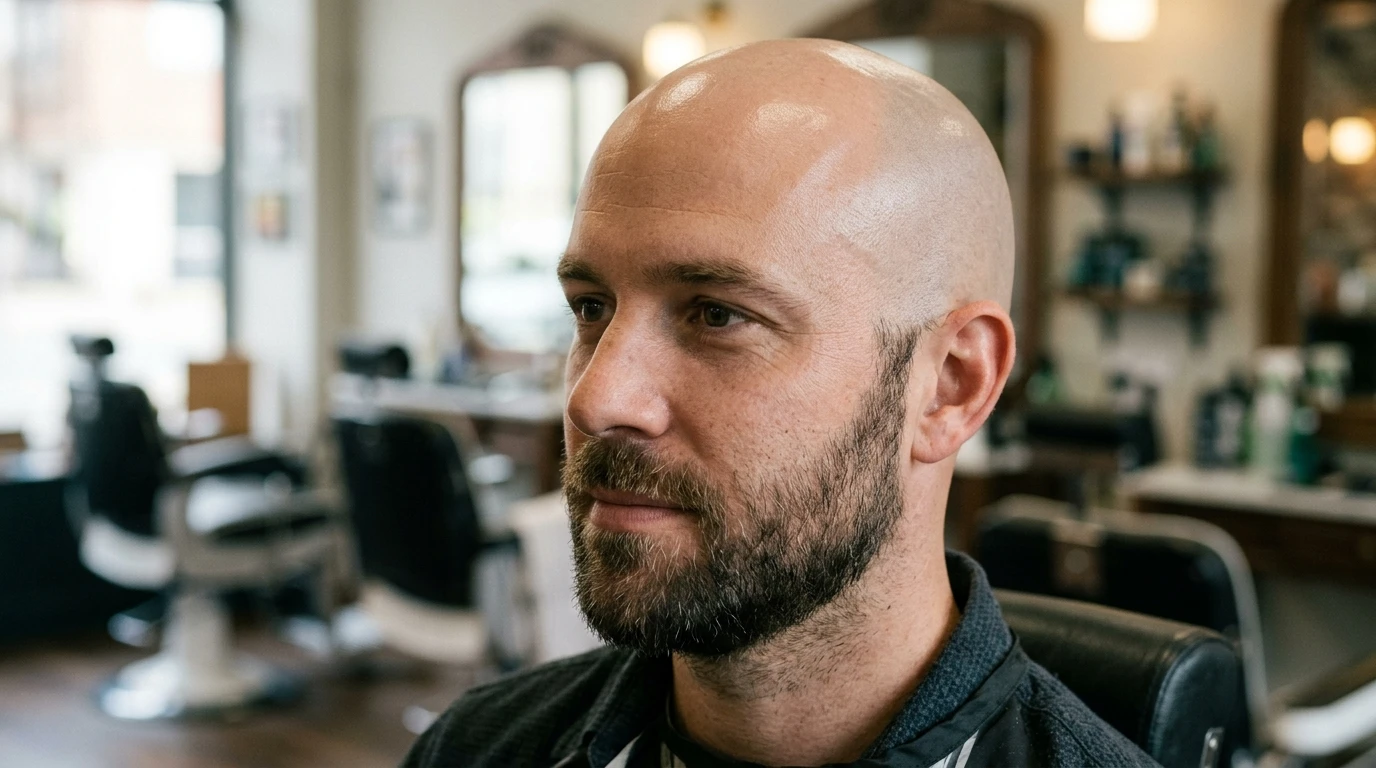
Shaving is the best choice once the top is bare and only the sides and back remain. Nothing is left to compare, so the balding stops being visible as balding.
A #0 clipper finish leaves a shadow and is easier on sensitive skin. A razor finish is smoother and needs doing every two to three days.
Buzz cut guard numbers for thinning hair
The thinner the top, the lower the guard. A guard number is the plastic comb on the clipper, and each step adds about 3 mm (1/8 inch) of length.
| Guard | Length | How it looks on thinning hair | Good for |
|---|---|---|---|
| #0 to #1 | 1.5 to 3 mm | Stubble, scalp clearly visible everywhere | Norwood 6 to 7 |
| #2 | 6 mm (1/4 in) | Even shadow, bald spot blends in | Norwood 4 to 5, diffuse thinning |
| #3 to #4 | 10 to 13 mm | Short hair with some cover | Early crown thinning |
| #5 to #6 | 16 to 19 mm | Soft, full-looking buzz | Light, even thinning |
| #7 to #8 | 22 to 25 mm | A short haircut, not a buzz | Receding hairline, solid crown |

Two tests tell you if your guard is too long. Wet your hair: if it separates and shows scalp, drop two guards. Stand under a ceiling light: if the crown looks lighter than the sides, drop one guard on top or fade the sides lower.
Going shorter in steps is easier to live with. Many men move from an 8 guard to a 6 guard and settle on a 2 guard over a few visits.
Choosing by hair type and head shape
Hair type changes which cut hides thinning best, and head shape decides how short you can comfortably go.
| Your hair | What helps | What to skip |
|---|---|---|
| Fine and straight | Textured crop, crew cut, matte products | Length over 5 cm, gels |
| Thick strands, low density | Skin fade with a short top | Heavy sides |
| Wavy | Short messy crop; waves add natural bulk | Slicking it flat |
| Curly or coily | Low fade with a short sponge or even #1 to #2 cut | A sharp line-up pushed behind the real hairline |
| Grey or white | Slightly longer cuts; low contrast with the scalp | Dark dye, which raises contrast |
Head shape. Run a hand over your skull before you shave. A fairly even, rounded shape suits any guard. A flat back, ridges or scars look better with a #2 or #3 than with a razor shave, because a few millimetres of hair soften the outline.
Face shape. Round faces gain from height on top and tight sides, such as a crew cut or quiff. Long faces look better with an even buzz and no added height. Square and oval faces can wear all twelve cuts.
What to tell your barber
Tell your barber where you are thinning before you name a haircut. The pattern shapes the cut more than any reference photo.
Use these lines as they are:
- Receding hairline: “My temples are receding. Keep the front textured and pushed forward, mid fade on the sides, no hard line-up at the corners.”
- Thinning crown: “My crown is thin. Take the top short enough that it blends, and keep the back and sides tight so the crown is not the lightest area.”
- Thin all over: “I want one guard all over, a #3 to start, with a taper at the neck and around the ears.”
- Bald on top: “Take it all down to a #1, or a zero, and clean the neckline.”
Three more points worth saying:
- Ask them not to use thinning shears on top. You need every hair there.
- Ask for the first pass one guard longer than you think. They can always go shorter.
- Ask to see the crown in the hand mirror under the shop light before you leave.
Styling products that help and hurt
Use matte, lightweight products and apply them to dry hair. Shine reflects light off the scalp, and wet-look products glue fine hairs into clumps with gaps between them.
| Product | Effect on thinning hair | Verdict |
|---|---|---|
| Matte clay or paste | Adds grip and separation without shine | Best daily choice |
| Texture powder | Lifts roots, makes strands look thicker | Best for fine hair |
| Sea salt spray | Light hold and grit before blow-drying | Good as a base |
| Hair fibres | Tint the scalp and cling to existing hair | Useful for a crown at #3 and longer |
| Gel and wet-look pomade | Clumps hair, exposes scalp | Avoid |
| Heavy wax or oil | Weighs hair flat | Avoid |
Use a pea-sized amount. Rub it fully into your palms, then work from the back of the head forward so the front gets the least product. Blow-dry on low heat in the direction you want the hair to sit, because damp hair always looks thinner.
Hairstyles to avoid when you are balding
Avoid any style that relies on long hair to cover a bare area. Wind, sweat and overhead light undo it within minutes, and it draws more attention than the thinning did.
- The comb-over. Long strands laid across a bald area. The parting sits too low and the scalp shows between the strands.
- Long sides with a bald top. The ring of thick hair frames the bare crown. Take the sides down to a #1 or #2.
- Ponytail or bun with a thin crown. Pulling hair back tightens it over the scalp and exposes the hairline.
- Slicked-back wet styles. They show the exact shape of the recession.
- A line-up cut behind the natural hairline. It looks sharp for a week, then the stubble in front grows back.
- Dye much darker than your natural shade. More contrast with the scalp means more visible thinning.

When to buzz it or shave it
It is time to go to a short buzz or a shave when styling takes longer and hides less. Three signs make the call simple:
- You can see scalp through the top in normal indoor light, not only under a spotlight.
- The front and crown patches have joined, or will soon (Norwood 5 and above).
- You check your hair in every mirror and avoid wind, rain or swimming.
If two of the three are true, try a #3 buzz first. Hair grows about 1 cm a month, so the decision is reversible within weeks.
Not ready? An app or photo filter that previews a buzz cut on your own face is a low-risk way to check your head shape first.
Beard, scalp care and upkeep
A short beard balances a buzzed or shaved head by putting weight back at the jaw. Keep it shorter on the cheeks and fade the sideburns into the haircut so there is no hard step.
| Head | Beard that pairs well |
|---|---|
| Clean shave | Full short beard or heavy stubble |
| #1 to #2 buzz | Stubble at the same guard, or a short boxed beard |
| Crew cut or crop | Light stubble or clean shaven |
Scalp care matters more once the scalp is exposed:
- Sun. Use SPF 30 or higher on a buzzed or shaved head, and reapply outdoors. A bare scalp burns fast.
- Washing. Shampoo two or three times a week. Daily washing dries the scalp and makes fine hair fluffy and flat.
- Shine. A matte moisturiser controls shine on a shaved head.
- Clippers at home. A #2 or #3 all over is easy to maintain yourself between barber visits. Go against the direction of growth and finish the neckline with no guard.
If you want to slow the loss as well as style around it, talk to a doctor or dermatologist. Approved treatments exist, as the NHS guide to hair loss explains, and they work best when started early. A haircut and a treatment plan are not either-or.
FAQs about hairstyles for balding men
What is the best haircut for a balding man?
The buzz cut is the best all-round haircut for a balding man. One short length across the head removes the contrast between thick and thin areas. Use a #2 or #3 for a thinning crown and a #6 to #8 if only the hairline is receding.
Is short or long hair better for thinning hair?
Short hair is better in almost every case. Short strands stand up and cover the scalp evenly, while long thin hair lies flat, separates and shows gaps. Keep the top under 5 cm and the sides tighter than the top.
What haircut hides a receding hairline?
A textured crop or French crop hides a receding hairline best. Both push uneven, choppy hair forward over the temples, so there is no clean M-shape to see. They need reasonable density at the front to work.
What is the best haircut for a bald spot on the crown?
A short buzz at #2 to #4, or a high and tight, is best for a bald spot on the crown. Cutting the surrounding hair short brings it close to the density of the thin patch, so the spot blends in.
What guard number should I use for a buzz cut with thinning hair?
Start with a #3 or #4 and go down from there. A #2 suits clear thinning on top, and a #1 or #0 suits a mostly bald top. If only your hairline is receding, a #6 or #8 keeps more length.
Does a buzz cut make balding look worse?
No. A buzz cut usually makes balding less noticeable because it evens out density. It can look harsher for the first few days if the scalp is much paler than your face. A slightly longer guard and some sun protection solve that.
Should I shave my head if I am balding?
Shave your head when the top is mostly bare and only the sides and back are full, around Norwood 6 or 7. Before that, a #1 to #3 buzz gives a similar effect and is easier on an uneven head shape.
Do hats or frequent haircuts cause hair loss?
No. Male pattern baldness is driven by genetics and hormones, not by hats or how often you cut your hair. Cutting hair does not make it grow back thicker either. It only changes how thick it looks.
How often should a balding man get a haircut?
Every two to four weeks. Fades and high and tights need a visit every two weeks. Crops and crew cuts last about four. Thinning shows more as the sides grow out, so short intervals matter more than they used to.
Conclusion
The right hairstyle for a balding man lowers contrast: short on top, tighter on the sides, matte in finish. Match the cut to your pattern. A crop for receding temples, a short buzz for the crown, a shave once the top is bare.
Pick your stage from the table above, take the matching barber line with you, and start one guard longer than you think you need.
Next step: if a buzz cut is on your shortlist, compare the lengths side by side in our guides to the 2 guard buzz cut, the 6 guard buzz cut and the 8 guard buzz cut before you book.
Pingback: Fluffy Hair for Men: 4 Easy Steps for Straight Hair (2026)
Pingback: Gentleman Haircut: 9 Best Styles + Exact Barber Script
Pingback: Hairstyles for Older Men: 20 Best Cuts for 50+ & Grey Hair