

A French crop haircut is a short men’s cut with a textured top pushed forward into a fringe, and sides that are tapered or faded. The top is usually 1 to 2 inches long, the fringe sits between mid-forehead and the eyebrows, and the sides run from a #0 to a #3 guard.
Most guides stop at photos. This one gives you the numbers: top length, fringe position and clipper guards for every version, plus the exact words to say in the chair. If you only read one part, read the barber script.
Table of Contents
French crop haircut at a glance
| Detail | Standard French crop haircut |
|---|---|
| Top length | 1 to 2 in (2.5 to 5 cm), scissor cut |
| Fringe | Pushed forward, ends mid-forehead to just above the eyebrows |
| Sides and back | #0 to #3 guard, faded or tapered |
| Finish | Matte and textured, not shiny or slicked |
| Daily styling | About 2 minutes |
| Barber visits | Every 2 to 4 weeks with a skin fade, 4 to 6 weeks with a taper |
| Minimum hair needed | About 1 in (2.5 cm) on top |
| Also called | Crop top haircut, cropped fringe |
What is a French crop haircut?
A French crop haircut is a short back and sides with one signature detail: the top is brushed forward and ends in a fringe (bangs) across the forehead. Without the forward fringe it is just a short textured cut.
Every French crop haircut has four parts, and each one is a decision you make before the clippers come out:
- The top. Scissor cut and usually point cut, so it breaks into pieces instead of lying flat.
- The fringe. Blunt and straight, or choppy and broken. This is what changes your face the most.
- The sides. A taper, a fade or an undercut. This sets how bold the cut looks.
- The neckline. Tapered out, or squared off. Tapered grows out cleaner.
French crop haircut vs textured crop, Caesar, Edgar and crew cut
The difference is almost always at the front. The sides can be identical on all five cuts, so compare the fringe and the top length.
| Haircut | Top | Fringe | How it reads |
|---|---|---|---|
| French crop | 1 to 2 in, scissor cut, textured | Forward, mid-forehead to brow, blunt or choppy | Clean but relaxed |
| Textured crop | 1.5 to 3 in, heavily layered | Loose and broken, often no clear line | Messier, more movement |
| Caesar cut | 0.5 to 1 in, one even length, often clipper cut | Very short, straight, high on the forehead | Neat, flat, classic |
| Edgar cut | Short to medium, heavy and flat | Razor-straight line with a sharp line-up, high skin fade | Boxy, high contrast |
| Crew cut | 0.5 to 1 in, shorter toward the crown | None, the front is brushed up or to the side | Sporty, open forehead |
A French crop haircut is a type of textured crop with a defined fringe. If your barber asks which one you mean, say how clean you want the fringe line. That answers the question.
Types of French crop haircut (with lengths and guards)
There are seven versions worth knowing, and they differ in three numbers: top length, fringe position and side guard. Pick the row that matches your hair and how bold you want it, then take those numbers to your barber.
| Type | Top length | Fringe | Sides | Best for |
|---|---|---|---|---|
| Classic French crop | 1 to 1.5 in | Blunt, mid-forehead | #2 or #3 taper | Offices, first-timers, straight hair |
| Textured French crop | 1.5 to 2 in | Choppy, point cut | #1 to #2 low or mid fade | Most men, thick or wavy hair |
| Short French crop | 0.75 to 1 in | Short and straight, upper forehead | #0.5 to #1.5 mid fade | Hot weather, fine hair, zero styling |
| Long French crop | 2 to 3 in | Soft, reaches the eyebrows | #2 to #3 low taper or scissor cut | Long faces, high foreheads |
| Messy French crop | 1.5 to 2.5 in | Uneven on purpose | #2 low taper | Wavy hair, casual look |
| Curly French crop | 2 to 3 in when stretched | Curls shaped forward, not cut blunt | #1 to #2 low or mid fade | Curly and coily hair |
| Disconnected French crop | 1.5 to 2.5 in | Heavy, blunt or jagged | #0 to #1 with no blend into the top | Thick hair, high contrast |
Classic French crop

The original: a compact top, a blunt fringe and tapered sides with no skin showing. It is the safest version for work and the easiest to grow out.
Textured French crop

The version most people picture today. The barber point cuts the top so it separates into pieces, and the fringe is choppy instead of ruler-straight. A choppy fringe forgives a cowlick or an uneven hairline. A blunt one does not.
Short French crop

Halfway to a Caesar. The top is under an inch, so there is nothing to style, but there is also nothing to hide behind. It needs an even hairline.
Long French crop

Keeps 2 to 3 inches on top so the fringe can reach the eyebrows. Good for covering a tall forehead, but it takes a blow-dryer to keep it from splitting in the middle.
Messy French crop
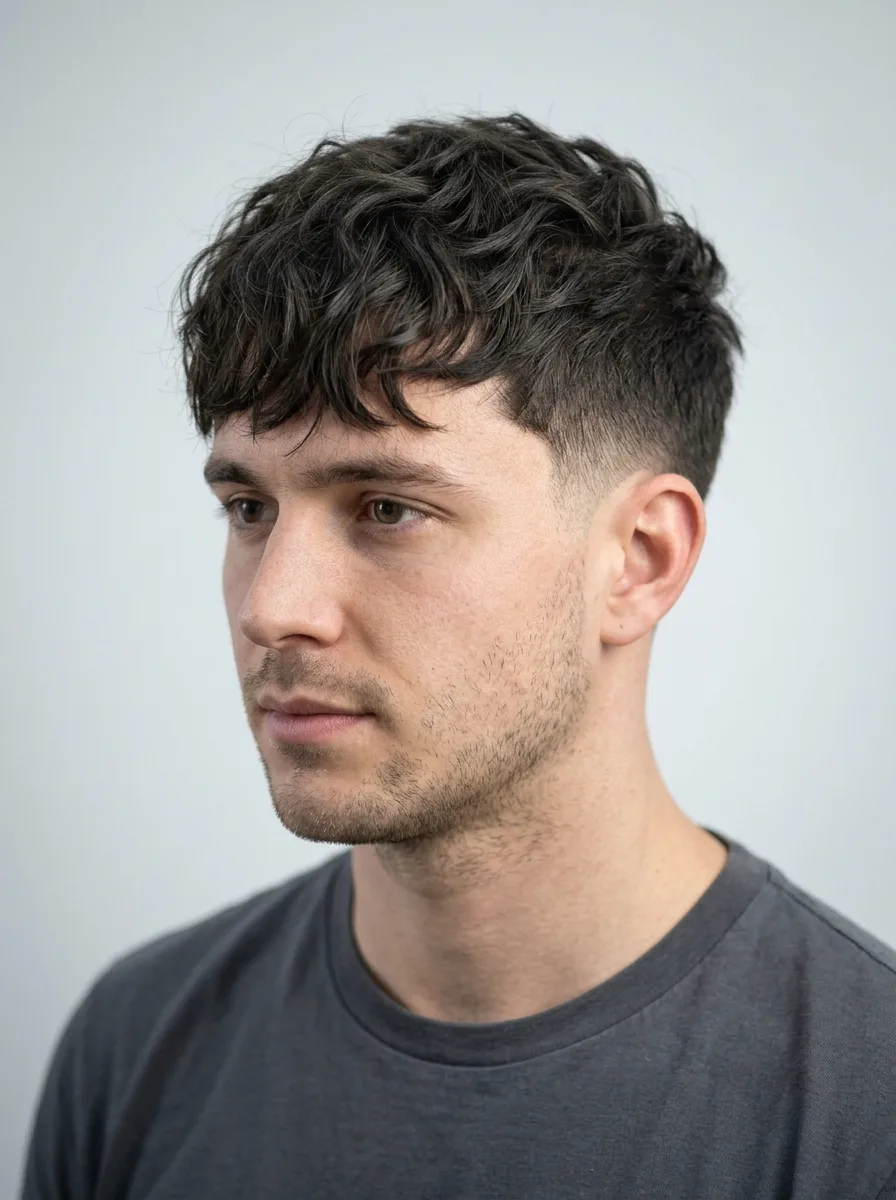
Same cut as the textured crop, styled looser. Ask for a soft taper instead of a sharp fade, so the sides match the relaxed top.
Curly French crop
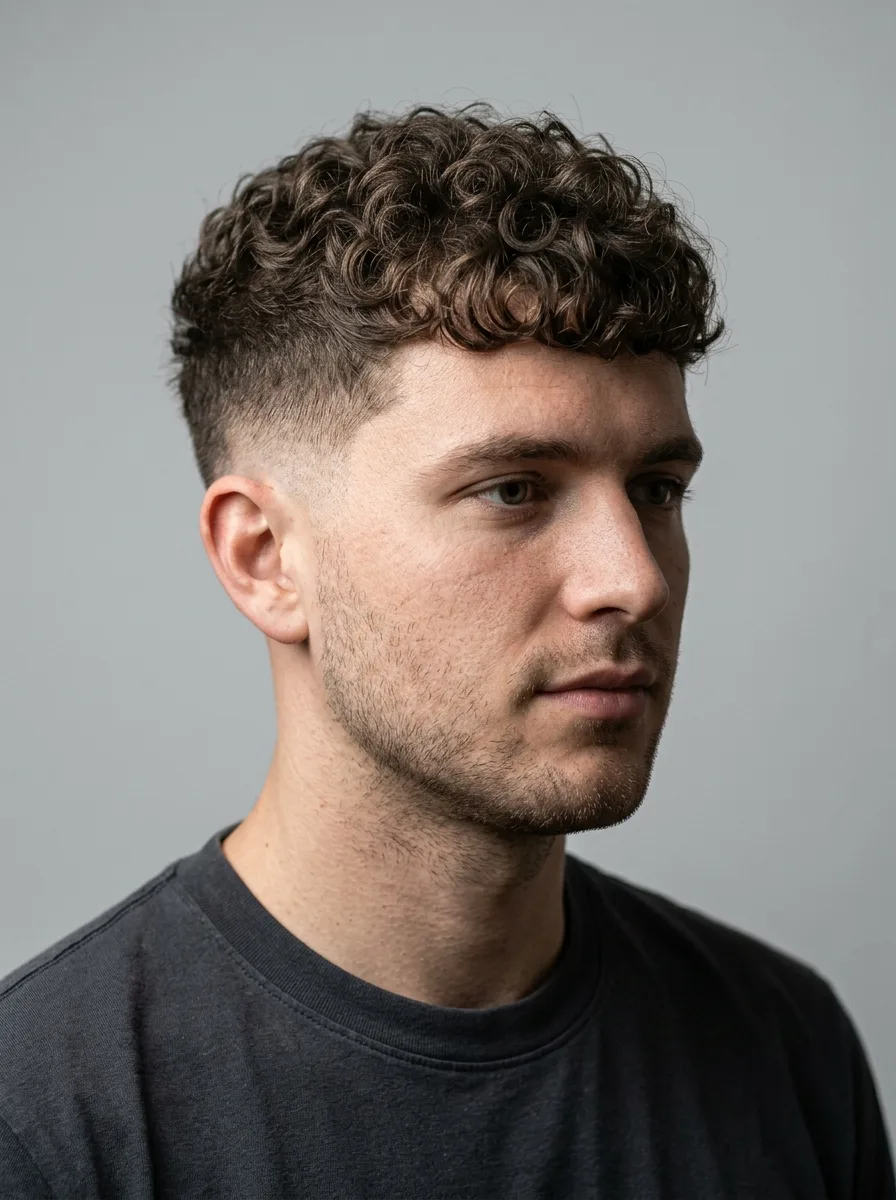
Curls shrink as they dry, so the barber should cut the fringe longer than the target or cut it dry. Ask for the curls to be shaped, not thinned. Thinning shears make curls frizz.
Disconnected French crop

The sides are clipped very short and not blended into the top, so the top sits like a cap with a hard edge. It looks sharp on thick hair and thin on fine hair, because fine hair cannot fill the weight line.
French crop haircut fade options: low, mid, high, taper or skin
A low taper is the safest pairing, a mid fade is the most popular, and a high skin fade is the boldest. The fade does not change the top. It changes how much contrast sits under it and how often you need a cut.
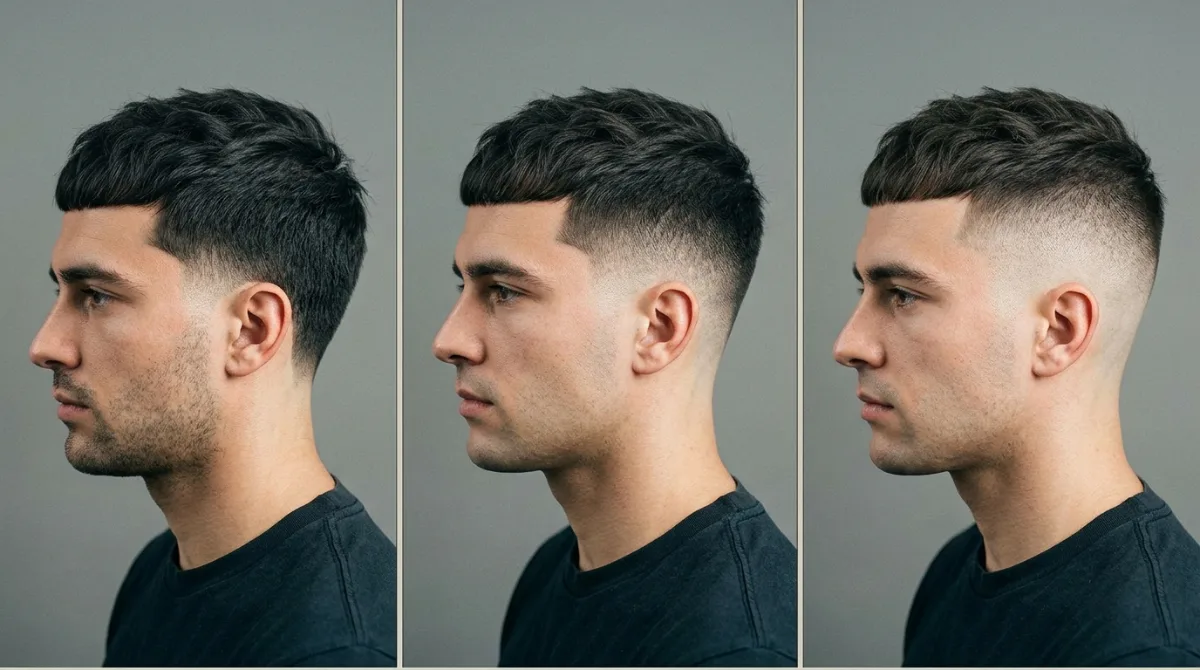
| Sides | Where it starts | Typical guards, bottom to top | Look | Recut |
|---|---|---|---|---|
| Low taper | Sideburns and neckline only | #1 into #3 | Natural, office-safe | 4 to 6 weeks |
| Low fade | Just above the ear | #0.5, #1, #2 | Clean, subtle | 3 to 4 weeks |
| Mid fade | Temple height | #0.5, #1, #2 | Balanced, modern | 3 weeks |
| High fade | Above the temple, near the parietal ridge | #0, #1, #2 | Sharp, strong contrast | 2 to 3 weeks |
| Skin fade | Any height, shaved to skin at the bottom | Foil or #0, then #0.5, #1 | Sharpest, shows scalp | 2 weeks |
| Drop or burst fade | Curves down behind the ear | #0.5, #1, #2 | Adds shape at the back | 3 weeks |
| Scissor taper | No clippers | Scissor over comb | Soft, grown-in | 5 to 6 weeks |
Two rules keep the proportions right. First, the higher the fade, the more top length you need, or the cut starts to look like a cap. Second, fine or thinning hair looks fuller with a low fade, because a high skin fade makes the top look sparse by comparison.
Not sure which height suits your head shape? Our low fade vs mid fade vs high fade comparison breaks down all three. If you want the sides tight but not shaved, read the high taper fade guide.
Clipper guard numbers for a French crop haircut
Guard numbers only apply to the sides and back. The top of a French crop haircut is cut with scissors, so ask for it in inches or centimetres, not a guard.

| Guard | Length (mm) | Length (in) | Where it is used on a French crop haircut |
|---|---|---|---|
| #0 | 0.5 to 1.5 | Under 1/16 | Bottom of a skin or high fade |
| #0.5 | 1.5 | 1/16 | Start of most low and mid fades |
| #1 | 3 | 1/8 | Middle of the fade |
| #1.5 | 4.5 | 3/16 | Blending step between #1 and #2 |
| #2 | 6 | 1/4 | Top of the fade, or the whole side on a taper |
| #3 | 10 | 3/8 | Classic taper, no scalp showing |
| #4 | 13 | 1/2 | Soft sides on a long French crop |
Lengths vary by a millimetre or so between clipper brands. To see what a #2 looks like before you commit the sides to it, see the 2 guard buzz cut guide.
What to tell your barber for a French crop haircut
Say five things in this order: top length, fringe position, sides, texture, neckline. “French crop” on its own is not enough, because one barber hears a Caesar and the next hears an Edgar.
- Top length. “About an inch and a half on top, scissor cut.”
- Fringe position. Point to the spot. “Fringe ends here, a finger above my eyebrows.”
- Sides. Give the height and the lowest guard. “Mid fade, starting from a half guard.”
- Texture. “Point cut the top so it is choppy, not blunt.”
- Neckline. “Tapered at the back.”
Bring two photos, one from the front and one from the side. The front shows the fringe. The side shows the fade height. A single front photo leaves the barber guessing half the haircut.
Barber scripts you can read out
Textured French crop with a mid fade (the default).
“Textured French crop, please. An inch and a half on top, point cut for texture. Choppy fringe pushed forward, ending a finger above my eyebrows. Mid fade from a half guard up to a two. Tapered neckline.”
Classic French crop for the office.
“Classic French crop. About an inch on top, kept neat. Straight fringe at mid-forehead. Low taper with a two on the sides, no skin showing. Natural tapered neckline.”
Short French crop with a skin fade.
“Short French crop. Three quarters of an inch on top with light texture. Short straight fringe. High skin fade blended up to a one and a half. Line up the front, but keep my natural hairline.”
Curly French crop.
“French crop that keeps my curls. Leave about two and a half inches on top when stretched, and shape the curls forward into a fringe. Please cut the fringe dry. Low fade from a one. No thinning shears.”
Receding hairline or thin on top.
“Textured French crop, a bit longer on top, around two inches. Soft, broken fringe, not a straight line. Low taper with a two, and keep some weight at the temples.”
How to describe the fringe position
Use landmarks on your own face instead of inches. A barber can hit a landmark every time.

| Say this | Where the fringe ends | Effect |
|---|---|---|
| “High fringe” | Upper third of the forehead | Bold, close to a Caesar, shows the full forehead |
| “Mid-forehead” | Halfway between hairline and brows | The standard French crop haircut |
| “A finger above the brows” | About 0.5 in (1.5 cm) above the eyebrows | Softer, covers a high forehead |
| “At the brows” | Touching the eyebrows | Long French crop, needs a trim every 3 weeks |
If it is your first crop, ask for the fringe one step longer than you think you want. A barber can take more off in thirty seconds. A fringe that is too short takes about a month to come back.
Will a French crop haircut suit you?
A French crop haircut suits most face shapes and hair types, as long as you adjust the fringe and the fade. The men it works against are those with a strong cowlick at the front hairline, and those who dislike hair on their forehead.
By face shape
| Face shape | Best version | Avoid |
|---|---|---|
| Oval | Any. Start with a textured crop and mid fade | Nothing in particular |
| Round | Textured top with a little height, mid or high fade, choppy fringe | A heavy, straight fringe that widens the face |
| Square | Classic or textured, low or mid fade | A blunt fringe plus a skin fade together, which is too hard-edged |
| Long or oblong | Long French crop, fringe near the brows, low taper | High fades and extra height on top |
| Heart | Soft, fuller fringe with a low fade | Shaved temples that widen the forehead |
| Diamond | Textured crop with some width at the sides, low taper | Very tight high fades |
By hair type
| Hair type | Verdict | What to ask for |
|---|---|---|
| Straight | Ideal | Point cutting, or it lies flat like a helmet |
| Wavy | Ideal | 1.5 to 2.5 in on top so the wave bends forward |
| Curly or coily | Works with more length | A dry-cut fringe and no thinning shears |
| Thick | Very good | Weight removed inside the top, not from the fringe edge |
| Fine | Good | A short, compact top with a low fade and light texturing only |
| Thinning on top | Good | Forward styling, matte product, low fade to reduce contrast |
Receding hairline, high forehead and cowlicks
A French crop haircut is one of the better cuts for a receding hairline, because the hair is styled forward over the temples instead of swept back from them. Keep the fringe soft and broken. A hard straight line draws a ruler across the exact area you want to blur.
For a high forehead, bring the fringe down to a finger above the brows. For a low forehead, go the other way and keep the fringe short, or the face looks closed in.
A front cowlick is the one real obstacle. If your fringe grows straight up or hard to one side, leave it at least 2 inches long so its weight holds it down, and blow-dry it forward. If it still stands up, a crew cut will suit you better.
With a beard or glasses
A beard balances the fringe by adding weight to the lower face. Fade the sideburns into the beard so there is no step at the ear. With glasses, keep the fringe clear of the frames, at mid-forehead or higher, so the two lines do not stack on top of each other.
How to style a French crop haircut in 2 minutes
Dry the hair forward, add a small amount of matte product, and break up the fringe with your fingers. The cut does most of the work, so the routine is short.
- Towel-dry until the hair is damp, not wet.
- Blow-dry on low heat, pushing the hair forward from the crown to the fringe with your fingers. This takes about 60 seconds and sets the direction for the day.
- Rub a pea-sized amount of matte clay or paste between your palms until it disappears.
- Work it in from the back to the front, roots first. Starting at the fringe leaves a greasy clump at the front.
- Pinch and twist a few pieces of the fringe to separate them. Stop there.
| Hair type | Product | Why |
|---|---|---|
| Fine or thinning | Texture powder or sea salt spray | Adds grip and volume without weight |
| Straight, medium | Matte clay | Hold and separation with no shine |
| Thick | Matte paste or fibre | Strong enough to control bulk |
| Wavy | Sea salt spray, then a little cream | Keeps the wave, cuts frizz |
| Curly or coily | Curl cream or leave-in conditioner | Defines curls and keeps them soft |
Skip gel and high-shine pomade. They glue the fringe into stiff strips and show the scalp through fine hair.
French crop haircut maintenance: a week-by-week timeline
Plan on a French crop haircut every 3 to 4 weeks with a fade and every 4 to 6 weeks with a taper. Scalp hair grows about 1 cm a month, a little under half an inch, according to InformedHealth.org on the NCBI Bookshelf. On a cut this short, you notice that quickly.
| Week | What you will notice | What to do |
|---|---|---|
| 1 | The sharpest it will look. A skin fade is at its cleanest | Nothing. Style as usual |
| 2 | Skin fades start to blur. The fringe is about 1/4 in lower | Skin fade wearers: book a tidy-up |
| 3 | Neckline and around the ears look fuzzy. The fringe has dropped 3/8 in | Ask for a sides-only clean-up if your shop offers one |
| 4 | The fringe is half an inch longer and may touch the brows | Full cut for fades |
| 5 to 6 | Sides puff out, the top loses its shape | Full cut for tapers and scissor cuts |
| 7 and later | It has become a loose textured fringe | Recut, or keep growing it on purpose |
Between cuts, leave the fringe alone. Trimming your own fringe is the most common way a French crop haircut gets ruined at home, because hair cut wet springs up shorter once it dries.
Growing into a French crop haircut from a buzz cut
You need about 1 inch on top for the shortest French crop haircut and 1.5 inches for a textured one. Starting from a #2 buzz (1/4 in), these are the waiting times at average growth.
| Target cut | Top length needed | Wait from a #2 buzz |
|---|---|---|
| Short French crop | 0.75 to 1 in | 4 to 6 weeks |
| Classic French crop | 1 to 1.5 in | 6 to 10 weeks |
| Textured French crop | 1.5 to 2 in | 10 to 14 weeks |
| Long French crop | 2 to 3 in | 14 to 22 weeks |
While you wait, keep the sides tidy with a low taper every 3 to 4 weeks and tell the barber not to touch the top. The grow-out then looks like a deliberate crew cut instead of a neglected buzz.
Common French crop haircut problems and how to fix them
Most bad French crops come from one of six mistakes, and all but one can be fixed at the next visit. The exception is a fringe cut too short, which only time fixes.
| Problem | Cause | Fix |
|---|---|---|
| Fringe too short | You asked for “short” without pointing to a spot | Wait 3 to 4 weeks. Style it slightly to the side until then |
| Helmet or bowl look | Blunt top with no texture, or a heavy weight line over a high fade | Ask for point cutting and for the weight line to be blended |
| Fringe sticks up | Front cowlick, or the fringe is too short to hold itself down | Grow it to 2 in and blow-dry forward. Use a touch of cream, not clay |
| Looks flat by midday | Too much product, or a shiny product | Halve the amount. Switch to powder or sea salt spray |
| Top looks thin | Over-thinned with texturizing shears, or a skin fade on fine hair | Let it grow 4 weeks. Next time ask for a low taper and “no thinning” |
| Fringe splits in the middle | Natural parting at the front, air-dried | Blow-dry forward and slightly across the split |
If the cut is wrong on the day, say so before you leave the chair. A weight line, a missed blend or a heavy corner takes a barber two minutes to correct while you are still caped.
French crop haircut FAQs
What guard number is a French crop haircut?
There is no single guard, because the top is cut with scissors. Guards apply to the sides only. Most French crops use a #0.5 to #2 fade, or a #2 to #3 taper. Ask for the top in inches, usually 1 to 2, and the sides by guard number.
How long does your hair need to be for a French crop haircut?
You need about 1 inch (2.5 cm) on top for a short French crop and 1.5 to 2 inches for a textured one. The sides can be any length, since they get clipped down. From a #2 buzz cut, that is roughly 6 to 14 weeks of growth.
Is a French crop haircut the same as a Caesar cut?
No. A Caesar is one short, even length on top with a very short, straight fringe, and it is often cut with clippers. A French crop haircut keeps more length on top, adds texture with scissors, and has a longer fringe that can be blunt or choppy.
What is the difference between a French crop haircut and an Edgar cut?
An Edgar has a heavier, flatter top, a razor-straight fringe with a sharp line-up, and usually a high skin fade. A French crop haircut is softer. The top is textured, the fringe can be broken up, and the sides can be anything from a scissor taper to a fade.
Is a French crop haircut good for a receding hairline or thinning hair?
Yes, in most cases. The hair is styled forward, which covers the temples, and a matte textured finish makes hair look denser. Choose a soft, broken fringe and a low taper. A straight blunt fringe and a high skin fade both make recession more obvious.
Can you get a French crop haircut with curly hair?
Yes. Keep 2 to 3 inches on top when stretched, have the fringe cut dry or left longer to allow for shrinkage, and pair it with a low or mid fade. Ask the barber to shape the curls with scissors and to skip thinning shears.
How often should you get a French crop haircut?
Every 2 to 3 weeks with a skin fade, every 3 to 4 weeks with a regular fade, and every 4 to 6 weeks with a taper or scissor cut. The fringe grows about half an inch a month, so it needs a trim at least that often.
Is a French crop haircut professional enough for work?
Yes. The classic version, with about an inch on top, a mid-forehead fringe and a #2 or #3 low taper, is as conservative as a crew cut. Skin fades, disconnected sides and very blunt fringes read as more casual.
Can you get a French crop haircut without a fade?
Yes. Ask for a scissor taper or a #3 to #4 on the sides. The cut looks softer and more grown-in, and it lasts 5 to 6 weeks between visits instead of 3.
The short version
A French crop haircut is four decisions: top length, fringe position, side fade and texture. For a first one, ask for a textured French crop with 1.5 inches on top, a choppy fringe a finger above the brows, and a low or mid fade starting from a #0.5. Then adjust one thing at a time at the next visit.
Still choosing the sides? Compare them in low fade vs mid fade vs high fade, then save the barber script above to your phone before your appointment.
Pingback: Hair Trends 2027 for Men: 12 Short Cuts Barbers Expect
Pingback: Hairstyles for Older Men: 20 Best Cuts for 50+ & Grey Hair
Pingback: Haircuts for Thick Wavy Hair Men: 17 Best Cuts by Wave Type