
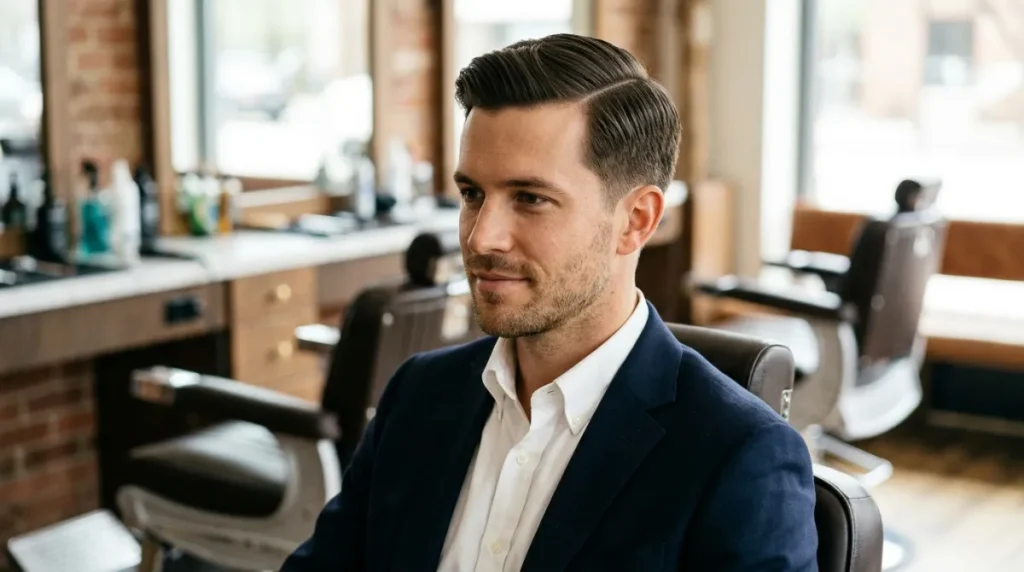
A gentleman haircut is a short-to-medium men’s cut with tapered back and sides, a top long enough to comb (usually 1.5–3 inches), and clean edges around the ears and neck. It is worn with a side part, a comb-over or brushed back.
No single shape defines it. Proportion and tidiness do: a good gentleman haircut looks sharp the day you get it and still looks deliberate three weeks later.
This guide shows the 9 classic versions, which one suits your hair and face, and the word-for-word script to read to your barber for each one.
Quick answer — what to tell your barber: “A classic gentleman’s cut. Scissor-over-comb or a #3 taper on the back and sides, low, no skin. Leave about 2 inches on top so I can side-part it. Tapered neckline, light texturizing only.”
Table of Contents
What Is a Gentleman Haircut?
A gentleman haircut is any classic men’s cut built on four elements: tapered sides, a combable top, a defined direction (usually a part) and clean edges. If a cut has all four, it qualifies, whether it is short and matte or longer and slicked.
| Element | What it means | Typical spec |
|---|---|---|
| Sides and back | Graduated shorter toward the ears and neck | #2–#4 guard or scissor-over-comb; low taper |
| Top | Long enough to comb and hold a direction | 1.5–3 inches (4–8 cm); 4–5 inches for a slick back |
| Direction | A side part, comb-over or brushed back | Natural part, or a shaved hard part |
| Edges | Clean around the ears, sideburns and neckline | Tapered, blocked or rounded neckline |
The style took shape in the 1920s–1950s, when men wore short sides under hats and controlled the top with pomade. It faded in the long-hair decades, survived in rockabilly circles and came back as the default “smart” cut for offices, weddings and interviews (see this gentleman’s cut history from L’Oréal Paris).
Gentleman Haircut vs Side Part vs Ivy League vs Crew Cut
“Gentleman haircut” is the umbrella. The side part, Ivy League and slick back are versions of it; the crew cut is its shorter cousin. The difference is mostly top length and whether you can part it.
| Cut | Top length | Sides | Can you part it? | How it differs |
|---|---|---|---|---|
| Gentleman haircut | 1.5–3 in | Low taper or scissor | Yes | The broad category |
| Classic side part | 2–3 in | Low taper | Yes, the part is the point | A gentleman cut where the part defines the look |
| Ivy League | 1–2 in, longest at front | Short taper, #2–#3 | Yes, a short part | A crew cut grown just long enough to part |
| Crew cut | 0.5–1.5 in | #1–#3 taper | No | Too short to part; brushed up or forward |
| Slick back | 4–6 in | Longer taper, no undercut | No part, combed back | Needs more top length and more product |
| Pompadour | 3–5 in with front volume | Taper or fade | Optional | A gentleman cut only when volume stays controlled |
Barber Terms to Know Before Your Gentleman Haircut
Most bad haircuts are a vocabulary problem. Learn these six terms and your barber will cut what you picture.
- Taper vs fade: A taper shortens hair gradually and keeps some length at the bottom. A fade goes down to very short or bare skin. Gentleman cuts use a taper by default — our low taper fade guide shows the difference up close.
- Low / mid / high: Where the shortening starts. Low begins just above the ear; high begins near the temple. Low keeps the look classic (compare all three in low vs mid vs high fade).
- Scissor-over-comb: Sides cut with scissors, not clippers. Softest finish, takes longer, grows out best.
- Hard part vs natural part: A hard part is a line shaved with a trimmer. A natural part is just combed in.
- Neckline: Tapered (fades into the neck, grows out cleanly), blocked (square line, looks sharp but grows out fast) or rounded (softened corners).
- Texturizing / point cutting: Removes bulk without losing length. Ask for “bulk only” so the front is not thinned out.
Clipper Guard Numbers (Standard Wahl/Andis Sizing)
Guard numbers are the fastest way to get the exact length you want. Use this chart when you read your script.
| Guard | Length (inches) | Length (mm) | Use in a gentleman haircut |
|---|---|---|---|
| #0.5 | 1/16 | 1.5 | Neckline clean-up only |
| #1 | 1/8 | 3 | Bottom of a mid taper |
| #2 | 1/4 | 6 | Bottom of a low taper; short sides |
| #3 | 3/8 | 10 | Classic side length |
| #4 | 1/2 | 13 | Fuller, softer sides |
| #6 | 3/4 | 19 | Upper sides on a slick back |
| #8 | 1 | 25 | Blending into a longer top |
Rule of thumb: ask for one guard longer than you think. Your barber can always take more off.
9 Classic Gentleman Haircut Styles (With Barber Scripts)
Each gentleman haircut style below has who it suits, daily effort and a script you can read out loud or show on your phone.
1. Classic Side Part With a Low Taper
The default gentleman haircut and the safest first choice. It works for straight and wavy hair, most face shapes and any dress code.

- Best for: Medium-to-thick straight or wavy hair; offices and formal events
- Daily effort: Low–medium (cream or matte paste, 3 minutes)
Barber script: “Classic side part. #3 on the sides and back, low taper down to a #1 at the neckline — no skin. Leave 2 to 2.5 inches on top, a bit longer at the front. Use my natural part, don’t shave a line. Tapered neckline, clean around the ears.”
2. Scissor-Over-Comb Gentleman Cut
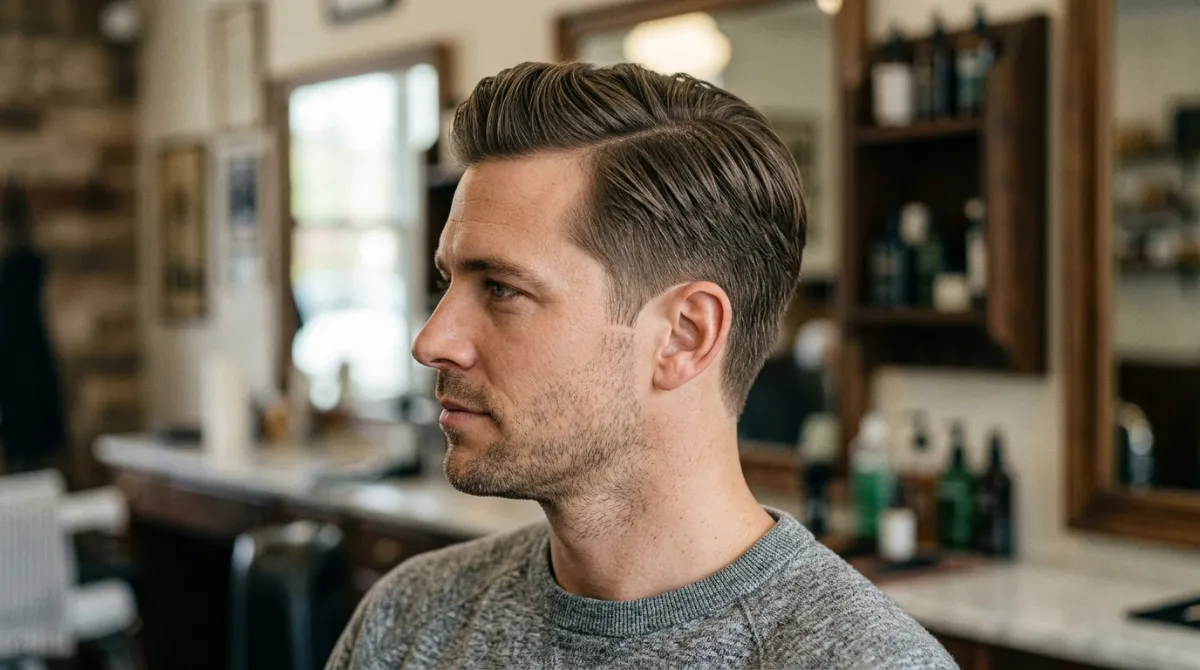
No clippers on the sides, so there is no visible line at any point. It is the most traditional version and grows out the most gracefully.
- Best for: Men who want a soft, mature look; anyone who goes 5–6 weeks between cuts
- Daily effort: Low
Barber script: “All scissor-over-comb on the back and sides, about half an inch at the sides. Taper it to my natural hairline at the back. Leave 2.5 inches on top and blend it into the sides — no visible line. Tapered neckline.”
3. Hard Part Gentleman Haircut
A side part with a thin shaved line and a slightly shorter side. It looks sharper in photos but needs a touch-up every 2–3 weeks because the line blurs fast. For more shaved-line ideas, see our haircut with a line on the side guide.

- Best for: Thick, straight or wavy hair; men who like a crisp look
- Daily effort: Medium
Barber script: “Low-to-mid taper starting at a #2 above the ear. Keep 2 inches on top. Shave a thin hard part along my natural parting line, and stop it before the crown.”
Avoid a hard part on fine or thinning hair: the shaved line shows scalp and makes the top look sparser.
4. Modern Comb-Over With a Mid Taper
More contrast on the sides and more height at the front than a classic side part. It reads modern but still formal. Want even more contrast? Our high taper fade guide shows how far up the sides can go before the look stops being “classic”.

- Best for: Thick hair; round or oval faces that benefit from height
- Daily effort: Medium (blow-dry needed)
Barber script: “Mid taper starting at a #2, blended up to a #4 at the top of the sides. Leave 3 inches at the front, 2 at the crown, so it combs over with some lift. Light texturizing on the top for bulk only.”
5. Gentleman Slick Back
The old-Hollywood version: longer top combed straight back with a soft taper. It is the most formal option and the most product-dependent.

- Best for: Thick straight or wavy hair; oval, square and oblong faces
- Daily effort: Medium–high
Barber script: “Keep 4 to 5 inches on top, longest at the front. Sides at a #4 tapering to a #2 at the bottom — no undercut, I need enough length on the sides to lie flat. Take some bulk out of the crown so it doesn’t stick up.”
6. Ivy League (Harvard Clip)
A short, easy cut: a crew cut left just long enough at the front to part. It is the lowest-effort way to look “put together”.

- Best for: Busy routines, fine hair, receding temples, hot climates
- Daily effort: Low (finger-styled, 1 minute)
Barber script: “Ivy League. #2 on the sides tapering to a #1. Top graduated: about 1.5 inches at the front down to 1 inch at the crown, so I can do a short side part.”
7. Short Gentleman Quiff
A side-swept top with gentle lift at the front. It adds height without the drama of a pompadour. For more volume options, see our full quiff hairstyle for men guide.

- Best for: Fine to medium hair that needs volume; round faces
- Daily effort: Medium
Barber script: “Low taper, #3 to #2. Leave 3 inches at the front and about 2 inches through the crown. Point-cut the front for texture but don’t thin it out — I want lift, not wisps.”
8. Textured Gentleman Crop
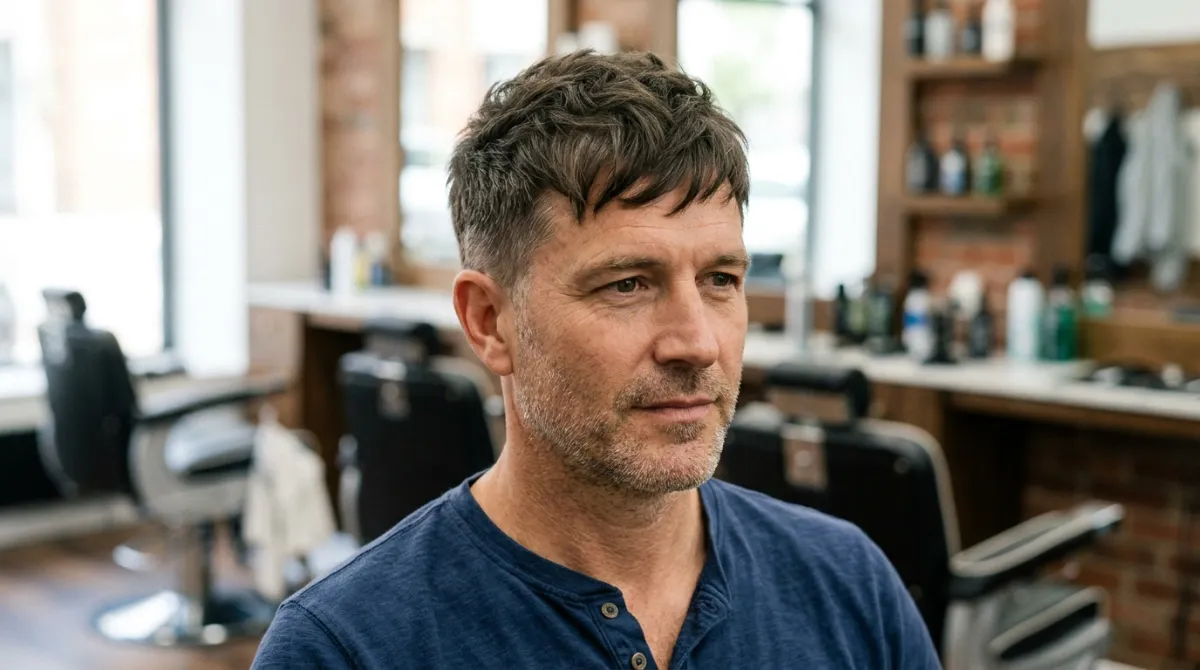
Short, textured top pushed forward or slightly to the side, with a low taper. It hides a receding hairline better than any parted style, and it sits close to the French crop haircut.
- Best for: Thinning or receding hair; very thick hair that won’t lie flat
- Daily effort: Low (matte clay)
Barber script: “Low taper, #3 down to a #1. Top about 1.5 to 2 inches, cut with texture and pushed slightly forward and to the side. Soft, uneven fringe — no blunt line, no part.”
9. Gentleman Haircut for Curly and Afro-Textured Hair
Keep the curls on top, taper the sides tight and shape a clean outline. The “gentleman” comes from the edges and proportions, not from forcing a side part.

- Best for: Curly (3a–3c) and coily (4a–4c) hair
- Daily effort: Low–medium (leave-in conditioner + curl cream)
Barber script: “Keep 1.5 to 2 inches of curl on top, shaped rounder at the front. Low taper on the sides from a #2 down to a #1. Natural line-up at the temples — don’t push the hairline back. Tapered neckline.”
If you want a part on coily hair, ask for a subtle hard part — a combed part will not hold.
Best Gentleman Haircut for Your Face Shape
The goal is balance: add height to short or round faces, keep it flatter on long faces, and soften strong angles only if you want to. Use this table, then confirm with your barber in person. For every cut type, see our full men’s haircuts for your face shape guide.
| Face shape | Best versions | Avoid | Why |
|---|---|---|---|
| Oval | Any — side part, slick back, quiff | Very heavy fringe | Balanced proportions take every style |
| Round | Modern comb-over, short quiff, hard part | Full sides, flat top, rounded crop | Height on top and tight sides lengthen the face |
| Square | Classic side part, slick back, scissor-over-comb | Very high fades | Strong jaw already gives structure; keep sides soft |
| Oblong / long | Classic side part, textured crop, Ivy League | Tall quiffs and pompadours | Extra height makes the face look longer |
| Heart / triangle (narrow chin) | Scissor-over-comb, side part with fuller sides | High tight fades | Fuller sides balance a wide forehead; a beard helps |
| Diamond | Textured crop, side part with soft fringe | Slick back with flat sides | A little forehead coverage softens wide cheekbones |
Best Gentleman Haircut for Your Hair Type
Hair type decides what will actually hold at home, so weigh it as heavily as face shape. This is the factor most guides skip.
| Hair type | Best version | Ask the barber for | Product |
|---|---|---|---|
| Straight, fine | Ivy League, short quiff | Little or no thinning; blunt-ish ends for density | Light matte paste or powder |
| Straight, thick | Hard part, slick back, comb-over | Bulk removal through the crown and sides | Water-based pomade or cream |
| Wavy | Classic side part, slick back | Leave 0.5 inch extra on top; waves shrink when dry | Light cream or sea-salt pre-styler |
| Curly (3a–3c) | Style 9, or a loose side-swept cut | Cut dry if possible; no clipper on top | Curl cream + light gel |
| Coily (4a–4c) | Style 9 with a low taper | Natural line-up; avoid harsh hairline push-back | Leave-in + curl sponge or soft cream |
| Thinning or receding | Textured crop, Ivy League | Shorter top, no hard part, texture forward | Matte clay; avoid shiny pomade |
| Grey or white, coarse | Scissor-over-comb, classic side part | Slightly longer sides to soften wiry texture | Light cream; purple shampoo weekly if yellowing |
If thinning is your main concern, our guide to hairstyles for balding men covers more options.
How to Style a Gentleman Haircut at Home (5 Minutes)
Start with damp hair, blow-dry the direction in, then add product. Most “my cut looks bad at home” problems come from skipping the blow-dry or using too much product.
- Towel-dry to damp. Not wet, not dry.
- Add a pre-styler. A pea-size cream or 2–3 sprays of sea salt spray for grip.
- Blow-dry the direction. Use a comb or brush to push hair away from the part on medium heat. This sets 80% of the style.
- Apply product back to front. Warm a pea-size amount in your palms, start at the crown, finish at the front. This avoids a greasy fringe.
- Set the part. Line it up with the arch of your eyebrow, comb the small side down and the big side across or back.
Best Products for a Gentleman Haircut
Pick the product by the finish you want, not by the brand.
| Finish you want | Product | Hold | Best for |
|---|---|---|---|
| Wet-look shine | Pomade (water-based) | Medium–strong | Slick back, hard part |
| Natural, soft | Cream | Light | Classic side part, wavy hair |
| Matte texture | Clay | Strong | Crop, quiff, thinning hair |
| Flexible, low-shine | Paste | Medium | Comb-over, Ivy League |
| Defined curls | Curl cream + light gel | Light–medium | Curly and coily hair |
Styling in Hot and Humid Climates
Pick water-based pomade or clay over oil-based products. Oil-based pomade melts in heat and is hard to wash out. Blow-dry fully — damp roots collapse in humidity within an hour.
Gentleman Haircut Maintenance and Grow-Out Timeline
Most gentleman cuts need a trim every 3–4 weeks. Hair grows about half an inch (1.25 cm) a month, and the taper around the ears loses shape first.
| Time since cut | What you’ll notice | What to do |
|---|---|---|
| Week 1 | Sides look tight; top may feel stiff | Use less product than you think |
| Week 2 | Best-looking week; hard parts start to blur | Normal styling |
| Week 3 | Hair touches the ear tops; neckline fuzzy | Book the next cut; tidy only the neckline at home |
| Week 4 | Taper gone; sides puff out | Trim due for most styles |
| Week 5–6 | Shape is lost | Only scissor-over-comb and slick back still pass |
| Style | Trim every |
|---|---|
| Hard part, Ivy League | 2–3 weeks |
| Classic side part, comb-over, quiff, crop, curly taper | 3–4 weeks |
| Scissor-over-comb, slick back | 4–6 weeks |
Between cuts, you can tidy the neckline below the taper with a trimmer. Never touch the taper itself — that is how home touch-ups turn into a buzz cut.
7 Mistakes That Ruin a Gentleman Haircut
Every one of these is avoidable with one sentence to your barber.
- Saying “short on the sides”. You get a high fade. Say “#3, low taper, no skin” instead.
- Over-thinning the top. It looks great on day 1, then goes puffy and flat. Ask for “bulk only, don’t thin the front.”
- A hard part on fine hair. The line shows scalp. Use a natural part.
- A blocked neckline on an uneven hairline. It grows out messy in a week. Choose tapered.
- Ignoring the crown cowlick. Tell the barber where it is so they leave weight there.
- Shiny pomade on thinning hair. Shine shows scalp. Switch to matte clay.
- Haircut and beard done separately. The sideburn ends up disconnected. Ask for one blend from hair to beard.
Got a bad cut? Wait 10–14 days, then ask for a scissor clean-up. Asking for more clipper work on day 1 usually makes it shorter, not better.
Pairing a Gentleman Haircut With a Beard
Match the contrast: a soft taper goes with stubble or a short boxed beard; a sharper fade can carry a fuller beard. The sideburn is the bridge, so ask for it to be blended from your side length (e.g. #3) down to your beard length (e.g. #2) with no step. Our beard styles for your face shape guide helps you pick the beard first.
| Haircut | Beard that suits it |
|---|---|
| Scissor-over-comb, classic side part | Clean-shaven, light stubble, short boxed beard |
| Hard part, comb-over | Short boxed or medium beard with a sharp cheek line |
| Slick back | Full beard, kept tidy and shaped at the neck |
| Textured crop, Ivy League | Heavy stubble |
| Curly taper | Lined-up short beard |
The Universal Gentleman Haircut Barber Script (Screenshot This)
Fill in the blanks before your appointment, and show it with three photos of the look you want: front, side and back.
I’d like a classic gentleman’s cut.
Sides and back: [scissor-over-comb / #__ guard], [low / mid] taper, [no skin / skin at the bottom].
Top: about [__] inches, longer at the front.
Part: [natural / hard part] on my [left / right].
Neckline: [tapered / blocked / rounded].
Texture: remove bulk only — don’t thin the front.
Beard: blend the sideburn into my beard at a #__.
Before you leave the chair, ask three questions: “What product did you use?”, “How do I style this in 5 minutes?” and “When should I come back?” Then take a photo of the finished cut for next time.
Gentleman Haircut FAQs
Is a gentleman haircut the same as a side part?
Not exactly. The side part is the most common version of a gentleman haircut, but the term also covers the slick back, Ivy League, comb-over and textured crop. What they share is tapered sides, a combable top and clean edges. So every classic side part is a gentleman haircut, but not every gentleman haircut has a part.
How long does my hair need to be for a gentleman haircut?
You need at least 1.5 inches on top for the shortest version (Ivy League) and about 2–3 inches for a classic side part. A slick back needs 4–5 inches. Hair grows roughly half an inch a month, so from a buzz cut expect about 6–8 weeks before a barber can shape a side part.
Should I get a taper or a fade with a gentleman haircut?
Choose a taper for a classic, office-friendly look that grows out cleanly. Choose a fade if you want more contrast and don’t mind a trim every 2–3 weeks. For a first gentleman haircut, a low taper with a #2–#3 at the bottom is the safest choice.
Does a gentleman haircut work for curly or afro-textured hair?
Yes. Keep 1.5–2 inches of curl on top, taper the sides low and get a natural line-up. The cut looks “gentleman” because of its clean edges and balanced shape, not because of a part. If you want a part on coily hair, a subtle shaved part holds better than a combed one.
Is a gentleman haircut good for thinning hair or a receding hairline?
It can be, if you choose the right version. A textured crop or Ivy League hides recession best because the short, forward-moving top covers the temples. Avoid hard parts and shiny pomade, which both show scalp. Use matte clay and keep the top a little shorter.
How often should I get a gentleman haircut trimmed?
Every 3–4 weeks for most versions. Hard parts and Ivy League cuts need 2–3 weeks to stay crisp. Scissor-over-comb cuts and slick backs can stretch to 5–6 weeks because they have no sharp lines to blur.
Which side should I part my hair on?
Use your natural part. Comb wet hair straight back, then push it forward from the crown with your palm; it will split where your part naturally falls. Fighting your natural part or crown cowlick means the hair will lift by midday.
Is a gentleman haircut appropriate for a job interview or wedding?
Yes — it is the most widely accepted formal men’s cut. Get it trimmed 5–7 days before the event, not the day before, so the edges settle and any small mistakes have time to soften.
Conclusion: Choose the Gentleman Haircut That Fits Your Routine
The best gentleman haircut is the one that fits your hair type and your real morning routine, not just the photo. Pick your version from the 9 above, fill in the universal script and give your barber exact numbers instead of “a little off the sides.”
Next step: if you want more height on top, read our quiff hairstyle for men guide. If you want more contrast on the sides, compare options in our high taper fade guide.