
What Is a Haircut With Line on the Side?
A haircut with line on the side is any cut where the barber shaves a thin, visible line into the hair on the side of the head. It is usually one of three things: a hard part cut along your natural parting, a slit cut into the fade, or a longer design line.
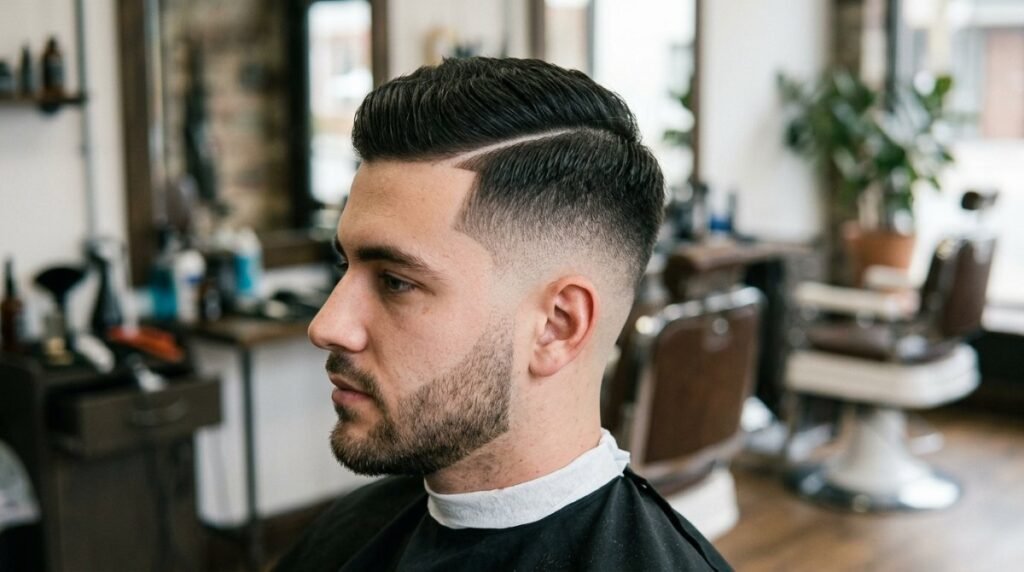
Most men ask for “a line” and leave the rest to chance. That is how you end up with a line that is too wide, too high, or on the wrong side.
This guide to the haircut with line on the side separates the three types, shows 15 ideas, and covers what most style galleries skip: what it costs, how it looks on day 3, day 10 and day 21, and how to grow it out without an awkward month.
Quick answer: for a first line, ask for a low or mid fade with one thin slit near the temple, about the width of a trimmer blade edge. It costs little or nothing extra and is hidden again within three to four weeks.
In this guide
Hard part vs slit vs line-up: which line do you mean?
A hard part follows your parting, a slit sits inside the fade, and a line-up is not a shaved line at all. It is the squared-off edge of your hairline. Barbers use these words differently from city to city, so name the type and point to the spot.

| Type | Where it sits | Typical length | What it does | Grow-out |
|---|---|---|---|---|
| Hard part (shaved part, razor part) | Along the natural side parting, where the top meets the sides | 5 to 10 cm, front hairline towards the crown | Makes a side part or comb over look deliberate | Slowest. The stubble sits between long hair and sticks up |
| Slit (nick, slash) | Inside the fade, usually at the temple or above the ear | 1 to 4 cm | Adds one sharp detail to a plain fade | Fastest. Vanishes into the next fade |
| Design line (surgical line) | Runs through the fade, often curving behind the ear | 8 cm or more | Becomes the main feature of the cut | Medium. Blurs first where the hair is longest |
| Line-up (edge-up, shape-up) | The outer hairline: forehead, temples, sideburns | The whole perimeter | Frames the face with crisp corners | Needs a touch-up every one to two weeks |
The confusion matters because the price, the upkeep and the regret risk are all different. A slit is a low-stakes detail. A hard part changes how you style your hair every morning for a month.
Most good versions of a haircut with line on the side combine two of them: a line-up to sharpen the hairline, plus one hard part or slit.
15 Ideas for a Haircut With Line on the Side
Every haircut with line on the side below is grouped by line type, so you can jump to the kind you want. Each one includes the words to say in the chair.
Hard part ideas
1. Low fade with a thin hard part. The safest office version. The fade stays below the temple and the part is barely wider than a pencil line. Ask for: “Low fade, side part, and shave the part in thin.”

2. Mid fade comb over with a hard part. The classic. The top is swept away from the line, so the line reads as the start of the style. Our low vs mid vs high fade guide helps you pick the fade height first.
3. Skin fade with a tapered razor part. The line is thicker at the front hairline and narrows towards the crown. It looks sharper than an even line and grows out more gracefully.
4. Ivy League with a short hard part. The part runs only 4 to 5 cm back from the hairline. Good for fine or thinning hair, because a full-length part exposes too much scalp.
5. Pompadour with a disconnected hard part. A bold line separates a tall top from tight sides. It needs daily product and a trim every two weeks, so choose it only if you enjoy styling.
6. Afro or waves with a hard part. On coily hair the line shows the strongest contrast of any texture. Keep it thin, because dense hair makes any line look wider than it is.
Slit ideas
7. Taper fade with one temple slit. The beginner pick. One 2 cm diagonal nick near the temple. Ask for: “One short slit at the temple, thin, inside the fade.”
8. High taper fade with a slit. A high taper fade leaves a wide, clean area, which gives a slit room to stand alone without crowding the hairline.

9. Two parallel slits. The “two lines” cut. Spacing decides everything. Ask for at least a trimmer blade’s width between them, or they merge into one fuzzy bar by the second week.

10. Buzz cut with a single slit. With no styling on top, the slit is the whole design. It is also the easiest to maintain, since the full cut takes ten minutes to refresh.
11. Textured crop with a short slash. One short diagonal line at the temple balances a heavy fringe. Keep it under 3 cm so it does not compete with the texture on top.
12. Slit joined to an eyebrow slit. The temple line continues the angle of a cut in the eyebrow. Decide carefully: eyebrow hair grows back far slower than scalp hair.
Design line ideas
13. Burst fade with a curved line. The line follows the arc of the fade around the ear. It works because it repeats a shape the haircut already has.

14. Drop fade with a line behind the ear. Visible from the side and back, almost invisible from the front. A good choice if you want a design that work colleagues rarely see face-on.
15. Surgical line through a skin fade. One long line from the front hairline towards the back of the head. High impact, high upkeep. Bring a photo, because this one cannot be described from memory.
Which line suits you
Plan a haircut with line on the side by your hair first and your face second. Hair type decides whether the line stays crisp. Face shape only decides where it looks best.
By hair type
| Hair type | Best line | Avoid |
|---|---|---|
| Straight, thick | Hard part or double slit | Very wide lines, which look harsh against flat hair |
| Straight, fine or thinning | Short, thin hard part or one low slit | Full-length parts that show the scalp |
| Wavy | Short slit or curved line in a burst fade | Lines placed where the waves will fall over them |
| Curly | Slit or curved line low in the fade | Hard parts, unless you blow-dry and style daily |
| Coily | Thin hard part, temple slit, sharp line-up | Thick lines, which read wider on dense hair |
By face shape
| Face shape | Placement that helps | Why |
|---|---|---|
| Round | Higher slit or hard part with height on top | Adds an angle and draws the eye upward |
| Square | Hard part with a comb over | Echoes a strong jaw |
| Long or oblong | Low slit, low fade, flatter top | A high line stretches the face further |
| Oval | Any placement | Choose by dress code and upkeep |
| Heart | Temple slit, controlled volume | Sharpens the sides without widening the forehead |
Which side should the line go on?
Put a hard part on the side your hair already parts. Comb wet hair straight forward, then push it back and watch where it splits. That is your natural part.
A part cut against your growth pattern will fight you every morning. A slit is more flexible, so place it on the side you prefer in photos.
Two things can override this. A cowlick or scar near the line will be exposed by it. A receding temple makes a temple slit look like more recession, so move the line lower and further back.
What to tell your barber
For any haircut with line on the side, give your barber six details: type, side, position, length, width and finish. “Just give me a line” leaves all six to a guess.

- Type: hard part, slit, or design line.
- Side: left or right, matched to your natural part.
- Position: on the part, at the temple, above the ear, or behind the ear.
- Length: point to where it starts and stops with your finger.
- Width: thin (trimmer edge), medium, or bold.
- Finish: trimmer only, or trimmer plus razor.
The finish is the detail most people miss. A trimmer-only line is softer and kinder to sensitive skin. A razor finish is whiter and sharper, and more likely to cause bumps.
Script for a first line: “Mid fade, and one thin slit on the right temple, about two centimetres, inside the fade. Trimmer only, no razor.”
Script for a hard part: “Side part on the left where my hair splits. Shave the part in thin, and stop it before the crown.”
Ask the barber to mark the line with the trimmer corner or a white pencil and show you in the mirror before cutting. Bring two photos: one of the whole haircut and one close-up of the line.
How much it costs and how long it lasts
On a haircut with line on the side, a single line usually adds about $5 to the bill and five minutes in the chair. It stays sharp for 7 to 14 days and is hard to see after three to four weeks.
What barbers charge
These are examples from published barbershop price lists, not national averages. Prices vary by city and barber, so confirm before you sit down.
| Service | Example price | Source |
|---|---|---|
| Hard part added to a haircut | $5 extra | Taperz Barber Shop, Keller, Texas |
| Simple shaved design added to a cut | $5 and up, about 5 minutes | Booksy listings, Coraopolis, Pennsylvania |
| Detailed design work | $40 and up, about 45 minutes | Booksy listings, Coraopolis, Pennsylvania |
| Hair design or pattern (UK) | £12 to £18 per design | BizHub365 pricing guide, Shildon |
Some barbers include one part in the haircut price and charge only for designs. Ask, “Is one line included?”
The real cost is the upkeep. A line that needs a touch-up every two weeks doubles your barber visits compared with a monthly cut.
The grow-out timeline
Scalp hair grows roughly 1 cm a month, which is about a third of a millimetre a day. That is why a haircut with line on the side fades in stages.

| Day | What the line looks like | What to do |
|---|---|---|
| 1 to 3 | Bright and sharp. A razor-finished line may look slightly red | Keep it clean, skip heavy product on the line |
| 4 to 7 | Still crisp. Dark, dense hair starts to show shadow | Nothing |
| 8 to 14 | Edges soften. Double lines start to close up | Book a touch-up if you want it sharp |
| 15 to 21 | A faint groove rather than a line | Decide: recut it or let it go |
| 22 to 30 | A slit disappears into the next fade. A hard part shows short stubble that sticks up | See the grow-out tips below |
How to grow out a hard part
A slit needs no plan, because the next fade removes it. A hard part does, because the regrowth sits between longer hair.
- Move your part a few millimetres higher so the top hair covers the stubble.
- Use a matte clay or paste and comb the top over the line, not away from it.
- At the next cut, ask the barber to take the sides slightly higher so the old line falls inside the fade.
- Expect six to eight weeks before the stubble is long enough to lie flat.
Risks, aftercare and when to skip the line
The main risks of a haircut with line on the side are razor bumps, a line that widens with every touch-up, and a line that breaks a dress code. All three are avoidable.
Razor bumps and irritation
A razor-finished line is a close shave on skin that is rarely shaved. Curly and coily hair is most prone to bumps, because the cut hair curls back into the skin.
The American Academy of Dermatology advises shaving in the direction the hair grows, rinsing the blade after each pass and using a sharp, clean blade. See its guides on how to shave and preventing razor bumps.
If you bump easily, ask for a trimmer-only line. It is slightly less sharp and far gentler.
The line that keeps getting wider
Every touch-up removes a little hair on each side of the line. After three or four recuts, a thin part becomes a wide stripe.
Let the line grow out fully every third cut. Then have it recut fresh at the original width.
Aftercare for the first three days

- Wash with a mild shampoo and pat the area dry.
- Use an alcohol-free moisturiser or aftershave balm on the line.
- Keep pomade and gel off the fresh line for a day.
- Use sunscreen on a wide line in strong sun. That strip of scalp has never seen daylight.
Skip the line if
- Your school, employer, team or military unit has a grooming rule against shaved designs. Check before you cut, because it takes weeks to hide.
- You have a formal event within two weeks and want the option of a classic look.
- You are changing your fade, top length and beard in the same visit. Add the line next time.
- You cannot get to a barber at least every three weeks.
Do not cut your own line unless you already line up your own hair. A slip of two millimetres takes a month to fix.
Frequently asked questions
What is the line on the side of a haircut called?
It is called a hard part when it follows your natural parting, and a slit, nick or slash when it sits inside the fade. A long line through the fade is a design line or surgical line. A line-up is different: it is the sharpened edge of the hairline, not a shaved line.
What does a haircut with two lines on the side mean?
In almost every barbershop it is only a style choice. There is no single agreed meaning. Symbols in hair can carry local meanings in some schools or neighbourhoods, so if you are unsure, ask your barber what reads as neutral where you live.
How long does a line in a haircut last?
A shaved line looks sharp for 7 to 14 days. By week three it is a faint groove, and by week four a slit is usually gone. Dark, thick, fast-growing hair blurs sooner. A hard part takes six to eight weeks to grow out fully.
How much does it cost to add a line to a haircut?
Many barbers charge about $5 extra for one hard part or simple line, and some include it in the haircut. Detailed designs are priced separately and can cost $40 or more. Always confirm the price before the cut starts.
Does a shaved line grow back normally?
Yes. A line is only hair cut very short, so the follicles are untouched and the hair regrows at its usual rate. Repeated razor irritation in the same spot can cause bumps or dark marks, which is a reason to rest the area between recuts.
Is a hard part unprofessional?
A thin hard part with a low fade is accepted in most offices and reads as a neat side part. Wide lines, double lines and curved designs are more casual. If your workplace has a written grooming policy, check it first.
Can I get a line with a receding hairline or thin hair?
Yes, with care. A haircut with line on the side still works if you keep the line short, thin and low in the fade. Avoid a temple slit beside a receding corner and avoid a long hard part through thin hair, since both expose more scalp.
Final Word on a Haircut With Line on the Side
A haircut with line on the side works when you choose the type on purpose. Pick a slit for a low-risk detail, a hard part for a structured side part, and a design line only if you can keep up the touch-ups.
Start thin, keep it inside the fade, and tell your barber all six details.
Next step: choose the fade that carries your line. Read our low fade vs mid fade vs high fade comparison, or see how a slit sits on a high taper fade. Then save the barber script above to your phone before your next appointment.