
The most iconic 90s men’s hairstyles were curtains, the heartthrob, the Caesar cut, frosted tips, spiky hair, the high top fade, grunge long hair and the Britpop moptop. Most of them are back, with cleaner sides and lighter products.
The 90s were the decade men’s hair split into tribes. Grunge kids grew it out and stopped brushing. Boy bands bleached the tips and gelled them into spikes. Hip-hop took the high top and the cornrow mainstream. And one middle part on a young Leonardo DiCaprio sent half the world’s teenagers to the barber with a magazine cutout.
This guide to 90s men’s hairstyles is built for the barber chair, not just nostalgia. For every cut you get what it looked like then, how it’s worn now, the exact words to say to your barber, and who it suits. If you’ve already read our guide to 80s men’s hairstyles, this picks up where big perms and mullets left off.
Quick answer: If you want one of the 90s men’s hairstyles that works in 2026 for most men, get modern curtains: 4–6 inches on top, a center part, and tapered sides. Short hair or a thinning crown? The Caesar cut is the safer 90s pick.
In this guide
What Defined 90s Men’s Hairstyles? (1990–1999 Timeline)
90s men’s hairstyles moved from leftover 80s volume to long, undone grunge, then to short, gelled, bleached pop hair by the end of the decade. Music drove almost every shift.
The decade didn’t have one look. It had three phases and five tribes, and knowing which one you’re copying makes it much easier to explain to a barber.
| Period | Dominant look | Driven by | Signature cuts |
|---|---|---|---|
| 1990–1992 | Leftover 80s height and shape | Late-80s hip-hop, hair metal fade-out | Flat top, high top fade, mullet, tram lines, rattail |
| 1993–1996 | Long, center-parted, undone | Grunge, Hollywood heartthrobs, Britpop | Curtains, heartthrob, shoulder-length grunge, moptop, bowl cut |
| 1997–1999 | Short, spiky, bleached | Boy bands, pop-punk, TV | Frosted tips, spiky hair, Caesar, buzz cut, bleached crops |
The Five Tribes Behind 90s Men’s Hairstyles
- Grunge: long, unwashed-looking, center part, zero product. Think Seattle bands and flannel.
- Hollywood heartthrob: curtains and chin-length hair pushed back. Teen-magazine covers.
- Hip-hop: high top fades, flat tops, cornrows, waves and sharp line-ups. The most barber-skilled looks of the decade.
- Britpop: moptops and fringe-heavy cuts that borrowed from the 1960s.
- Boy band / pop: frosted tips, spikes, bleached crops and lots of gel.
If you remember the 90s as “curtains,” you’re thinking of the middle of the decade. If you remember “gel spikes,” you’re thinking of the end of it.
20 Iconic 90s Men’s Hairstyles (Then vs Now)
Each of the 90s men’s hairstyles below lists the original, the modern update, the exact words to say to your barber, and who it suits. Clipper guard numbers are standard: #1 = 1/8 inch (3 mm), #2 = 1/4 inch (6 mm), #3 = 3/8 inch (10 mm), #4 = 1/2 inch (13 mm).
1. Curtains (Middle-Part Haircut)

Curtains are a center-parted cut where the front falls to both sides like stage curtains. It’s the single most recognized of all 90s men’s hairstyles.
- Then: Flat, heavy, often cut like a long bowl cut. Worn by Leonardo DiCaprio, Nick Carter and Devon Sawa.
- Now: Lighter, textured ends with tapered sides, so it looks styled rather than grown out.
- Tell your barber: “Leave 4 to 6 inches on top for a center part, point-cut the ends for movement, and taper the sides with scissors or a #3 to #4.”
- Best for: Straight or wavy hair, oval and long faces. Avoid if your temples are receding.
2. The Heartthrob (Chin-Length, Pushed Back)

The heartthrob is curtains grown to chin length and pushed back off the face so pieces fall forward.
- Then: Thick, glossy, slightly wet-looking, the Titanic-era DiCaprio look.
- Now: Air-dried with sea salt spray, more texture, less shine. It sits close to today’s fluffy hair for men.
- Tell your barber: “Keep length to my chin all round, add long layers so it falls back, and clean only the neckline.”
- Best for: Thick straight or wavy hair, square jaws.
3. Grunge Long Hair
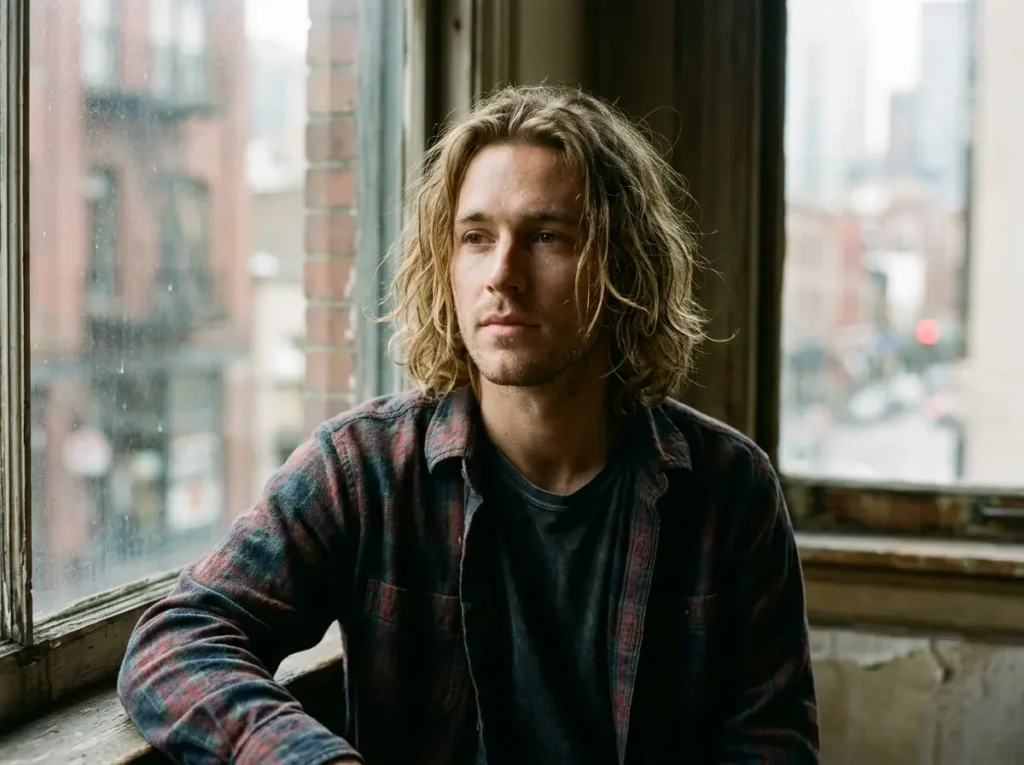
Grunge hair is shoulder-length, center-parted and deliberately undone. Kurt Cobain and early-90s Brad Pitt defined it.
- Then: Unwashed, uneven, no product.
- Now: Same shape, healthier ends. “Messy” now means texture spray, not dirty hair, much like modern messy hairstyles for men.
- Tell your barber: “Dust the ends only, keep it one rough length to the shoulders, no layering at the front.”
- Best for: Wavy or straight hair, long faces. Expect 12–18 months to grow from short.
4. Caesar Cut

The Caesar is a short, even cut with a straight fringe brushed forward. George Clooney wore it through his ER years.
- Then: Flat fringe, uniform length, no fade.
- Now: Textured top with a skin or low fade, closer to a French crop haircut.
- Tell your barber: “About an inch on top brushed forward, a straight fringe, and a #2 taper or low fade on the sides.”
- Best for: Thinning hair, receding temples, round and oval faces. The most forgiving 90s cut.
5. Frosted Tips
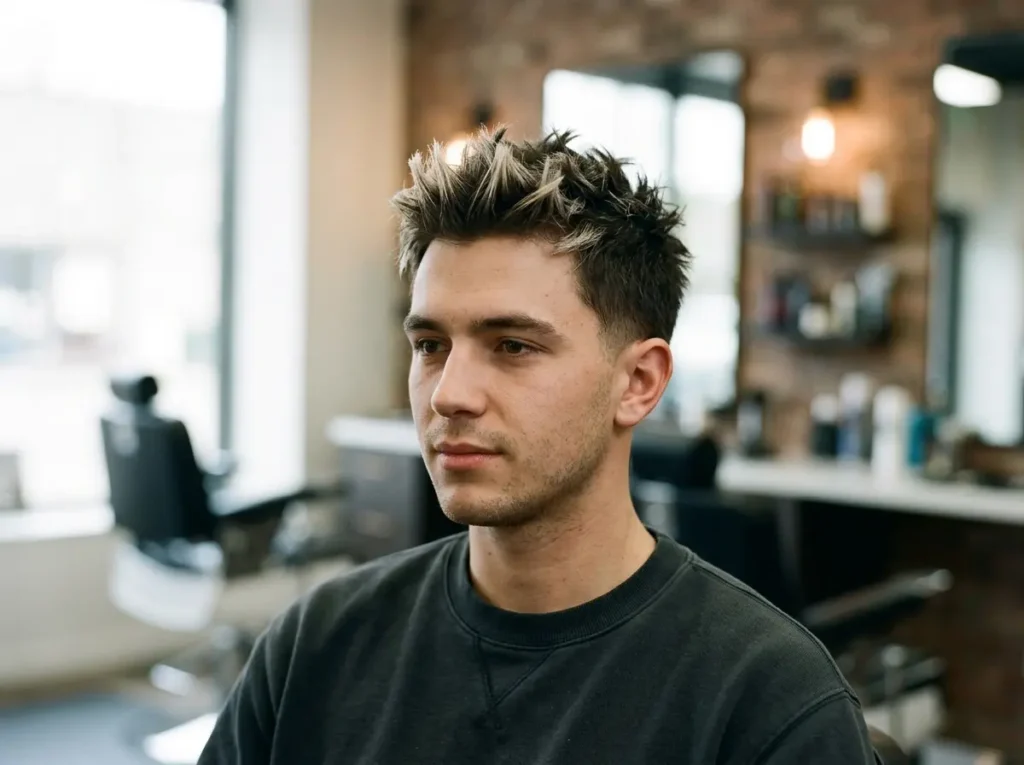
Frosted tips are short spiky hair with only the tips bleached near-white. They peaked with late-90s boy bands, including Justin Timberlake.
- Then: Bright white tips over dark roots, heavy gel.
- Now: Softer, toned blonde ends on a textured crop.
- Tell your colorist: “Bleach and tone only the top half-inch of my spikes; keep it ash, not yellow.”
- Best for: Dark straight hair, 1–2 inches on top. Get bleach done professionally to avoid scalp burns.
6. Spiky Gel Hair

Spiky hair is a short cut pulled straight up into points with strong gel. Sugar Ray’s Mark McGrath made it a late-90s staple.
- Then: Crunchy, wet-look, separated spikes.
- Now: Matte paste, looser texture, shorter sides.
- Tell your barber: “1.5 to 2 inches on top, heavily texturized, and a #2 taper on the sides.”
- Best for: Straight, thick hair. Fine hair collapses by midday.
7. Bowl Cut

The bowl cut is one even length all round with a blunt fringe, as if cut around a bowl. Jonathan Taylor Thomas made it a teen-idol look.
- Then: Blunt, helmet-shaped, no taper.
- Now: Textured “modern bowl” with an undercut or fade below.
- Tell your barber: “Fringe to my eyebrows, point-cut so it isn’t blunt, and a #2 undercut underneath.”
- Best for: Straight, thick hair; popular with Asian hair types.
8. Britpop Moptop

The Britpop moptop is a shaggy, fringe-heavy cut covering the ears, borrowed from the 1960s and worn by Oasis’s Liam Gallagher.
- Then: Heavy fringe into the eyes, full sides.
- Now: Lighter shag layers, fringe just above the brows.
- Tell your barber: “Shaggy layers, fringe sitting on my eyebrows, sides covering half the ear.”
- Best for: Straight or slightly wavy hair, long and heart-shaped faces.
9. High Top Fade

The high top fade is tall, flat-sided hair on top with skin-faded sides. Will Smith wore it on The Fresh Prince of Bel-Air.
- Then: Very tall, sharp corners, often with designs.
- Now: Shorter top (3–4 inches), softer edges, burst or drop fade. Not sure which fade height to ask for? See low vs mid vs high fade.
- Tell your barber: “High top, 3 to 4 inches, squared corners, skin fade from 0 to #2, sharp line-up.”
- Best for: Coily (type 4) hair. Needs a skilled barber every 2 weeks.
10. Flat Top

The flat top is short hair standing straight up and cut perfectly level on top.
- Then: Military-flat, gelled, with long sides.
- Now: Paired with a fade and a slightly rounded deck.
- Tell your barber: “Flat deck at 1 to 2 inches, set with a flat-top comb, faded sides.”
- Best for: Coarse or coily hair; straight hair needs strong hold.
11. Cornrows

Cornrows are tight braids close to the scalp in straight or patterned rows. Snoop Dogg brought them mainstream in the 90s.
- Then: Straight-back rows, often thick.
- Now: Thinner rows, zigzags, paired with a taper.
- Tell your braider: “Straight-back cornrows, medium size, not tight at the edges.”
- Best for: Coily hair, 4+ inches. Avoid repeated tight tension at the hairline; dermatologists link it to hairstyle-related hair loss.
12. 360 Waves

360 waves are a short, brushed pattern of ripples around the head, built with daily brushing and a durag.
- Then: Deep waves under a Caesar.
- Now: Same, often with a low taper fade.
- Tell your barber: “Low Caesar with the grain, a #1 or #1.5 on top, light line-up.”
- Best for: Coily hair. Takes weeks of brushing (“wolfing”) to set.
13. Tram Lines (Hair Designs)
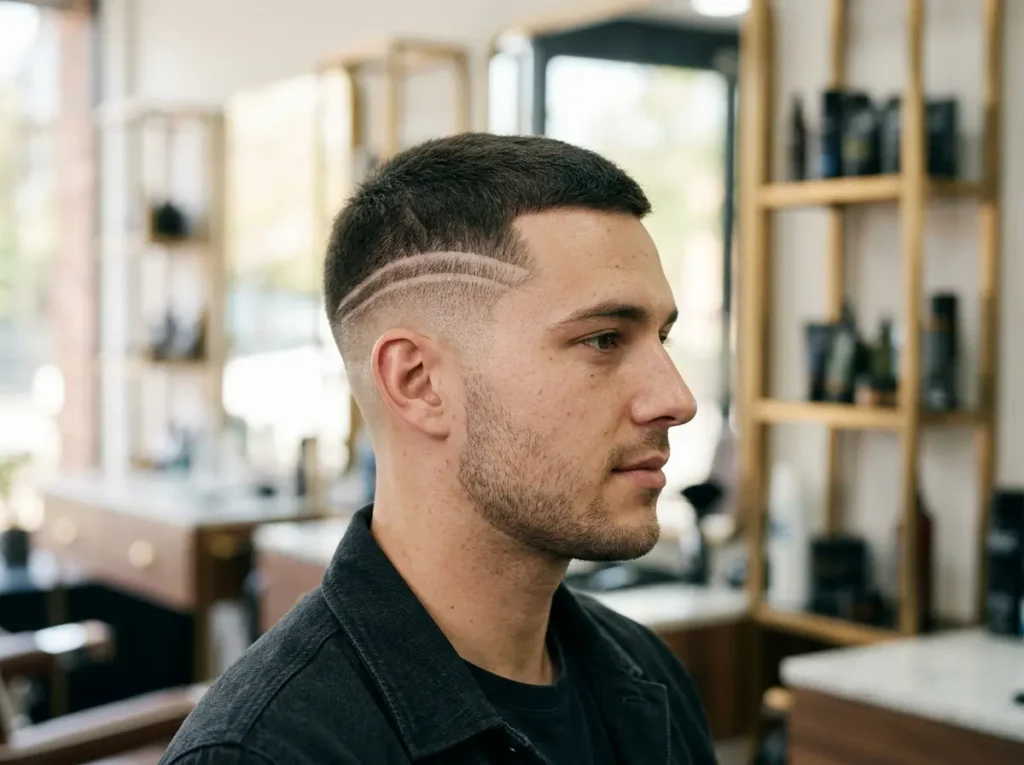
Tram lines are thin lines shaved into the sides of a short cut. MC Hammer and Vanilla Ice wore them.
- Then: Several parallel lines, bold zigzags.
- Now: One or two subtle lines, or a haircut with a line on the side.
- Tell your barber: “One hard part line on the left, kept thin, over a #2 fade.”
- Best for: Any short cut. Grows out in about 10 days.
14. Buzz Cut / Shaved Head

The buzz cut is clipped all over with one guard. Michael Jordan and Tupac made the clean head a 90s statement.
- Then: One length, all over.
- Now: Buzz with a faded neckline and lined edges. Our 2 guard buzz cut guide shows the modern version.
- Tell your barber: “#2 all over, fade the back to a #0, line up the front.”
- Best for: Thinning hair, strong jawlines, any texture.
15. Bleached Buzz

The bleached buzz is a short buzz bleached platinum, worn by Eminem at the end of the decade.
- Then: Brassy-to-white platinum.
- Now: Cool platinum or pastel tones.
- Tell your colorist: “Bleach my #3 buzz to level 10 and tone silver.”
- Best for: Short hair that’s easy to re-buzz if the color fails.
16. Mullet

The mullet is short at the front and sides, long at the back. Billy Ray Cyrus’s 1992 look kept it alive into the 90s.
- Then: Big contrast, long straight back.
- Now: Softer modern mullet with textured layers and a taper, like the shaggy mullet.
- Tell your barber: “Textured top, tapered sides, leave 3 to 4 inches at the nape blended in.”
- Best for: Wavy or curly hair.
17. Blowback (Brushback)

The blowback is medium hair blow-dried casually back with a soft part, the Chandler Bing look from early Friends.
- Then: Soft, slightly puffy, light mousse.
- Now: Matte cream, a little more volume at the front.
- Tell your barber: “3 inches on top, longer at the front, scissor-cut sides to blend.”
- Best for: Office-friendly 90s hair; straight or wavy.
18. Undercut Curtains (Skater Cut)

The skater cut is curtains on top with the sides and back clipped short underneath, popular with 90s skaters.
- Then: Hard disconnect, long top hanging over shaved sides.
- Now: The base of today’s e-boy and K-pop curtains.
- Tell your barber: “Curtains on top, a disconnected #2 undercut that stays hidden when my hair is down.”
- Best for: Thick hair that puffs out at the sides.
19. Dreadlocks and Twists

Locs are matted, rope-like sections of hair; twists are shorter, two-strand sections. Lenny Kravitz made locs a 90s rock look.
- Then: Long, freeform locs.
- Now: Starter twists and short locs with a taper.
- Tell your loctician: “Two-strand starter twists, medium parts, temple taper.”
- Best for: Coily hair. Locs take months to mature.
20. Wet-Look Slick Back

The slick back is hair combed straight back with high-shine gel.
- Then: Glossy, crunchy, combed lines visible.
- Now: Medium-shine pomade with an undercut or taper.
- Tell your barber: “4 inches on top, longer at the front, short tapered sides so it lays flat.”
- Best for: Straight or wavy hair; not for thinning crowns.
90s Facial Hair to Pair
Most 90s men’s hairstyles were worn clean-shaven. The goatee was the decade’s facial hair. Pair a goatee with spiky hair, the Caesar or a buzz; keep curtains and heartthrob looks clean-shaven or lightly stubbled for the authentic 90s balance.
Which 90s Men’s Hairstyles Suit Your Hair Type?
Straight hair suits curtains and spikes, wavy hair suits grunge and the heartthrob, curly hair suits the modern mullet, and coily hair suits the high top, waves and cornrows. Copying a cut made for a different texture is the top reason 90s men’s hairstyles fail.
| Hair type | Best 90s cuts | Avoid or adapt |
|---|---|---|
| Straight | Curtains, spiky hair, bowl cut, frosted tips, slick back | Grunge waves need texture spray to work |
| Wavy | Heartthrob, grunge long hair, blowback, moptop | Flat bowl cut fights the wave |
| Curly | Modern mullet, curly curtains, shag moptop | Spikes; heavy gel flattens curl |
| Coily | High top fade, flat top, 360 waves, cornrows, twists | Straight-hair curtains references |
| Fine or thin | Caesar, buzz, short textured spikes | Long curtains and slick backs show scalp |
| Very thick | Undercut curtains, heartthrob, moptop | Bowl cut without an undercut goes bulky |
Which 90s Men’s Hairstyles Suit Your Face Shape?
Face shape decides where the volume and the part should sit. Use it to choose between two cuts you already like, not as a hard rule. For a deeper breakdown, see our guide to men’s haircuts for your face shape.
| Face shape | Best 90s cuts | Why |
|---|---|---|
| Oval | Almost all, especially curtains | Balanced proportions handle a center part |
| Round | Spiky hair, high top, flat top, Caesar with height | Height adds length to the face |
| Square | Heartthrob, grunge long hair, curtains | Soft length offsets a strong jaw |
| Long / oblong | Bowl cut, moptop, Caesar fringe | Fringe shortens the face; avoid tall tops |
| Heart | Curtains, moptop, heartthrob | Volume near the jaw balances a wider forehead |
| Diamond | Curtains, textured fringe | Covers the temples, softens cheekbones |
90s Men’s Hairstyles for Thinning Hair or a Receding Hairline
The Caesar, the buzz cut and short textured spikes are the best 90s men’s hairstyles for thinning hair. Center-parted curtains and slick backs are the worst, because both put the temples and part line on show.
It’s one of the first questions men over 30 ask a barber about any retro cut.
- Receding temples: choose a Caesar with a forward fringe. It covers the corners without looking like a cover-up.
- Thinning crown: keep the top under 2 inches. Long hair separates and shows the scalp.
- Diffuse thinning: a #2–#3 buzz reduces the contrast between hair and scalp.
- Want curtains anyway? Ask for an off-center part and textured, not heavy, ends. Matte product only; shine shows scalp.
More options are in our guide to hairstyles for balding men. If you’re losing hair quickly or in patches, see a dermatologist before choosing a cut. The American Academy of Dermatology explains the common types of hair loss and their treatments.
How Long Does It Take to Grow a 90s Haircut?
Scalp hair grows roughly half an inch (about 1.25 cm) a month, so going from a short cut to curtains takes about 6–8 months. Plan trims to shape the grow-out, not to remove length.
| Target cut | Length needed on top | From a #2 buzz (approx.) |
|---|---|---|
| Caesar, spiky, frosted tips | 1–2 in | 2–4 months |
| Blowback, bowl cut | 3 in | 5–6 months |
| Curtains | 4–6 in | 7–10 months |
| Heartthrob (chin length) | 7–9 in | 12–15 months |
| Grunge shoulder length | 10–12 in | 18–24 months |
Growth speed varies by person, so treat these as planning estimates. During the awkward stage of longer 90s men’s hairstyles, a light trim around the ears and neckline every 6–8 weeks keeps it looking intentional.
90s Hair Products: Then vs Now
90s men relied on wet-look gel, mousse and hairspray. Today the same 90s men’s hairstyles are made with matte paste, clay, sea salt spray and cream, which hold the style without the crunch.
| Look | 90s product | Modern swap | Why it’s better |
|---|---|---|---|
| Spiky, frosted tips | Extra-strong gel | Fiber paste or matte clay | Hold without crunch or flakes |
| Curtains, heartthrob | Mousse | Sea salt spray + light cream | Movement, not stiffness |
| Grunge | Nothing (unwashed) | Texture spray on clean hair | Same look, healthy scalp |
| Slick back | High-shine gel | Water-based pomade | Washes out, medium shine |
| Flat top, high top | Gel + hairspray | Holding spray + pick | Lighter, less residue |
| Waves | Pomade + durag | Wave cream + durag | Less build-up |
How to Fake 90s Men’s Hairstyles for a Party (No Haircut Needed)
You can fake most 90s men’s hairstyles in 10 minutes with gel, a blow-dryer and temporary color. Pick the look that matches your current length.
- Short hair (under 2 in): work strong gel through damp hair, twist into spikes, and blast with a cool dryer. Add white or blonde temporary color spray to the tips for instant frosted tips.
- Medium hair (3–5 in): blow-dry with a center part, brushing each side away from the face, then mist with hairspray for 90s curtains.
- Long hair: skip shampoo for a day, scrunch in sea salt spray, center part, and leave it. Add a flannel shirt for full grunge.
- Any length: comb back with lots of gel for the wet look.
- Finish the costume: a backwards cap, bucket hat or bandana covers any styling misses and is fully 90s.
Test temporary color on a small patch first and keep it off light-colored pillowcases.
5 Mistakes That Make 90s Men’s Hairstyles Look Dated
A 90s cut looks modern when the sides are clean, the ends are textured and the product is matte. It looks like a costume when it’s copied literally.
- Keeping the sides long. Original curtains had bulky sides. Ask for a taper so the top is the focus.
- Using 90s-level gel. Crunchy, shiny spikes read as costume. Use matte paste.
- Blunt ends. Point-cut or texturized ends make bowl cuts and curtains move.
- DIY bleach. Home frosted tips often turn yellow-orange and can irritate the scalp. Get toner applied professionally.
- Ignoring the hairline. A center part on receding temples highlights them. Choose a Caesar or off-center part instead.
FAQs About 90s Men’s Hairstyles
What were the most popular men’s hairstyles in the 90s?
The most popular 90s men’s hairstyles were curtains, the heartthrob, the Caesar cut, frosted tips, spiky gel hair, the high top fade, grunge long hair, the bowl cut and the buzz cut. Curtains dominated the mid-90s, while frosted tips and spikes took over in the late 90s.
What is the 90s men’s haircut called?
The haircut most people mean is “curtains,” also called the middle-part haircut or curtain bangs. It has 4–6 inches on top split by a center part, with the front falling to both sides of the face. Leonardo DiCaprio’s version is the classic reference.
Are 90s men’s hairstyles back in style in 2026?
Yes. Curtains, the Caesar, textured mullets and bleached crops are all common in barbershops now. The modern versions keep the 90s shape but add tapered or faded sides, textured ends and matte products, so they look current rather than retro.
Which 90s haircut is best for thinning hair?
The Caesar cut is the best 90s option for thinning hair. Its short, forward-brushed fringe covers receding temples, and the short length hides a thin crown. A #2–#3 buzz cut is the next-best choice. Avoid center-parted curtains and slick backs.
How do I ask my barber for 90s curtains?
Say: “Leave 4 to 6 inches on top for a center part, point-cut the ends for movement, and taper the sides with scissors or a #3 to #4.” Bring a photo of someone with your hair texture, since straight-hair curtains look very different on curly hair.
How long does it take to grow 90s curtains?
From a short buzz, curtains take about 7–10 months, because hair grows roughly half an inch a month and the style needs 4–6 inches on top. Get the sides and neckline tidied every 6–8 weeks while the top grows.
How can I get a 90s hairstyle for a party without cutting my hair?
Use strong gel to twist short hair into spikes and add temporary blonde spray on the tips for frosted tips. With medium hair, blow-dry a center part for curtains. With long hair, scrunch in sea salt spray and leave it messy for grunge.
What 90s hairstyles suit Black men?
The high top fade, flat top, 360 waves, cornrows, twists, locs and the Caesar with a sharp line-up were all major 90s styles for Black men. Modern versions use shorter tops, burst or drop fades and lighter wave creams.
Final Take: Which of the 90s Men’s Hairstyles Should You Get?
Pick the 90s cut that matches your hair, not just your nostalgia. Straight or wavy hair with a full hairline suits curtains or the heartthrob. Thinning hair suits the Caesar or a buzz. Coily hair suits the high top, waves or cornrows. Short on patience? Spikes and frosted tips work with only 1–2 inches.
Whichever of these 90s men’s hairstyles you choose, update three things: cleaner sides, textured ends and matte product. That’s the difference between a 2026 haircut and a costume.
Keep exploring: go back to big perms, flat tops and mullets in our 80s men’s hairstyles guide, or see where men’s hair is heading next in our 2027 hair trends for men.
Take this to your barber: screenshot the “Tell your barber” line under your chosen cut. It’s the fastest way to get the 90s look you actually pictured.