

A curtain haircut is a longer fringe parted in the center (or just off-center) so it falls to both sides of the forehead, like a pair of open curtains. It needs about 4–6 inches of length at the front and pairs with anything from long sides to a skin fade.
Most guides stop at a photo gallery. This one answers what you actually need before you sit in the chair: will a curtain haircut suit your face and hair, how long it takes to grow, the exact words to tell your barber, and how to fix curtains that won’t stay put.

Table of Contents
What Is a Curtain Haircut?
A curtain haircut is defined by the fringe, not the part. The front section is cut long enough to split down the middle and fall outward toward the eyebrows, temples or cheekbones.
People often use “middle part” and “curtains” as if they mean the same thing. They don’t. A middle part is just the line on your scalp. Curtains are the longer front panels on each side of that line, usually with a slight outward bend at the root.
The sides and back are flexible. That is why the same curtain haircut can look 90s grunge with long sides, or sharp and modern with a taper fade.
Key Features at a Glance
- Front length: 4–6 inches (10–15 cm), reaching the eyebrows or below
- Part: center or slightly off-center, following your natural growth
- Shape: two panels that open at the root and curve away from the face
- Sides/back: anything from shoulder-length to a skin fade
A Short History of the Curtain Haircut
Curtains are older than the 90s. The look is often traced back to Oscar Wilde in the late 1800s, stayed popular into the 1920s, then returned with the 1960s hippie movement.
The version most people picture came in the 1990s, when Leonardo DiCaprio, Brad Pitt, Kurt Cobain and Brendan Fraser made it the default heartthrob cut. You can see how it fit the decade in our guide to 90s men’s hairstyles. According to Wikipedia’s entry on curtained hair, British street gangs such as Glasgow’s neds and the Peaky Blinders wore a long-on-top, short-sides version in the early 20th century.
The current wave started around 2020, driven by K-pop idols (BTS, NCT, Monsta X), TikTok’s eBoy trend and actors like Timothée Chalamet. Today’s curtains are softer and more textured than the stiff, gelled 90s version.
Will a Curtain Haircut Suit You?
A curtain haircut suits most people because the length and part can be adjusted. The two things that decide success are your face shape (how wide the opening should be) and your hair texture (how the fringe will fall).
Curtain Haircut by Face Shape
Oval and long faces get the easiest win. Round and square faces can wear it too, with a few adjustments. For a broader breakdown, see our men’s haircuts for your face shape guide.

| Face shape | Suitability | What to adjust |
|---|---|---|
| Oval | Excellent | Almost any length and part works |
| Long / oblong | Excellent | Longer curtains to cheekbone level shorten the face visually; avoid extra height on top |
| Square | Very good | Soft, textured ends break up a strong jaw; avoid blunt, straight panels |
| Heart | Very good | Curtains cover a wider forehead; keep fullness near the cheeks, not the crown |
| Diamond | Good | Fringe softens high cheekbones; part slightly off-center |
| Round | Good with tweaks | Ask for more height at the root and tighter sides (taper or fade) so the face looks longer; avoid curtains ending at the widest point of the cheeks |
Long face? Our oblong face hairstyles for men list has more options that balance length.
Curtain Haircut by Hair Type
Hair texture changes how much length you need and how much styling the fringe takes.
| Hair type | How curtains behave | Tip |
|---|---|---|
| Straight | Clean, defined panels; can fall flat or close up | Blow-dry the root outward; light texture spray |
| Wavy | Easiest type; natural bend opens the part | Scrunch in mousse, air-dry or diffuse |
| Curly | Broken, clustered fringe; shrinks when dry | Cut and judge length dry; leave 1 inch extra |
| Thick | Holds shape well but can look bulky | Ask for weight removed (point cutting or thinning) |
| Fine | Fringe can split unevenly or separate | Shorter curtains, volume mousse, matte product |
Curtain Haircut for Thin Hair or a Receding Hairline
Curtains can work with thinning hair, but not every version will. A center part exposes the scalp and the temples, so it can make thin spots more visible.
If your hairline is receding at the temples, go for shorter, textured curtains with a slightly off-center part. The fringe falls forward over the temple corners and hides them better than a long, heavy panel.
If the thinning is at the crown or along the part line itself, a textured crop or a side-swept fringe is usually the better choice. Our guides to haircuts for thin hair and hairstyles for balding men cover those alternatives. Be honest with your barber about this before cutting.
How Long Does Hair Need to Be for Curtains?
You need 4–6 inches (10–15 cm) at the front for a classic curtain haircut that reaches the eyebrows. Short curtains work from about 3 inches; long curtains that reach the cheekbones need 6–8 inches.
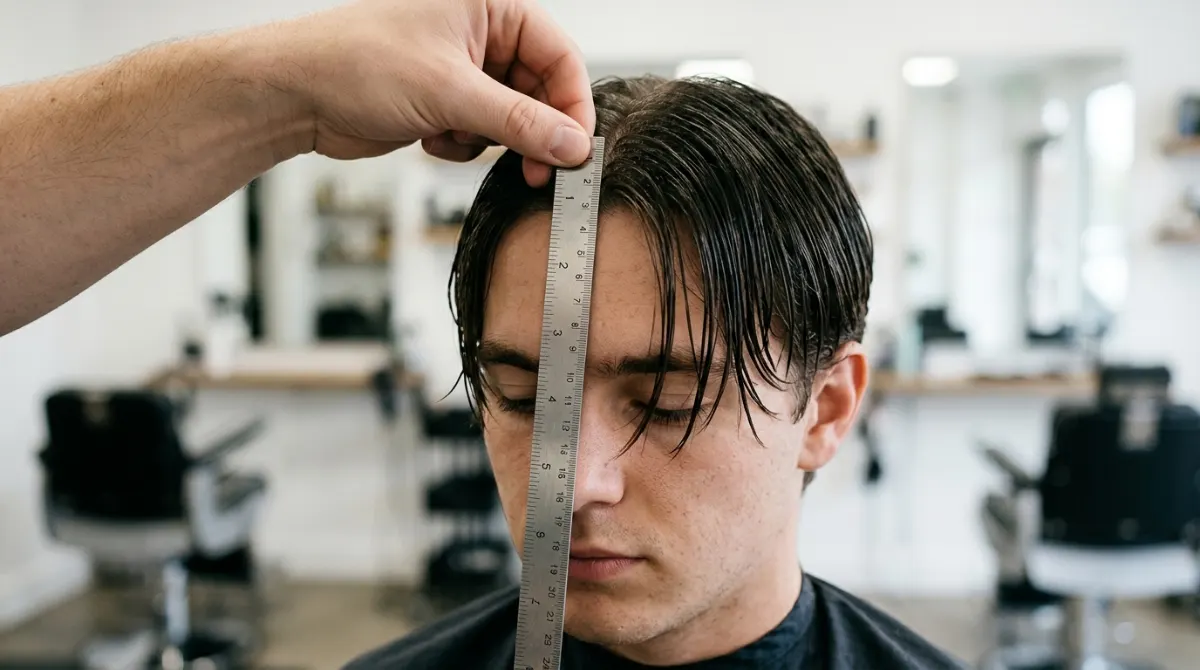
| Curtain length | Front length | Where the fringe ends | Best for |
|---|---|---|---|
| Short | 3–4 in (7–10 cm) | Mid-forehead to brows | Office, low maintenance, fine hair |
| Classic / medium | 4–6 in (10–15 cm) | Brows to eye level | Most people, most face shapes |
| Long | 6–8 in (15–20 cm) | Cheekbones | Oval, long or square faces; 90s look |
| Extra long | 8 in+ | Jaw or chin | Flow and grunge styles |
Curly hair can shrink 30–50% when it dries, so add at least an inch to these numbers.
How to Grow Out a Curtain Haircut
Hair grows roughly half an inch (1.25 cm) a month. From a short crop with 2 inches on top, classic curtains take about 4–6 months. The awkward stage is real, but you can manage it.
- Month 0–2 (2–3 in): Keep the sides tidy with a taper every 3–4 weeks. Don’t cut the top at all. Push the fringe forward or to one side.
- Month 2–3 (3–4 in): Start training a center part. Blow-dry it daily so the hair learns the direction. A light paste stops it sticking up.
- Month 3–4 (4–5 in): Short curtains are now possible. Ask your barber only to shape the front corners, not shorten them.
- Month 4–6 (5–6 in): Full classic curtains. From here, trim the fringe every 6–8 weeks.
The biggest mistake in the grow-out phase is letting the barber “just tidy up the top.” Tell them clearly that the top and front are off-limits.
12 Curtain Haircut Styles to Try
Each curtain haircut style below lists what it looks like, who it suits and the one line to give your barber. Pick by your hair type and how much time you want to spend styling.
1. Classic 90s Curtains
Two long, smooth panels from a center part, with the sides left medium length over the ears. This is the DiCaprio look.
- Best for: straight or slightly wavy hair, oval and long faces
- Ask for: “5–6 inches at the front, scissor cut all over, sides just touching the ears”
2. Short Curtain Haircut (Curtain Crop)
A compact fringe split in the middle over a short back and sides. Office-friendly and the easiest to maintain.
- Best for: fine hair, busy mornings, first-timers
- Ask for: “3–4 inches at the front, textured, number 2 or 3 on the sides”
3. Curtain Haircut with Taper Fade
Curtains on top with a gradual taper at the temples and neckline. Clean edges without a harsh contrast. If you’re new to tapers, read our low taper fade guide first.

- Best for: square and round faces, professional settings
- Ask for: “Low taper fade, keep the top and fringe long and blended”
4. Curtain Haircut with Undercut
Long curtains over a disconnected short or shaved section. The fringe stands out more because there is no bulk under it.
- Best for: thick hair that gets puffy at the sides
- Ask for: “Disconnected undercut, no blending, top left long for curtains”
5. Wavy Curtains
The natural bend of wavy hair opens the part on its own. Usually the lowest-effort version. More ideas in our wavy hair for men guide.

- Best for: wavy hair, heart and round faces
- Ask for: “Long layers on top, cut to follow my wave, not thinned too much”
6. Curly Curtains
Clustered curls split down the middle. The line is softer and less exact, which is the point. Pair it with a solid curly hair routine so the fringe stays defined.
- Best for: curly hair, diamond and square faces
- Ask for: “Cut dry, curl by curl at the front, keep extra length for shrinkage”
7. Long Curtains (Flow Curtains)
The fringe blends into chin- or shoulder-length sides. Part curtains, part flow haircut.
- Best for: oval and long faces, thick hair
- Ask for: “Long layers all over, front pieces blended into the sides”
8. Shaggy Curtains
Choppy, uneven layers that cross the part. Messy on purpose and very low effort once cut. See the full shag haircut for men guide for variations.
- Best for: thick or wavy hair, angular faces
- Ask for: “Shag layers, point-cut ends, curtains that look lived-in”
9. Curtain Mullet
Curtains up front, length at the back, shorter at the sides. A newer twist on the shaggy mullet that classic galleries rarely cover.
- Best for: wavy hair, confident style, oval faces
- Ask for: “Curtain fringe, taper the sides, leave 3–4 inches longer at the nape”
10. Korean Two-Block Curtains
The K-pop version: a soft, fluffy fringe over a two-block cut, where the sides are clipped short underneath and covered by the top. Our fluffy hair for men guide shows how to get that airy texture.
- Best for: thick, straight hair (common in East and South Asian hair)
- Ask for: “Two-block cut, sides clipped underneath, soft see-through curtain fringe”
11. eBoy Curtains
Curtains with a darker, emo-skater edge, often with color streaks. Popular on TikTok and Twitch.
- Best for: straight hair, younger crowd, social-first style
- Ask for: “Long curtain fringe, choppy ends, keep length near the eyes”
12. Slick or Wet-Look Curtains
Combed curtains with high-shine gel or pomade. Strands stay glossy and defined all day.
- Best for: events, straight hair, oval and square faces
- Ask for: “Classic curtains cut; I’ll style it wet with gel”
Quick pick: low effort → wavy, shaggy or short crop. Office → taper fade or classic. Statement → mullet, eBoy or undercut.
How to Ask Your Barber for a Curtain Haircut
Bring 2–3 photos, state the front length in inches, and say how you’ll style it. “Curtains, please” alone often ends with a fringe cut too short to split.

Word-for-Word Barber Script
Copy this and adjust the numbers:
“I want a curtain haircut. Please leave about 5 inches at the front so it can part in the middle and fall to my eyebrows. Use scissors on top and point-cut the ends so they’re soft, not blunt. Take some weight out if it’s bulky. On the sides, I’d like a low taper, blended into the top. I air-dry most days, so please cut it to fall with my natural part.”
Barber Terms That Help
| Term | What it means for curtains |
|---|---|
| Scissor over comb | Softer, longer sides that blend into the fringe |
| Point cutting | Snipping into the ends so the curtains look textured, not blunt |
| Texturizing / thinning | Removes bulk so thick hair falls flat and splits cleanly |
| Taper | Gradual shortening at the temples and neckline only |
| Fade | Sides blend down to very short or skin |
| Undercut | Short sides with no blending, a sharp line under the top |
| Two-block | Undercut hidden under a longer top layer (K-pop style) |
Choosing the Sides and Back
Not sure how high the fade should go? Our low vs mid vs high fade comparison explains the difference.
| Sides option | Look | Maintenance |
|---|---|---|
| Long / scissor cut | Classic 90s, soft | Trim every 6–8 weeks |
| Low taper | Clean but natural | Every 4–5 weeks |
| Mid or skin fade | Sharp, modern contrast | Every 2–3 weeks |
| Undercut / two-block | Bold, removes bulk | Every 3–4 weeks |
Mistakes to Avoid in the Chair
- Letting the barber cut the fringe wet on curly or wavy hair. It will shrink.
- Asking for a part that fights your cowlick. Let the barber find your natural part first.
- Not saying “don’t touch the top” if you’re still growing it out.
- Thinning fine hair. It makes the curtains separate and look sparse.
A good rule: ask for the fringe slightly longer than your target. Cutting more takes a minute; growing it back takes weeks.
How to Style a Curtain Haircut in 5 Minutes
Curtains are set by the blow-dryer, not the product. Dry the roots in the direction you want them to fall, and the shape holds all day with very little product.

You’ll need: a blow-dryer (with a nozzle), a wide-tooth comb or your fingers, a heat protectant, and one styling product for your hair type.
- Start with damp hair. Towel-dry until it’s about 70% dry. Soaking wet hair takes longer and frizzes more.
- Apply heat protectant and pre-styler. A light spray, plus sea salt spray (straight hair) or mousse (fine or wavy hair) at the roots.
- Find and set the part. Comb the front straight forward, then split it where it naturally divides. Center or a few millimeters off is fine.
- Blow-dry the roots outward. Point the nozzle down the hair shaft. Push the left side left and the right side right with your fingers, lifting at the root. This creates the curtain curve.
- Cool shot to lock it. Hit each side with the cool button for 5–10 seconds. Cooling sets the shape.
- Finish with a pea-sized amount of product. Rub it into your palms, then work it in from the back forward. Touch the fringe last and lightly.
- Shape the ends. Twist or pinch a few front pieces for texture. Done.
No blow-dryer? Part your hair while damp, then tuck each side behind your ears for 10–15 minutes as it air-dries. Release and shake out.
Curly hair: skip the blow-dryer. Apply curl cream to wet hair, part it, scrunch, and diffuse on low heat or air-dry. Don’t touch it until fully dry.
Best Products for a Curtain Haircut by Hair Type
Use less product than you think. Heavy product at the root is the number one reason curtains collapse. For specific brand picks, see our roundup of the best hair styling products for men.
| Hair type | Pre-styler (damp) | Finisher (dry) | Hold / finish |
|---|---|---|---|
| Straight | Sea salt or texture spray | Matte paste or clay | Medium, matte |
| Wavy | Light mousse | Cream or light paste | Light, natural |
| Curly | Curl cream or leave-in | Light gel (scrunch out the crunch) | Light–medium |
| Thick | Blow-dry cream | Clay or fiber | Medium–strong |
| Fine | Volumizing mousse | Texture powder or light spray | Light, matte |
| Slick look | None | Water-based pomade or gel | Strong, shine |
Always add a heat protectant if you blow-dry daily, and keep the dryer on low or medium heat, as the American Academy of Dermatology’s hair care tips recommend.
Common Curtain Haircut Problems (and Fixes)
Most curtain problems come from three causes: a fringe cut too short, roots dried in the wrong direction, or too much product.
| Problem | Why it happens | Fix |
|---|---|---|
| Curtains won’t stay parted | Roots dried flat or forward | Blow-dry the roots outward, then use the cool shot |
| Fringe sticks straight up | Front cut too short (under 3 in) | Let it grow 4–6 weeks; use a weighted cream meanwhile |
| Part keeps closing by noon | Fine or straight hair, heavy product | Swap to a matte, light-hold product; add sea salt spray at the roots |
| Splits off-center or zigzags | Cowlick at the hairline | Part where the cowlick wants; a slightly off-center curtain looks natural |
| Looks flat and greasy | Oil plus product at the roots | Wash every 1–2 days; dry shampoo at the part |
| Puffy, triangular sides | Thick hair with no weight removed | Ask for thinning or a two-block / undercut |
| Frizzy curtains | Humidity, rough towel drying | Microfiber towel, anti-frizz cream, dry on low heat |
Frizz is a bigger issue? Our frizzy hair for men guide goes deeper.
Curtain Haircut Maintenance and Trim Schedule
Plan a curtain haircut fringe trim every 6–8 weeks and a sides clean-up based on how short they are. Curtains grown too long close up and cover the eyes.
| Task | How often |
|---|---|
| Fringe and top shape-up | Every 6–8 weeks |
| Taper touch-up | Every 4–5 weeks |
| Fade touch-up | Every 2–3 weeks |
| Wash | Every 1–3 days (daily for oily hair) |
| Deep conditioner | Once a week for long or curly curtains |
Tip for the gym or helmets: pull the fringe straight back with a headband, then re-split it with damp fingers afterwards. The part comes back in a minute because the roots are trained.
Curtain Haircut vs Middle Part vs eBoy vs Flow vs Curtain Bangs
These names overlap online, which is why barbers get confused. Here is the difference.
| Style | What defines it | Length | Sides |
|---|---|---|---|
| Curtain haircut | Long fringe split to both sides | 4–6 in front | Any |
| Middle part | Only the part line; no specific fringe | Any | Any |
| eBoy haircut | Curtains with an emo/skater, choppy finish | 5–7 in front | Medium |
| Flow haircut | Swept-back length all over, no fringe needed | 6 in+ all over | Long |
| Curtain bangs | Women’s fringe cut shorter in the center, longer at the edges | Bang length | N/A (long hair) |
Curtain Haircut for Women
For women, a curtain haircut usually means curtain bangs or a curtain-cut bob. The fringe is cut shortest at the center and longer toward the cheekbones, so it blends into face-framing layers.

It works on almost any length, from a chin-length bob to waist-length hair. It’s also a common low-commitment way to try bangs, because curtain bangs grow out into face-framing layers instead of an awkward blunt fringe.
Ask for: “curtain bangs that start at the bridge of my nose and blend into cheekbone-length layers.” Styling is the same idea: blow-dry the center up and out with a round brush.
Curtain Haircut FAQs
What is a curtain haircut called?
It’s also called curtains, curtained hair, the 90s middle part, or the eBoy haircut. In Korea, a similar soft version is often paired with a two-block cut. All describe a longer fringe parted to fall on both sides of the forehead.
How long should hair be for a curtain haircut?
Aim for 4–6 inches (10–15 cm) at the front so the fringe reaches your eyebrows. Short curtains work from 3 inches. Curly hair needs about an inch more because it shrinks as it dries.
Does a curtain haircut suit a round face?
Yes, with adjustments. Ask for more lift at the roots and shorter, tighter sides, such as a taper or fade. Avoid curtains that end right at the widest part of your cheeks, because that adds width.
Can you get a curtain haircut with thin hair?
You can, but choose shorter, textured curtains and an off-center part. A deep center part on thin hair shows more scalp. Volumizing mousse and a matte powder help the fringe look fuller.
How do I make my curtains stay in place?
Blow-dry the roots outward from the part while the hair is damp, then use the cool shot. Finish with a small amount of matte paste. Heavy product at the roots is what makes curtains collapse.
How long does it take to grow a curtain haircut?
From a short crop with about 2 inches on top, plan on 4–6 months. Hair grows around half an inch a month. Keep the sides tidy and ask your barber not to cut the front.
Is the curtain haircut still in style in 2026?
Yes. Curtains have stayed popular since their 2020 revival through K-pop, TikTok and actors like Timothée Chalamet. The current trend is softer and more textured, often with a taper fade or a shaggy finish.
Should curtains be parted exactly in the middle?
No. Part where your hair naturally divides. A part slightly off-center often looks more natural and handles cowlicks better than a forced dead-center line.
Can I cut a curtain haircut at home?
You can trim the front corners at home, but the first cut is best done by a barber. Getting both panels even and removing bulk correctly is hard to do on yourself.
How much does a curtain haircut cost?
It’s priced as a standard men’s scissor cut at most barbershops and salons. Expect to pay a bit more if you add a fade, thinning or color.
Conclusion
A curtain haircut works when three things line up: enough front length (4–6 inches), a part that follows your natural growth, and roots blow-dried outward. Get those right, and the cut adapts to almost any face shape, hair type or dress code.
Start with the face shape and hair type tables, pick one of the 12 styles, then take the barber script into your next appointment. Your first curtain cut will look like the photo instead of a fringe that’s too short to split.
Next step: Still deciding? Compare more options in our medium-length hairstyles for men guide, or check which cuts flatter you most with our face shape haircut guide.