

The best haircuts for thin hair men are short-to-medium cuts with a textured top and tapered sides: the textured crop, French crop, Caesar, crew cut and buzz cut lead the list. They work because short, choppy hair stands up off the scalp, hides gaps between strands and shrinks the contrast between thin and full areas.
But “thin hair” means different things on different heads. A guy with fine strands and a full hairline needs a different cut from a guy with a receding hairline or a thinning crown. So this guide does not just list cuts. It matches each one to where your hair is thin, gives you the guard numbers, and tells you exactly what to say to your barber.
You are also far from alone. In a dermatology-clinic study of 419 men, pattern hair loss showed up in 43% of men aged 17 to 29 and 71% of men in their 30s. Thin hair is the norm, not the exception, and barbers cut for it every day.
Key takeaways
- Shorter and textured beats longer and flat. Long thin hair splits apart and shows scalp.
- Match the cut to your thinning zone: fringe styles for a receding hairline, compact tops for a thinning crown, buzz or skin fade once loss is advanced.
- Keep the sides tighter than the top to make the top look denser by contrast, but keep the gap between them moderate.
- Ask for point cutting, not heavy thinning shears or a razor on the top.
- Style with matte products. Shine reflects light off the scalp and makes hair look sparser.
- A haircut changes how thin hair looks. If you are actively shedding, see a dermatologist early, when treatment works best.
Table of Contents
Thin, fine or thinning? The 60-second check
Fine hair is about strand size, thin hair is about how many strands you have, and thinning hair is density you are losing. Dermatologist Dr. Rebecca Marcus puts it simply: fine hair is the thickness of each strand, while thin hair relates to density. You can have one, two or all three, and each one changes which cut works.
Run this check in front of a mirror with your hair dry and product-free:
- The strand test. Roll one hair between your fingers. If you can barely feel it, your hair is fine.
- The light test. Stand under a ceiling light and take a phone photo of the top of your head. If you see scalp through the top without parting your hair, density is low.
- The pattern test. Compare a photo from 3 to 5 years ago. Temples further back or a crown spot that wasn’t there means your hair is thinning, not just thin.
| What you found | Your hair type | What the haircut needs to do |
|---|---|---|
| Fine strands, no scalp showing | Fine but dense | Add texture and lift; most short and medium cuts work |
| Normal strands, scalp shows evenly | Naturally low density | Keep the top short and choppy so strands clump into fuller pieces |
| Scalp shows in one zone only | Pattern thinning | Use direction and length to cover that zone (see the thinning map below) |
| Fine strands + scalp shows + pattern | All three | Go short: textured crop, Caesar or buzz cut |
Why some haircuts make thin hair look thicker
A haircut cannot add a single hair, but it can change how much hair people see. Four principles do all the work, and every cut in this guide uses at least two of them.
1. Contrast: tight sides make the top look denser
When the sides are shorter than the top, the eye reads the top as the “full” part of your head. Keep the jump moderate, though. A bald skin fade under a sparse top can highlight the thin area instead of hiding it. A low or mid taper is usually safer than a high skin fade until thinning is advanced.
2. Length: shorter hair stands up, longer hair falls apart
Thin hair over about 3 inches gets heavy, lies flat and separates into strands with scalp showing between them. Under about 2 inches, hair stands away from the scalp and overlaps, so it looks thicker.
3. Texture: choppy ends scatter light
Point cutting (snipping into the ends vertically) creates uneven lengths that interlock into pieces. Those pieces hide gaps. Blunt, flat tops show every line where hair parts.
4. Direction: move hair over the thin zone
Forward styles (French crop, Caesar) cover a receding hairline. Back or side styles (slick back, side part) suit men whose front is full but crown is thin. Picking the wrong direction exposes exactly the area you want to hide.
A bonus factor most guides miss: color contrast. Dark hair on a light scalp shows gaps more than light hair on a light scalp, or dark hair on a darker scalp. If you have dark hair and fair skin, go one step shorter than you think you need.
Find your cut by thinning pattern
The right haircut depends on where you are thin, not just how thin you are. Find your row below, then jump to the cuts it names. Dermatologists grade male pattern hair loss on the Norwood (Hamilton-Norwood) scale from 1 (no loss) to 7 (only a band at the sides and back); the stages here are simplified for choosing a haircut.
| Your pattern | Rough Norwood stage | Best cuts | Avoid |
|---|---|---|---|
| Fine or low-density all over, hairline intact | 1 | Textured quiff, side part, Ivy League, messy medium top | Long flat styles, heavy gel |
| Slight temple recession (mature hairline) | 2 | Ivy League, textured crop, short side part, crew cut | Slicked-back with a hard part that exposes temples |
| Clear temple recession, front still has hair | 3 | French crop, Caesar, textured crop with fringe | Quiff or pompadour pushed up and back |
| Thinning crown (vertex), front is fine | 3 vertex | Crew cut, short textured crop, slick back from a full front | Spiky tops, middle-length layers that split at the crown |
| Receding hairline + thinning crown | 4 to 5 | Short Caesar, buzz cut (#2 to #4), high and tight | Comb-over, anything over 2 inches on top |
| Top mostly gone, sides and back full | 6 to 7 | Buzz cut (#1 to #2), skin fade + stubble or beard, clean shave | Keeping long sides with a bare top |
If you are at stage 4 or beyond, read our guide to hairstyles for balding men for the next step.
One rule covers every row: if a cut needs more than 2 minutes of styling to hide scalp, it’s the wrong cut for your stage. Go one step shorter.
17 best haircuts for thin hair men
The textured crop is the safest all-round haircut for thin hair men; the rest of this list is about matching the cut to your pattern, texture and lifestyle. Use the table to shortlist, then read the entries for the exact barber ask.
| # | Haircut | Best for (pattern) | Top length | Sides | Trim every | Daily styling |
|---|---|---|---|---|---|---|
| 1 | Textured crop | Almost everyone, stage 1 to 4 | 1 to 2 in | #1 to #2 taper or fade | 3 to 4 weeks | 2 min |
| 2 | French crop | Receding hairline | 1 to 2.5 in, fringe forward | #1 to #3 | 3 to 4 weeks | 2 min |
| 3 | Caesar cut | Receding hairline + crown | 1 to 1.5 in, short fringe | #2 to #3 | 3 to 4 weeks | 1 min |
| 4 | Crew cut | Thinning crown | 1 to 1.5 in front, shorter crown | #2 to #3 | 3 to 4 weeks | 1 min |
| 5 | Buzz cut | Stage 4+, or zero effort | #2 to #4 all over | Same or one guard shorter | 2 to 3 weeks | 0 min |
| 6 | High and tight | Stage 3 to 5, active lifestyle | #3 to #4 (about 0.5 in) | #0 to #1, high | 2 to 3 weeks | 0 min |
| 7 | Ivy League | Mature hairline, fine hair | 1.5 to 2.5 in, longer at front | #2 to #3 taper | 4 weeks | 3 min |
| 8 | Soft side part | Fine hair, light crown thinning | About 2 in | #2 to #3 taper | 4 weeks | 3 min |
| 9 | Short textured quiff | Fine but dense hair | 2 to 3 in at front | #2 taper | 4 weeks | 4 min |
| 10 | Textured fringe | Receding hairline, wavy hair | 2 to 3 in, forward | #2 to #3 | 4 weeks | 2 min |
| 11 | Short slick back | Thinning crown, full front | 2.5 to 3.5 in | #1 to #2 undercut or taper | 4 weeks | 3 min |
| 12 | Subtle faux hawk | Temple thinning, stage 2 | 1.5 to 2.5 in, center | #1 to #2 | 3 to 4 weeks | 2 min |
| 13 | Curly crop with low taper | Thin wavy or curly hair | 1.5 to 3 in curls | #1 to #3 low taper | 4 weeks | 2 min |
| 14 | Low cut with taper | Afro-textured thin hair | #1 to #3 (about 0.25 in) | #0.5 to #1 taper | 2 weeks | 1 min |
| 15 | Messy medium top | Fine but dense, no loss | 3 to 4 in, layered | #3 to #4 or scissor | 5 to 6 weeks | 4 min |
| 16 | Classic taper (gentleman’s cut) | Grey or older men, any early stage | 1.5 to 2 in | #2 to #4 taper | 4 weeks | 2 min |
| 17 | Shaved head or skin fade + beard | Stage 6 to 7 | #0 to #1 or shaved | Skin | 1 to 2 weeks | 0 min |
Guard sizes: #1 = 1/8 in (3 mm), #2 = 1/4 in (6 mm), #3 = 3/8 in (10 mm), #4 = 1/2 in (13 mm).
1. Textured crop

The textured crop is the single best default for thin hair: a short, choppy top pushed slightly forward over tight sides. The choppy pieces interlock and hide scalp, and it works from a full head to a stage 4 recession.
- Ask your barber: “Low or mid fade starting at a #1, about 1.5 inches on top, point cut for texture. Please don’t use thinning shears on the top.”
- Style it: Towel-dry, rub a pea-sized amount of matte clay through, and push forward with your fingers. Messy is the point.
2. French crop

The French crop is the go-to cut for a receding hairline. It brings a short, straight fringe forward over the temples, so the hairline is covered by design rather than by a cover-up.
- Ask your barber: “French crop, 1 to 2 inches on top, fringe forward and point cut so it’s not a solid line, #2 taper on the sides.”
- Style it: A little sea salt spray on damp hair, blow-dry forward, finish with a small amount of matte paste.
- Watch out: A thick blunt fringe on very sparse front hair shows gaps. Keep it textured.
3. Caesar cut

The Caesar is a shorter, more uniform cousin of the French crop. Everything is cut to about the same short length and combed forward to a short straight fringe, which covers temples and keeps a thinning crown compact.
- Ask your barber: “Caesar cut, about 1 inch on top, short horizontal fringe, #2 on the sides blended into the top.”
- Style it: Little to none. A dab of light cream if it lifts.
4. Crew cut

The crew cut is the best choice when the crown is your problem zone. The top is slightly longer at the front and gets shorter toward the crown, so the thin area at the back gets the shortest hair and blends in.
- Ask your barber: “Crew cut, about 1.5 inches at the front graduating shorter toward the crown, #2 or #3 on the sides.”
- Style it: Push the front up and slightly to the side with a small amount of matte product.
5. Buzz cut

The buzz cut removes the contrast between thin and full areas completely, because everything is the same short length. It’s the most confident option once thinning reaches stage 4, and the lowest-maintenance cut on this list.
- Ask your barber: “Buzz cut, #3 on top and #2 on the sides” (start longer; you can always go shorter next visit).
- Style it: Nothing. Use an SPF on the scalp outdoors.
- Going shorter? See our 2-guard buzz cut guide.
6. High and tight

The high and tight pairs a short top with very short sides taken high up the head. The strong contrast makes even a thinning top look intentional, and it reads sharp and athletic.
- Ask your barber: “High and tight, #4 on top, #0 or #1 on the sides taken up to the parietal ridge, blended.”
- Style it: None, or a matte cream to flatten flyaways.
7. Ivy League

The Ivy League is a polished, office-friendly cut for men with a mature hairline or fine hair. It is a longer crew cut with a soft side part and slightly more length at the front.
- Ask your barber: “Ivy League, around 2 inches at the front tapering to 1 inch at the crown, natural side part, #3 taper on the sides.”
- Style it: Blow-dry to the side, then comb a little matte paste through. No hard part line.
8. Soft side part

A soft side part spreads the hair you have across more of the scalp, which helps fine hair and light crown thinning. Part on the side where your hair is fullest.
- Ask your barber: “Classic side part, about 2 inches on top, keep weight in the top, #2 taper on the sides, no shaved part line.”
- Style it: Pre-styler on damp roots, blow-dry across, set with matte paste.
9. Short textured quiff

A short quiff lifts the front, which adds height and the look of volume to fine but dense hair. Keep it short: a tall quiff on thin hair collapses by lunch.
- Ask your barber: “Short textured quiff, 2.5 inches at the front graduating shorter back to the crown, #2 taper on the sides, point cut the top.”
- Style it: Blow-dry the front up with a round brush or fingers, then a matte clay. Two minutes of blow-drying beats any product.
- Skip it if: Your temples are receding. Lifting the front shows the hairline.
10. Textured fringe

A textured fringe is a longer, messier take on the French crop, and it’s great for a receding hairline on wavy or slightly coarse hair. Hair is pushed forward in loose pieces that break up the hairline.
- Ask your barber: “About 2.5 inches on top, cut so it falls forward, choppy point-cut fringe, #3 on the sides with a low taper.”
- Style it: Sea salt spray, scrunch with your hands, air-dry or diffuse.
11. Short slick back
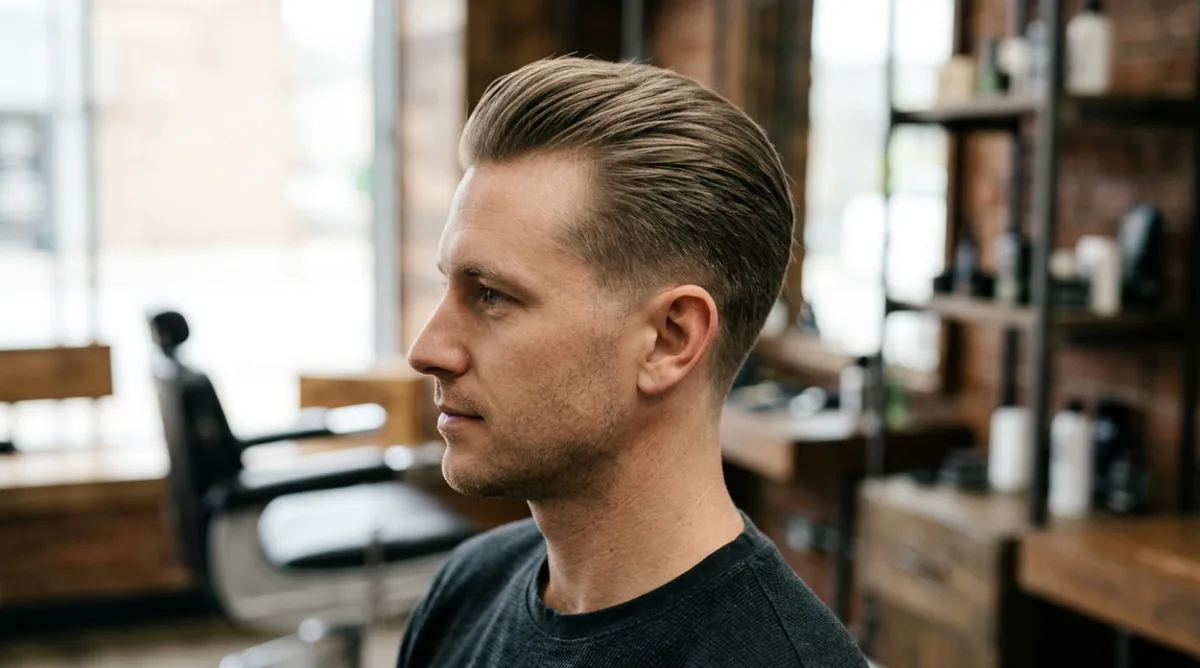
A short slick back is the one longer-top style that suits a thinning crown, as long as the front is still full. Combing back moves your strongest hair over the thin spot.
- Ask your barber: “About 3 inches on top, tapered shorter toward the crown, #1 or #2 undercut or taper on the sides.”
- Style it: Blow-dry back for lift, then a matte pomade. Wet-look gel clumps thin hair into lines and shows scalp.
- Skip it if: Your temples are receding. Slicking back exposes the hairline.
12. Subtle faux hawk

A subtle faux hawk pulls hair toward the center, which makes the top look denser and draws the eye away from thinning temples. Keep it low and textured, not a spiky ridge.
- Ask your barber: “Subtle faux hawk, about 2 inches through the center, shorter toward the edges of the top, #1 fade on the sides.”
- Style it: Matte paste worked toward the middle with your fingertips.
13. Curly crop with low taper

Thin curly or wavy hair has an advantage: curls take up more space than straight strands. A short curly crop keeps that volume while a low taper keeps the shape neat.
- Ask your barber: “Keep 2 to 3 inches of curl on top, shape it dry, low taper starting at a #1 on the sides. No thinning shears.”
- Style it: Leave-in curl cream or light mousse on wet hair, scrunch, don’t touch until dry.
14. Low cut with taper (Afro-textured hair)

For Afro-textured hair that’s thinning, a low cut keeps the coils short and even, so density looks uniform. Tight curls naturally cover more scalp than straight hair at the same length.
- Ask your barber: “Low cut, #1 or #2 on top, #0.5 taper on the sides, natural hairline, don’t push the line back.”
- Style it: Light moisturizer, soft brush. Add 360 waves with a durag routine if you like.
- Note: Pushing the hairline back with a razor line-up over time can make a receding hairline look worse. Ask for a natural edge.
15. Messy medium top

This is the exception to “go short.” If your strands are fine but your density is good and you have no pattern loss, a layered medium top (3 to 4 inches) with messy texture can look full and relaxed.
- Ask your barber: “Keep 3 to 4 inches on top with light internal layers for movement, scissor-cut sides, don’t take weight out of the ends.”
- Style it: Blow-dry upside down for 60 seconds, then texture spray or light paste.
- Skip it if: You see scalp under a ceiling light. Length will make it worse.
16. Classic taper (gentleman’s cut)

The classic taper is the best haircut for older men with thin or grey hair. Grey strands are often finer and wirier, and a short, tidy top with a gradual taper looks sharp without needing volume.
- Ask your barber: “Classic taper, 1.5 to 2 inches on top, gradual #4 to #2 taper on the sides, clean neckline.”
- Style it: A purple or silver shampoo once a week keeps grey from yellowing; a light matte cream keeps it neat.
17. Shaved head or skin fade + beard

When the top is mostly gone, owning it looks better than any cover-up. A shaved head or a #0 to #1 all-over with a skin fade, paired with stubble or a short beard, moves the visual weight to the jaw.
- Ask your barber: “#1 all over with a skin fade into the beard” or shave it with a foil shaver at home.
- Style it: Daily SPF on the scalp, a scalp moisturizer, beard oil.
- Next step: See our guide to beard styles for bald men.
Best haircuts for thin hair men by face shape, hair texture and age
Pick from your thinning-pattern shortlist first, then use face shape and texture as the tie-breaker. Your pattern decides what will look full; your face shape decides what will look balanced.
By face shape
| Face shape | Goal | Best thin-hair cuts | Be careful with |
|---|---|---|---|
| Oval | Keep balance | Almost any; textured crop, Ivy League, short quiff | Nothing major |
| Round | Add height, slim the sides | Short quiff, faux hawk, textured crop with mid fade | Caesar with full sides (makes the face wider) |
| Square | Soften or keep the strong jaw | Crew cut, side part, textured fringe | Very boxy flat tops |
| Oblong / long | Avoid extra height | French crop, Caesar, textured fringe | Quiff, faux hawk, high skin fade |
| Diamond | Add width at forehead | Textured fringe, French crop | Slick back with very tight sides |
| Heart / triangle | Balance a wider forehead | Side part, textured crop with forward fringe | Height on top with tight sides |
By hair texture
- Straight and fine: The hardest texture to bulk up, because strands lie flat. Go short (textured crop, Caesar, crew cut) and always use a pre-styler or sea salt spray before blow-drying.
- Wavy: Waves add natural volume. Textured fringe, curly crop or a messy medium top work well. Avoid heavy products that pull waves straight.
- Curly: Curls cover more scalp. Keep 1.5 to 3 inches on top, ask for a dry cut, and avoid thinning shears, which make curls frizz and separate.
- Afro-textured / coily: Short and even is the strongest look (low cut, taper, short Afro). Avoid tight cornrows or braids if your hairline is thinning; the American Academy of Dermatology notes that hairstyles that pull on hair can cause traction alopecia.
By age and grey hair
- 20s: Early thinning is common, so get a cut that looks good now and still works if the hairline moves (textured crop or French crop). This is also the best time to talk to a dermatologist, since early treatment keeps more hair.
- 30s to 40s: The Ivy League, crew cut and classic side part look professional and age well. Shorten the top as the crown thins.
- 50+ and grey: Keep it short and tidy (classic taper, crew cut). Grey hair reflects more light, so a matte finish matters even more; shine can make silver hair look see-through.
Haircut mistakes that make thin hair look thinner
Most “my hair looks thinner after the cut” moments come from a handful of avoidable mistakes. Each one either removes weight the hair needed or exposes the zone you wanted to hide.
| Mistake | Why it backfires | Do this instead |
|---|---|---|
| Thinning shears or razor on the top | Removes bulk thin hair can’t spare; ends look wispy and see-through | Ask for point cutting only |
| Growing it out to “cover” thin spots | Longer hair gets heavy, splits and shows scalp | Go shorter; short hair stands up |
| Comb-over | Draws attention to the exact area it hides, fails in wind and rain | Caesar, crop or buzz |
| Hard (shaved) part line | Adds a visible line of scalp | Natural side part |
| Very high skin fade under a sparse top | Bald sides next to a thin top highlights the thinning | Low or mid taper until stage 4+ |
| Wet-look gel or shiny pomade | Clumps strands into lines and reflects light off the scalp | Matte clay or paste |
| Pushing the hairline back with line-ups | Each line-up removes a little more edge | Ask for a natural hairline |
Barber cheat sheet, styling routine and upkeep
What to tell your barber (copy this)
Say this before any cut, then add the cut-specific line from the list above:
“My hair is thin [on top / at the crown / at the temples]. I want it to look fuller, so please keep weight on top, point cut for texture, no thinning shears or razor on the top, and keep the sides tighter than the top but not bald unless I ask.”
Two more tips that save a bad cut:
- Show two photos: one of the cut you want on a guy with thin hair, and one of what you don’t want. A model with dense hair sets the wrong expectation.
- Arrive with your hair styled the way you wear it. Your barber sees where it falls and where scalp shows.
The 3-minute styling routine for thin hair
- Wash with a volumizing shampoo, and use a lightweight conditioner on the ends only. Heavy conditioner weighs thin hair down.
- Towel-dry, then apply a pre-styler (sea salt spray or volume mousse) at the roots.
- Blow-dry on medium heat in the direction you want the hair to go, lifting at the roots with your fingers. This step adds more fullness than any product.
- Finish with a pea-sized amount of matte product, warmed between your palms and worked in from the back to the front.
- Optional: Hair-building fibers sprinkled over a thin crown give instant coverage for photos or events.
Products: what works and what doesn’t
| Product | Thin hair verdict | Why |
|---|---|---|
| Matte clay / paste | Best | Grips and separates without shine |
| Sea salt / texture spray | Best pre-styler | Adds grit and lift, very light |
| Volume mousse | Good | Lift at the roots; pick an alcohol-light one |
| Light cream | Good for Caesar, buzz and curls | Tames without weight |
| Shiny pomade / wet gel | Avoid | Clumps hair, shows scalp |
| Heavy wax / oil | Avoid | Weighs strands flat |
How often to get a trim
Short cuts lose their shape fast, and an overgrown cut on thin hair starts to split and lie flat. Most cuts in this guide need a trim every 3 to 4 weeks; buzz cuts and high and tights every 2 to 3 weeks; medium tops every 5 to 6 weeks. See the comparison table above for each cut.
Haircut vs hair loss: when to see a dermatologist
A haircut changes how thin hair looks; it does not slow hair loss. If your hair is getting thinner, not just naturally thin, a dermatologist visit is worth it, and earlier is better.
The American Academy of Dermatology says men who start treatment soon after noticing hair loss tend to see the best results. Its diagnosis guide notes that minoxidil can help early hair loss but can’t regrow a full head of hair, and results usually take 6 to 12 months. That timeline is exactly why the right haircut matters: it carries you through while treatment works.
Book a dermatologist if you notice:
- More hair than usual on your pillow, in the shower drain or on your comb for several weeks
- Temples or crown changing visibly within a year
- Patchy, round bald spots (this is not pattern hair loss)
- Itching, redness, scaling or pain on the scalp
- Sudden shedding after illness, stress, a new medication or weight loss
And a reality check that should take the pressure off: in a population study of 1,005 men aged 30 to 50, 58% had pattern hair loss. Thin hair is common, and with the right cut, it rarely looks like a problem.
FAQs about haircuts for thin hair men
What is the best haircut for thin hair men?
The textured crop is the best all-round haircut for thin hair men. It keeps the top at 1 to 2 inches with choppy, point-cut texture and tight tapered sides. Short textured hair stands up and interlocks, which hides scalp and makes hair look denser. For a receding hairline, the French crop is better; for a thinning crown, the crew cut.
Is short or long hair better for thin hair?
Short hair is better for most men with thin hair. Under about 2 inches, hair lifts off the scalp and overlaps; over 3 inches, it gets heavy, separates and shows scalp. The exception is fine but dense hair with no pattern loss, which can carry a layered 3 to 4 inch top.
What haircut hides a receding hairline?
Forward-styled cuts hide a receding hairline best: the French crop, Caesar cut and textured fringe. They bring hair over the temples on purpose, so it looks like a style rather than a cover-up. Avoid quiffs, pompadours and slick backs, which lift hair away from the hairline and expose it.
What haircut is best for a thinning crown?
The crew cut is best for a thinning crown because it graduates the top shorter toward the back, so the thin area gets the shortest hair. A short textured crop or a buzz cut also works. If the front is still full, a short matte slick back can move that hair over the crown.
Should I get a fade if I have thin hair?
Yes, but keep it low or mid while you still have hair on top. Tight sides make the top look denser by contrast. A very high skin fade next to a sparse top can make the thinning more obvious. Once you’re at stage 4 or beyond, a skin fade with a buzz cut works well.
What buzz cut guard is best for thinning hair?
A #2 to #4 guard is the sweet spot for thinning hair. A #3 or #4 keeps enough length to look like a haircut while blending thin areas. Go down to #2 or #1 as thinning advances. Start longer on your first buzz; you can always go shorter.
Does cutting hair make it grow back thicker?
No. Cutting hair does not change the follicle, so it can’t make hair grow back thicker or faster. It can make hair look thicker, because short hair stands up and trims remove split, see-through ends.
What should men with thin hair avoid?
Avoid thinning shears or razors on the top, comb-overs, hard part lines, growing it long to cover spots, and shiny gels or pomades. All of these either remove weight thin hair needs or make the scalp more visible.
Conclusion: pick the cut that fits your pattern
The best haircuts for thin hair men all follow the same logic: shorter, textured tops; tidy, tighter sides; and hair moved over the zone where you’re thinning. Start with your pattern in the thinning map, shortlist two cuts, and bring this guide’s barber script to your next appointment.
If you’re thinning fast, pair the haircut with a dermatologist visit. The cut handles how you look today; treatment handles what you keep.
Next step: Already past the thinning stage? Read our guide to hairstyles for balding men, or see exactly what a 2-guard buzz cut looks like before you commit.