

A bowl cut is a short haircut where the fringe and the hair around the head are cut to one rounded line, as if a bowl were placed on the head. The modern version keeps that rounded shape but adds texture, layers and a faded or undercut back and sides, so it looks styled, not homemade.
This guide covers what actually decides whether a bowl cut works on you: your face shape, your hair type, and the exact words you use in the barber’s chair. You’ll also get dedicated sections on the bowl cut mullet, the Asian bowl cut and the curly bowl cut, plus a maintenance plan and the mistakes that ruin the look.
Table of Contents
What Is a Bowl Cut?
The style has three defining parts: a fringe (bangs) across the forehead, a perimeter line that circles the head at roughly the same height, and even length on top that falls down and forward. Everything below the line is either shorter, faded or shaved.
The name comes from the old practice of putting a bowl on the head and trimming around its rim — a cheap home haircut that was common in medieval Europe and later in 1990s childhood photos.
Why it came back
Today’s version is a different haircut wearing an old name. Three changes made it fashionable again:
- Texture instead of a hard edge. Point-cutting and thinning shears break up the blunt line so it moves.
- Shorter back and sides. A taper fade or undercut removes the bulk that made the old version look like a helmet.
- K-pop and street style. Korean idols and actors made soft, rounded fringes mainstream, and films like The King (2019) put a sharp version on Timothée Chalamet.
Bowl Cut vs Mushroom Cut vs Edgar vs French Crop vs Two-Block
These cuts are often mixed up. The difference is mostly in the fringe line and the sides.

| Haircut | Fringe | Sides & back | Overall feel | Best for |
|---|---|---|---|---|
| Classic bowl cut | Blunt, one length, eyebrow level | Same line all around | Retro, bold | Straight, fine-to-medium hair |
| Modern bowl cut | Textured, slightly broken | Taper fade or undercut | Clean, current | Most straight and wavy hair |
| Mushroom cut | Rounded, more volume | Longer, puffier | Soft, voluminous | Thick or wavy hair |
| Edgar (Takuache) cut | Very straight, sharp, high | High skin fade | Sharp, graphic | Thick straight hair |
| French crop | Short, choppy | Short fade | Low-key, practical | Thinning hairline, busy routines |
| Two-block | Long, often parted or curtained | Undercut, disconnected | K-pop, flexible | Thick Asian hair |
Quick rule: if you want the round shape but less commitment, ask for a modern version with a taper. If you want maximum drama, go Edgar or classic.
Will a Bowl Cut Suit You? (Face Shape + Hair Type Table)
This style works best on oval, heart and long faces and on straight or wavy hair with medium-to-high density. Round and square faces can wear it too, but the fringe and sides need adjusting.
The fringe is the key: it shortens the face visually. That helps long faces and hurts very round ones unless you add height or texture.
| Face shape | Suits a bowl cut? | How to adjust |
|---|---|---|
| Oval | Yes — almost any version | Go classic or modern |
| Long / oblong | Yes — very flattering | Keep fringe at eyebrows to shorten the face |
| Heart | Yes | Soft, textured fringe; avoid very tight sides |
| Round | With changes | Choppy fringe, a bit of height on top, tight fade on sides |
| Square | With changes | Textured, slightly curved line to soften the jaw |
| Diamond | Yes | Keep some width near the temples |
| Hair type | Result | Tip |
|---|---|---|
| Straight, fine | Can look flat | Texture powder + point-cut fringe |
| Straight, thick | Excellent shape | Remove weight with thinning shears or a two-block |
| Wavy | Very natural, lived-in | Sea salt spray, air dry |
| Curly | Great volume | Cut dry, leave extra length for shrinkage |
| Coily | Possible as a rounded sculpted shape | Shape with clippers/shears around the head |
| Thinning crown or hairline | Mixed | French crop is usually the safer choice |
Exactly What to Tell Your Barber
Most bad versions come from vague instructions like “this haircut, please.” Give your barber four details: fringe length, line height, side style and texture.

Use this script and adjust the numbers:
“I’d like a modern bowl cut. Keep the fringe at eyebrow length, textured, not blunt. Bring the line around just above the ears. Do a low taper (or #2 undercut) underneath, and point-cut the top so it doesn’t look like a helmet. Please take weight out of the sides so they don’t puff out.”
| Decision | Options | What it changes |
|---|---|---|
| Fringe length | Mid-forehead / eyebrow / just below brows | Shorter = sharper; longer = softer |
| Fringe texture | Blunt / point-cut / choppy | Blunt = classic; textured = modern |
| Line height | Top of ear / mid-ear / below ear | Higher = bolder, more contrast |
| Underneath | Low taper / mid fade / #1–#3 undercut / none | More contrast = cleaner, more modern |
| Back | Tapered neckline / blocked / left long (mullet) | Sets the overall vibe |
Bring two photos: one front view and one side view. Side views matter most because they show where the line sits over the ear.

Bowl Cut Mullet
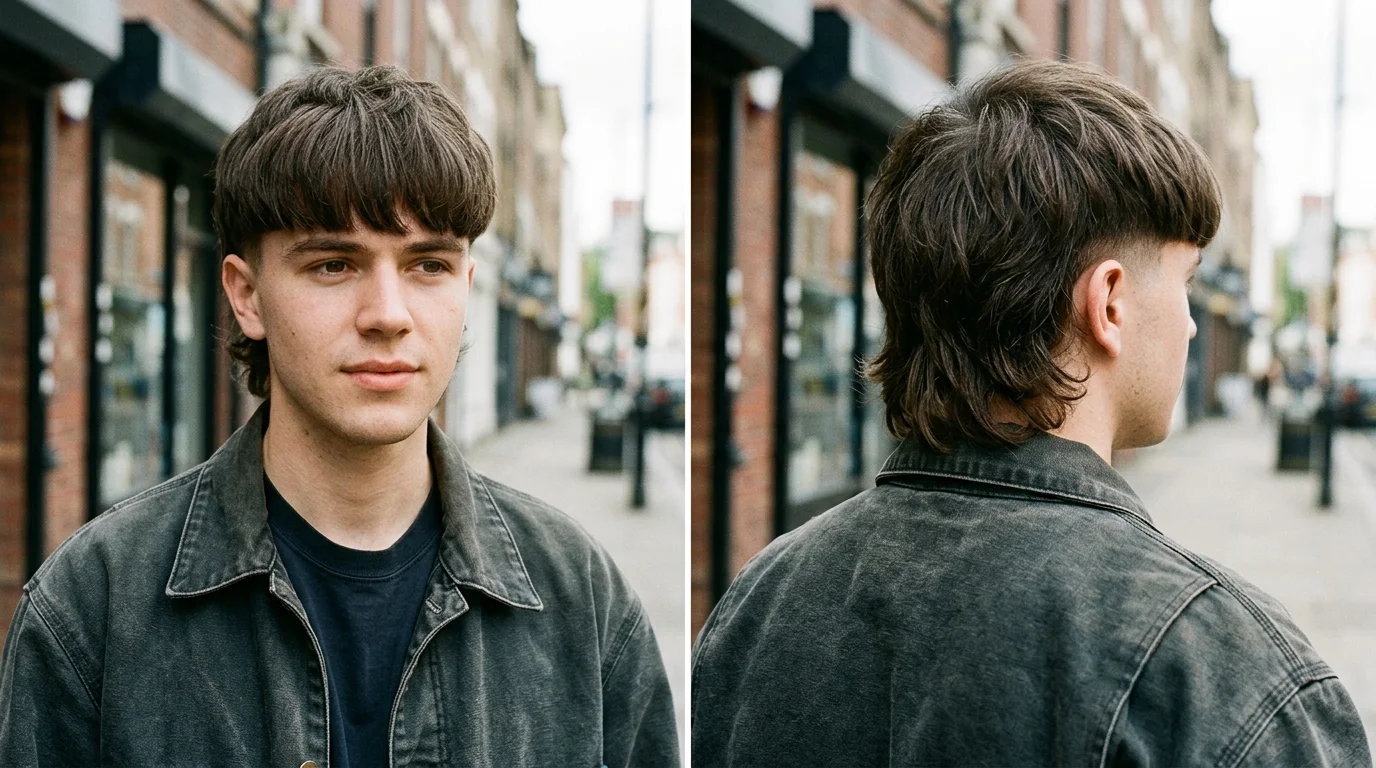
A bowl cut mullet combines a rounded bowl-shaped top and fringe with a longer section at the back (the classic mullet shape). It is the boldest version on this list — the contrast between short front and long back is the whole point.
How to ask your barber for one
Ask for a bowl-shaped fringe and top, the sides either tapered or kept short, and the back left at least 2–4 inches longer than the top. Keep the transition from top to back curved and smooth — sharp right angles make it look like a mistake.
Mullet variations
| Variation | Best hair type | Maintenance |
|---|---|---|
| Shaggy bowl mullet | Wavy or curly | Medium |
| Precision (blunt) bowl mullet | Straight | High — needs sharp lines |
| Bowl mullet with burst fade | Thick, any texture | Medium-high |
| Soft K-pop bowl mullet | Straight Asian hair | Medium |
Growing into a mullet (no awkward phase)
This is the easiest way to get a mullet without an awkward phase. Keep trimming the fringe and sides every 3–4 weeks, but ask your barber not to touch the back. After 2–3 months most people have enough length at the nape for a short mullet.
Asian Bowl Cut
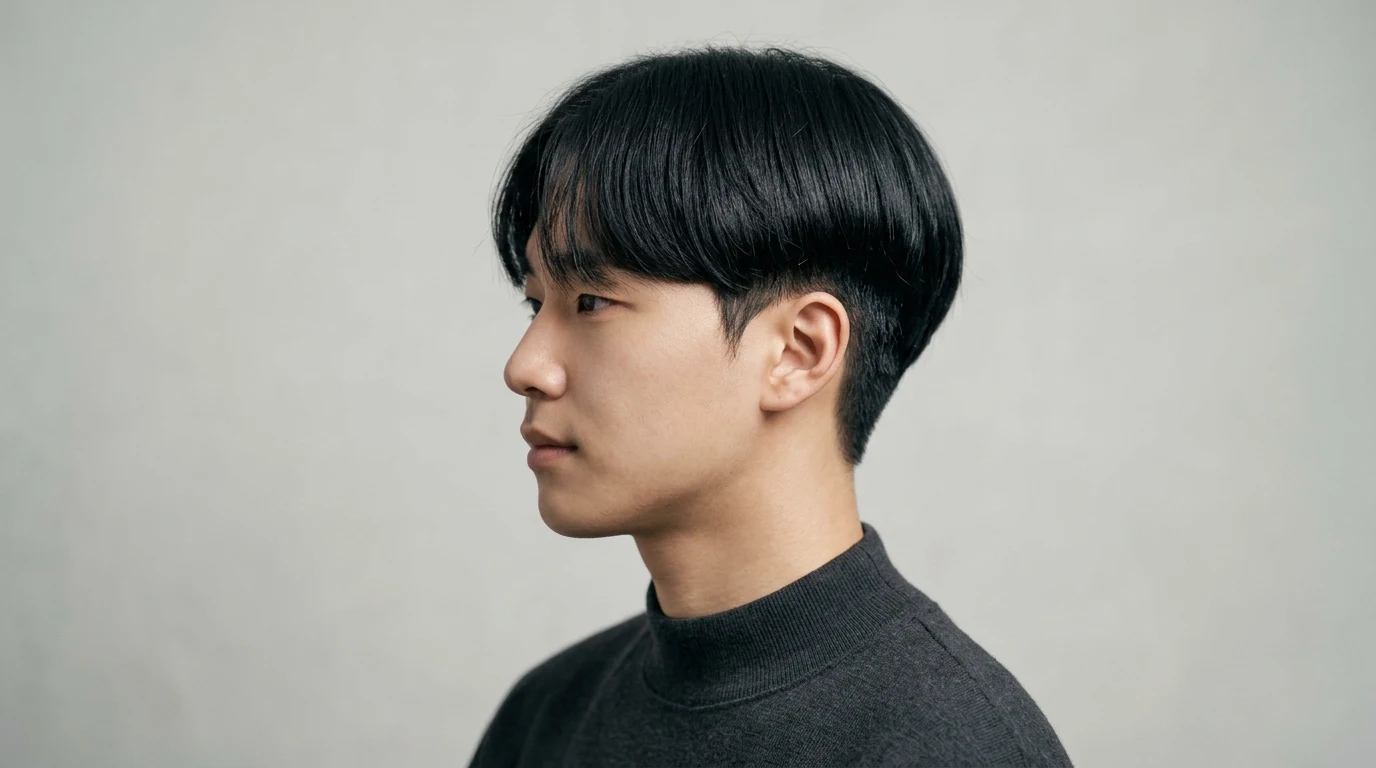
An Asian bowl cut is a softer, more textured bowl cut designed for thick, straight, coarse hair. Instead of a hard blunt line, it uses a light, wispy fringe and often an undercut so the sides lie flat.
The real problem with Asian hair (and the fix)
Thick straight hair tends to stick out at the sides and crown instead of falling down. That’s why a classic version can look puffy or mushroom-like on Asian hair. The fixes:
- Two-block undercut: the sides underneath are clipped short (#2–#3), and the top hair falls over them. This removes the puff completely.
- Thinning and point-cutting: removes bulk from the fringe so it lies flat and looks “see-through.”
- Blow-dry forward and down with a little heat, then add a light cream or matte paste.
Popular Korean-style versions
| Style | Look | Who it suits |
|---|---|---|
| Korean see-through cut | Wispy, light fringe | Oval and long faces |
| Two-block cut | Full top over a hidden undercut | Very thick hair |
| Curtain-fringe cut | Fringe split slightly in the middle | Round faces (adds vertical lines) |
| Down perm cut | Sides chemically flattened | Hair that refuses to lie flat |
Tip: a “down perm” is common in Korean salons to stop side hair from sticking out. Ask about it if your sides always puff up even after an undercut.
Curly Bowl Cut
A curly bowl cut shapes natural curls into a rounded, bowl-like silhouette. It is softer than a straight bowl cut because the curls blur the line, so it reads as stylish and relaxed rather than severe.

Why curly versions go wrong
Curls shrink when they dry. A blunt line cut on wet curly hair can jump 1–2 inches shorter and end up uneven. That’s the main reason curly bowl cuts fail.
How to get it right
- Cut dry or curl-by-curl — find a stylist who cuts curly hair dry.
- Leave extra length on the fringe; it will look shorter once curls form.
- Shape round, not flat — the top should keep volume; only the sides and back get shorter.
- Add a low taper or soft fade if you want a cleaner, more masculine finish.
Styling the curls
Apply a curl cream or leave-in conditioner to damp hair, scrunch, then diffuse on low heat or air dry. Don’t brush it once dry — use your fingers to separate curls. A light mousse adds hold without crunch. For a full wash-day setup, follow this curly hair routine for men.
Other Modern Variations
If none of the three main styles fits, these are the most-requested alternatives:
- Rounded cut with taper fade — the cleanest, most office-friendly version.
- Undercut version — strong contrast; the top falls over shaved sides.
- Textured / messy version — choppy layers, low effort, styled with powder.
- Edgar version — razor-straight fringe with a high skin fade.
- Women’s version / pixie bowl — rounded fringe with a soft feminine neckline.
- Long version — fringe and sides around jaw length; closer to a mod bob.
- Kids’ version — still popular because it grows out evenly and is easy to trim.
How to Style Bowl Cut Hair (Products by Hair Type)
The goal is a fringe that falls forward with movement, not a flat cap. Most these cuts only need one product and a hair dryer.
Basic routine (3 minutes):
- Towel-dry hair until damp.
- Apply a pre-styler (sea salt spray or light cream).
- Blow-dry forward and down, using fingers to shape the round line.
- Finish with a small amount of matte product; twist a few fringe pieces for texture.
| Hair type | Pre-styler | Finisher | Hold / shine |
|---|---|---|---|
| Fine straight | Sea salt spray | Texture powder | Light, matte |
| Thick straight / Asian | Styling cream | Matte paste or clay | Medium, matte |
| Wavy | Sea salt spray | Light cream | Light, natural |
| Curly | Curl cream / leave-in | Mousse or gel (scrunched) | Medium, soft shine |
Avoid heavy pomade on this cut — the weight flattens the fringe and makes the round shape collapse.
Maintenance, Cost and Grow-Out Plan
This cut needs a trim every 3–5 weeks. The fringe is the first thing to lose shape, and any fade or undercut grows out fast.
| Part | How often | Can you do it at home? |
|---|---|---|
| Fringe trim | Every 2–3 weeks | Yes, carefully, with point-cutting |
| Fade / undercut | Every 2–3 weeks | Only if you’re experienced with clippers |
| Full reshape | Every 4–6 weeks | No — see a barber |
Cost: this cut costs about the same as any standard men’s or women’s cut at your barber or salon. Precision versions (Edgar, blunt bowl mullet) need more frequent visits, so the yearly cost is higher.
Grow-out plan (no awkward stage)
- Weeks 0–6: keep cleaning the sides and neckline; let the fringe grow.
- Weeks 6–10: sweep the fringe to one side or split it into curtain bangs.
- Weeks 10+: ask for layers to turn it into a textured crop, a curtain cut, or (if you left the back alone) a mullet.

7 Mistakes That Ruin the Look
- Cutting the fringe too short — it should hit mid-forehead or lower, or the face looks wider.
- Leaving bulk on the sides — this creates the “helmet” look. Ask for weight removal or a two-block.
- A perfectly blunt line on wavy or curly hair — it won’t stay even.
- Wet-cutting curls — shrinkage makes it uneven.
- Ignoring cowlicks — a strong cowlick at the front can split the fringe; tell your barber before cutting.
- Heavy, shiny products — flatten the shape and look greasy.
- Skipping trims — this cut loses its shape faster than most short cuts.
Frequently Asked Questions
Are bowl cuts still in style in 2026?
Yes. The modern bowl cut — textured fringe with a taper or undercut — is still a popular request, especially through K-pop and street-style influence. The flat, helmet-like 1990s version is the one that looks dated, so ask for texture and shorter sides.
What is the difference between a bowl cut and a mushroom cut?
They share the same rounded shape. This cut usually has a straighter, cleaner line, while a mushroom cut has more volume and roundness on top and puffs out slightly at the sides. Many barbers use the two names interchangeably.
Does a bowl cut work on curly hair?
Yes, and it often looks better than on straight hair because curls soften the line. The key is to cut the hair dry, leave extra length for shrinkage, and style with curl cream and a diffuser rather than a brush.
How do I stop my Asian bowl cut from puffing out at the sides?
Ask for a two-block undercut so the bulky hair under the top layer is removed, and request thinning on the fringe. Blow-dry forward and down. If the sides still stick out, a down perm at a Korean salon can flatten them.
How long does hair need to be for a bowl cut?
You need roughly 3–4 inches (7–10 cm) on top and at the front so the fringe can reach the forehead. The sides can be any length because they are usually faded or undercut.
Can I cut a bowl cut at home?
You can trim the fringe at home with sharp scissors and point-cutting, but the full shape, line and fade are best left to a barber. Home cuts with a real bowl usually produce the old, uneven look people are trying to avoid.
Is a bowl cut mullet hard to maintain?
It needs a trim every 3–4 weeks to keep the front and sides sharp, while the back is only tidied occasionally. Shaggy versions are lower maintenance than precision blunt versions.
Final Verdict
The bowl cut is no longer a joke haircut — it’s a shape you can customise. Choose a modern bowl cut with a taper if you want an easy everyday look, a bowl cut mullet if you want maximum attitude, an Asian bowl cut with a two-block if your hair is thick and straight, or a curly bowl cut cut dry if you have natural curls.
Whatever you choose, the result depends on three things: the right version for your face and hair type, clear instructions for your barber, and a trim every few weeks.
Ready for the chair? Save the barber script above, bring a front and side photo, and book your cut with a barber who has bowl cuts or two-blocks in their portfolio. Not sure the cut is your shape? Check the best options in our guide to men’s haircuts for your face shape.