

A French crop fade is a short men’s haircut with faded sides, a textured top of 1–2 inches (2.5–5 cm), and a straight fringe pushed forward onto the forehead. It takes about 90 seconds to style, needs a trim every 3–4 weeks, and suits most face shapes and hair types.
The problem is that most guys walk in, say “French crop fade”, and walk out with something closer to a Caesar or a buzz cut. This guide fixes that. You get the exact clipper guard numbers, the fringe-length rule for your forehead, and fixes for the hair types that usually fight the cut.
New to the cut itself? Our complete French crop haircut guide covers the basics. This page focuses on the fade side of the cut and the numbers your barber needs.
Table of Contents
What Is a French Crop Fade Haircut?
A French crop fade has three parts: faded sides and back, a cropped textured top, and a fringe that sits forward on the forehead. If the fringe is missing, it isn’t a French crop. If the sides aren’t graduated, it isn’t a fade.
| Part | Typical length | What it does |
|---|---|---|
| Sides and back | Guard #0–#3 (0–10 mm), faded or tapered | Creates contrast and a clean outline |
| Top | 1–2 in (2.5–5 cm), shorter at the crown | Gives texture and weight to push forward |
| Fringe | Blunt or point-cut, 1–4 cm above the brows | The signature line of the cut |
The French crop started as a practical short style and has come back hard in recent years. Modern Barber links its revival to Peaky Blinders, Tom Holland and Gladiator II. Adding a fade is what made it the most-requested version in barbershops today.
French Crop Fade vs Caesar Cut vs Textured Crop
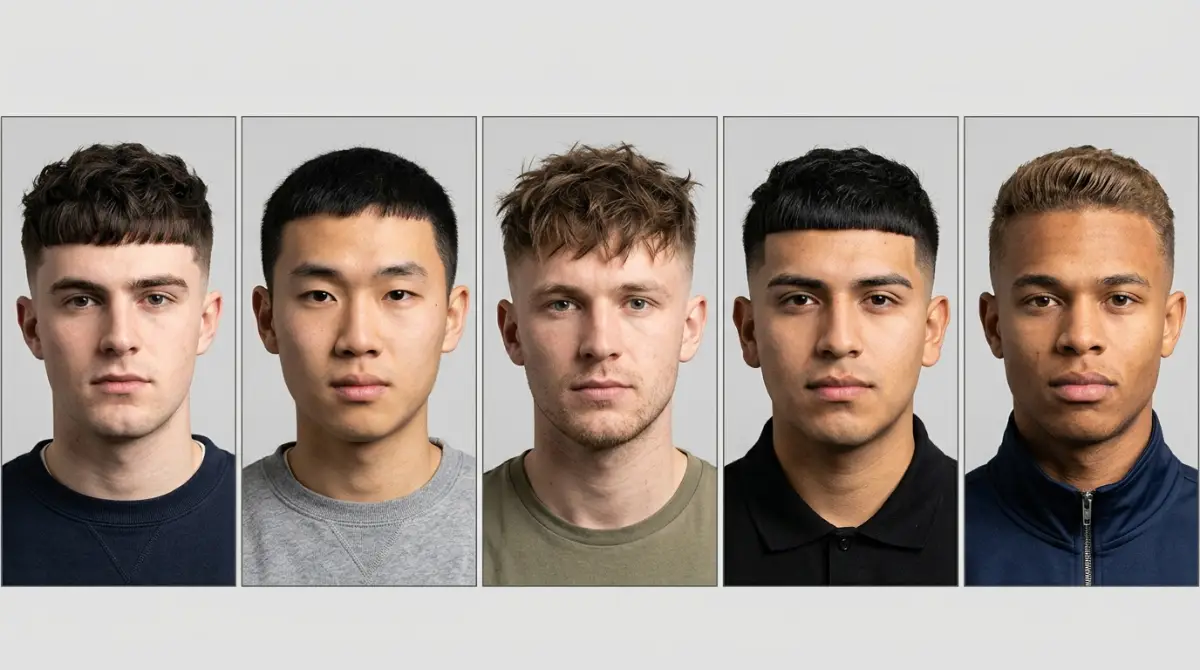
A French crop fade has more top length and a more visible fringe than a Caesar cut. A textured crop swaps the straight fringe for a choppy one. Some sites treat these as the same cut. They aren’t, and mixing them up is how bad haircuts happen.
| Cut | Top length | Fringe | Overall look |
|---|---|---|---|
| French crop fade | 1–2 in, textured | Straight or lightly textured, clearly visible | Clean but modern |
| Caesar cut | Under 1 in, uniform | Very short, straight across | Neat, military, minimal |
| Textured crop | 1–2.5 in, heavily point-cut | Choppy, jagged, piecey | Messy, casual, Gen Z |
| Edgar cut | 1–2 in | Very blunt, razor-sharp horizontal line | Bold, high contrast |
| Crew cut | 1–2 in | None — top pushed up or back | Classic, conservative |
Quick rule: if you want the fringe to be the feature, ask for a French crop fade. If you want the shortest, lowest-effort version, ask for a Caesar.
8 French Crop Fade Styles Worth Trying
The classic and the textured French crop fade cover most requests. The other six are variations on fade height, top length and fringe shape.
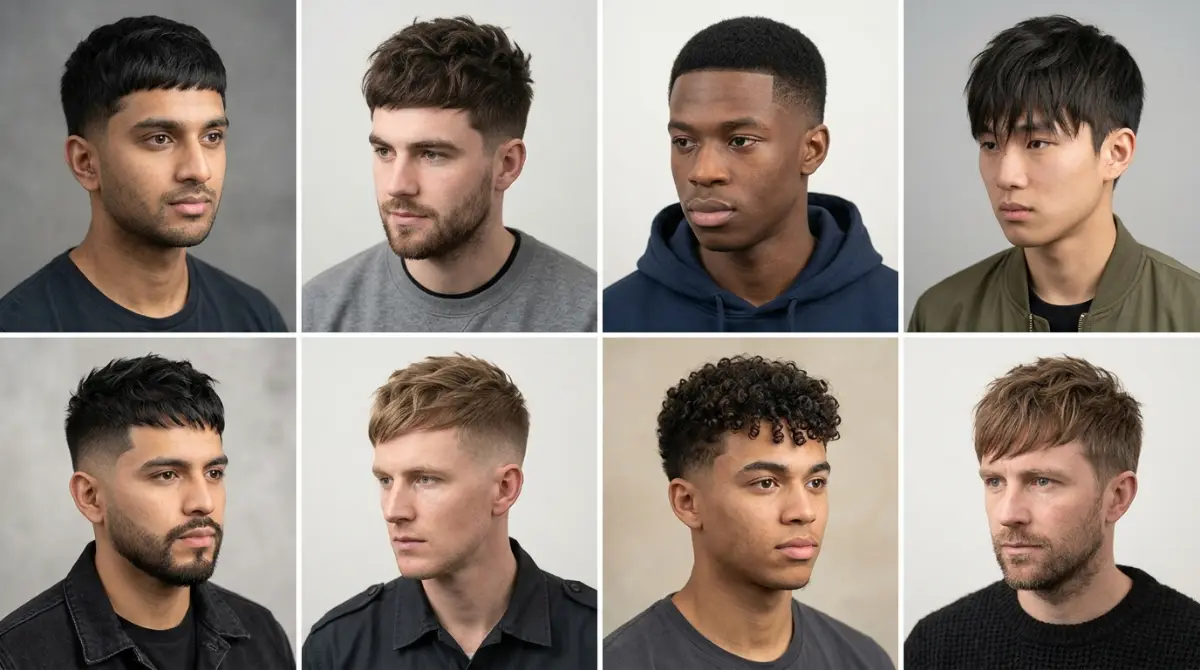
1. Classic French Crop With Low Taper
Short tapered sides, a 1–1.5 inch top and a straight fringe just above the brows. Best for office jobs and straight hair. It barely needs product.
2. Textured French Crop Fade
The top is point-cut into choppy layers and the fringe is broken up. Best for thick or wavy hair, because the texturising removes bulk so the hair falls forward instead of puffing up.
3. Short French Crop
Top under 1 inch with a high, short fringe. It sits between a French crop and a Caesar. Best for very low maintenance, hot climates and the gym.
4. Long French Crop
2–3 inches on top with a softer fringe that drops toward the brows. More movement and more styling options, but more daily work too.
5. Mid or High Skin French Crop Fade
The sides go down to bare skin and blend up to the top. A mid fade looks balanced; a high skin fade gives the sharpest contrast. Both look freshest for about two weeks.
6. Disconnected French Crop
Very short or shaved sides with no blend into the top. High contrast and bold. It looks sharpest for about 2 weeks, then the line softens.
7. Curly French Crop Fade
Curls kept 2–3 inches on top and allowed to fall forward, with a low or mid fade. You need a barber who cuts curls dry so the length isn’t misjudged.
8. French Crop for a Receding Hairline
The fringe is left a little longer and textured so it covers the temples without looking like a cover-up. Pair it with a soft taper, not a skin fade.
Which Fade to Pair With Your French Crop
Pick the fade by your job and head shape, not just by photos. A low taper is the safest first try; a high skin fade gives the most contrast but grows out fastest.
| Side option | Guard range | Best for | Looks fresh for |
|---|---|---|---|
| Scissor-cut or long taper | #3–#4 | Conservative workplaces, thinning hair | 4–5 weeks |
| Low taper / low fade | #0.5–#2 | Most guys; safe first try | 3–4 weeks |
| Mid fade | #0–#2 | Balanced, modern look | 3 weeks |
| High skin fade | Bare skin–#1 | Round faces, strong contrast | 2 weeks |
| Disconnected / undercut | #0–#1, no blend | Thick hair, bold style | 2 weeks |
If your head has flat spots or bumps at the back, skip the high skin fade. A low fade or taper hides the shape better. For a deeper look at fade heights, see our low fade vs mid fade vs high fade comparison or the full low taper fade guide.
Will a French Crop Fade Suit You? Face Shape and Hair Type
A French crop fade suits oval, square, long and heart-shaped faces best, and works on round faces if you keep some height on top. Hair type matters more than face shape: straight and wavy hair are easiest, while very thick or curly hair needs specific cutting.
By Face Shape
| Face shape | Works? | Adjustment |
|---|---|---|
| Oval | Yes | Any version |
| Square | Yes | Classic or textured; the straight fringe echoes the jaw |
| Long / oblong | Very well | Lower fringe adds width and shortens the face |
| Round | Yes, with care | Mid or high fade, some height on top, avoid flat styling |
| Heart | Yes | Fuller fringe balances a wide forehead |
| Diamond | Yes | Textured fringe softens the cheekbones |
Not sure of your shape? Our men’s haircuts for your face shape guide shows how to measure it in two minutes.
The Fringe-Length Rule (By Forehead)
This is the decision most guides skip. Set fringe length by forehead height and hairline, not by the photo:
- High forehead or receding temples: fringe 1–2 cm above the brows, textured so it spreads sideways over the temples.
- Average forehead: fringe at mid-forehead, about 3–4 cm above the brows.
- Low forehead or heavy brows: shorter, higher fringe so the face doesn’t look compressed.
- You wear glasses: keep the fringe above the top of the frames, or it will rest on them and split.
By Hair Type
- Straight, fine: ideal for a blunt fringe. Keep at least 1.5 inches on top so it doesn’t look thin.
- Wavy: go textured; the wave does the styling for you.
- Curly: keep 2–3 inches on top so curls can form, and ask for a dry cut.
- Thinning: works well. A forward fringe hides the hairline and short length reduces see-through spots. More ideas in our haircuts for thin hair guide.
- Thick, straight, dense hair (common in South Asian, East Asian and Middle Eastern hair): the hardest type for this cut — see the fix below.
Exactly What to Ask Your Barber for a French Crop Fade
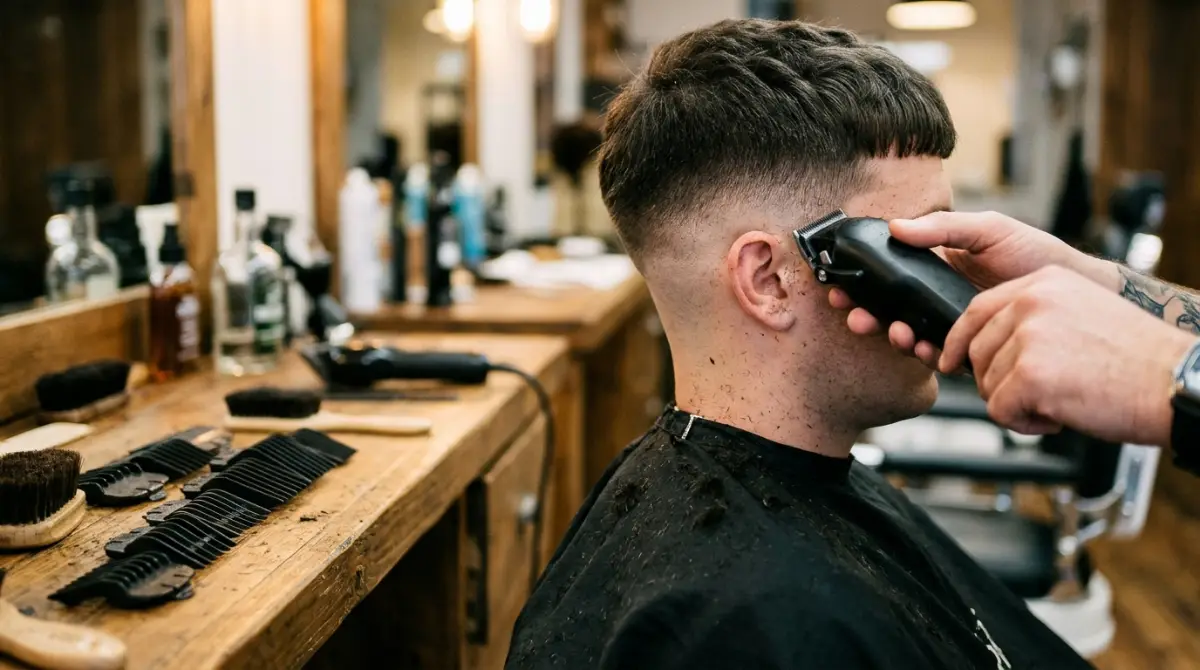
Give your barber four numbers and a photo: sides guard, fade height, top length and fringe position. “Just a French crop fade” leaves too much open to interpretation.
Copy this script and change the numbers:
“French crop, please. Low fade starting at a #1 on the sides and back. Leave about 1.5 inches on top, a bit shorter at the crown. Point-cut the top for texture. Fringe straight across, sitting about two fingers above my eyebrows.”
| Guard number | Length | Use it for |
|---|---|---|
| #0 (no guard) | ~0.8 mm | Bottom of a skin or high fade |
| #1 | 3 mm (1/8 in) | Low fade base, disconnected sides |
| #2 | 6 mm (1/4 in) | Taper base, conservative sides |
| #3 | 10 mm (3/8 in) | Long taper, top of a fade blend |
| #4 | 13 mm (1/2 in) | Soft scissor-over-comb look |
Want to see what those guard lengths look like on their own? Our 0 guard vs 1 guard comparison shows the difference up close.
Bring 2–3 photos of the same cut on someone with your hair type, from the front and side. A photo of straight hair won’t translate to curls.
How to Style a French Crop Fade in 90 Seconds
Towel-dry, add a pea-sized amount of matte product, push everything forward, and break up the fringe with your fingertips. No comb needed.

- Towel-dry until hair is damp, not wet.
- Optional: spray sea salt spray and blow-dry forward on medium heat for 30 seconds. This locks the direction.
- Rub a pea-sized amount of product between your palms until it’s invisible.
- Work it in from the back of the top toward the front.
- Pinch and twist small sections of the fringe so it doesn’t look like one solid block.
Best Products by Hair Type
| Hair type | Best product | Why |
|---|---|---|
| Fine / thinning | Texture powder or sea salt spray | Adds grip without weighing hair down |
| Straight, normal | Matte paste | Natural finish, flexible hold |
| Thick / dense | Strong-hold matte clay | Holds heavy hair forward |
| Wavy / curly | Curl cream or light cream | Defines curls without crunch |
| Wet-look trend | Light gel or water-based pomade | Shine and separation |
Not sure which finish you want? Read our hair gel vs pomade vs clay breakdown before you buy.
Common French Crop Fade Problems and How to Fix Them
Most failed French crops come from three things: hair that grows the wrong way, hair too thick to lie flat, or a fringe cut too short. All three are fixable in the chair.
Thick, Dense Hair Sticks Straight Up
Ask for heavy point-cutting or thinning-scissor work on the top to remove bulk, and keep the top 2 inches or longer. Short dense hair stands up; longer hair has the weight to fall. Blow-dry it forward every morning for the first week to train it.
Cowlick at the Front Hairline
Leave the fringe slightly longer so its weight holds it down, and choose a textured fringe over a blunt one. A blunt line shows every split.
Double Crown
Tell your barber before they start. They should leave the crown longer rather than clip it short, or you’ll get a spike at the back.
Fringe Cut Too Short
Hair grows about half an inch (1–1.5 cm) a month, according to the American Academy of Dermatology. Wear a messy textured style for 2–3 weeks and the fringe will be back in shape.
How Much Does a French Crop Fade Cost and How Long Does It Take?
Expect a French crop fade to take 30–45 minutes and cost about the same as any skin fade at your local shop. A fade costs more than a basic clipper cut because blending the sides takes extra time and skill.
| Region | Typical price range | Time in the chair |
|---|---|---|
| USA / Canada | $25–$50 | 30–45 min |
| UK | £15–£30 | 30–40 min |
| Australia | A$30–A$55 | 30–45 min |
| UAE | AED 50–120 | 30–45 min |
These are typical barbershop ranges, not fixed prices. City-centre and premium shops charge more, and a skin fade usually costs a few dollars more than a taper. A fringe-only touch-up between visits is often free or cheap, so ask your barber.
French Crop Fade Maintenance and How to Grow It Out
Book a full cut every 3–4 weeks to keep the fringe sharp and the fade clean. Between visits, a fringe-only trim around week 3 buys you an extra 1–2 weeks.
If you want to grow it out, the French crop moves into other good styles without an awkward phase:

| Time without a cut | What you have | Style it as |
|---|---|---|
| 4–6 weeks | Fringe reaching the brows | Messy textured crop |
| 8–10 weeks | 2.5–3 in on top | Side-swept fringe or a short quiff |
| 12–16 weeks | 3–4 in on top | Ivy League, side part or short curtains |
Ask your barber to keep tidying only the sides and neckline during this time. That keeps it looking intentional while the top grows. Once you hit the curtains stage, our curtain haircut guide takes over.
French Crop Fade FAQs
What is the difference between a French crop fade and a Caesar cut?
A French crop fade has a longer, textured top (1–2 inches), a clearly visible fringe and graduated sides. A Caesar cut is shorter all over, under an inch, with a very short, straight fringe and a uniform top. Think of the Caesar as the minimal military version and the French crop as the modern, textured one. If you want the fringe to be the feature, ask for a French crop.
Is a French crop fade good for thinning hair or a receding hairline?
Yes, it is one of the best options. The forward fringe covers the hairline and temples, and the short length reduces see-through spots on top. Ask for a slightly longer, textured fringe rather than a blunt one, and keep the sides tapered instead of skin-faded so the contrast doesn’t highlight thin areas.
How often should I get a French crop fade cut?
Every 3–4 weeks keeps the fringe sharp and the sides clean. Hair grows about half an inch a month, so after week 4 the fringe starts touching the brows and the fade looks soft. A quick fringe-only trim at week 3 can stretch the time between full cuts.
Does a French crop fade work on thick or Asian hair?
Yes, but it must be cut differently. Thick, straight, dense hair tends to stand up when cut short. Ask for heavy texturising on top, keep at least 2 inches of length so the weight pulls hair down, and blow-dry it forward for the first week. A strong matte clay will hold it in place.
What should I say to my barber for a French crop fade?
Give four details: the guard number for the sides (for example a #1 low fade), top length (around 1.5 inches), texture (point-cut or blunt), and fringe position (for example two fingers above the brows). Bring 2–3 photos of the cut on someone with your hair type, from the front and side.
Can I grow out a French crop without an awkward phase?
Yes. At 4–6 weeks it becomes a messy textured crop, at 8–10 weeks a side-swept fringe or short quiff, and at 12–16 weeks it can be styled as an Ivy League or side part. Keep getting the sides and neckline tidied while the top grows.
Final Thoughts: Is a French Crop Fade Worth Trying?
A French crop fade is one of the safest new cuts to try: low effort, office-friendly, and easy to change later. Start with a low taper if you’re unsure, then go higher on your next visit once you know how your hair behaves.
Ready to book? Save this guide, show your barber the cheat-sheet numbers above, and pick your products from our best hair styling products for men list.
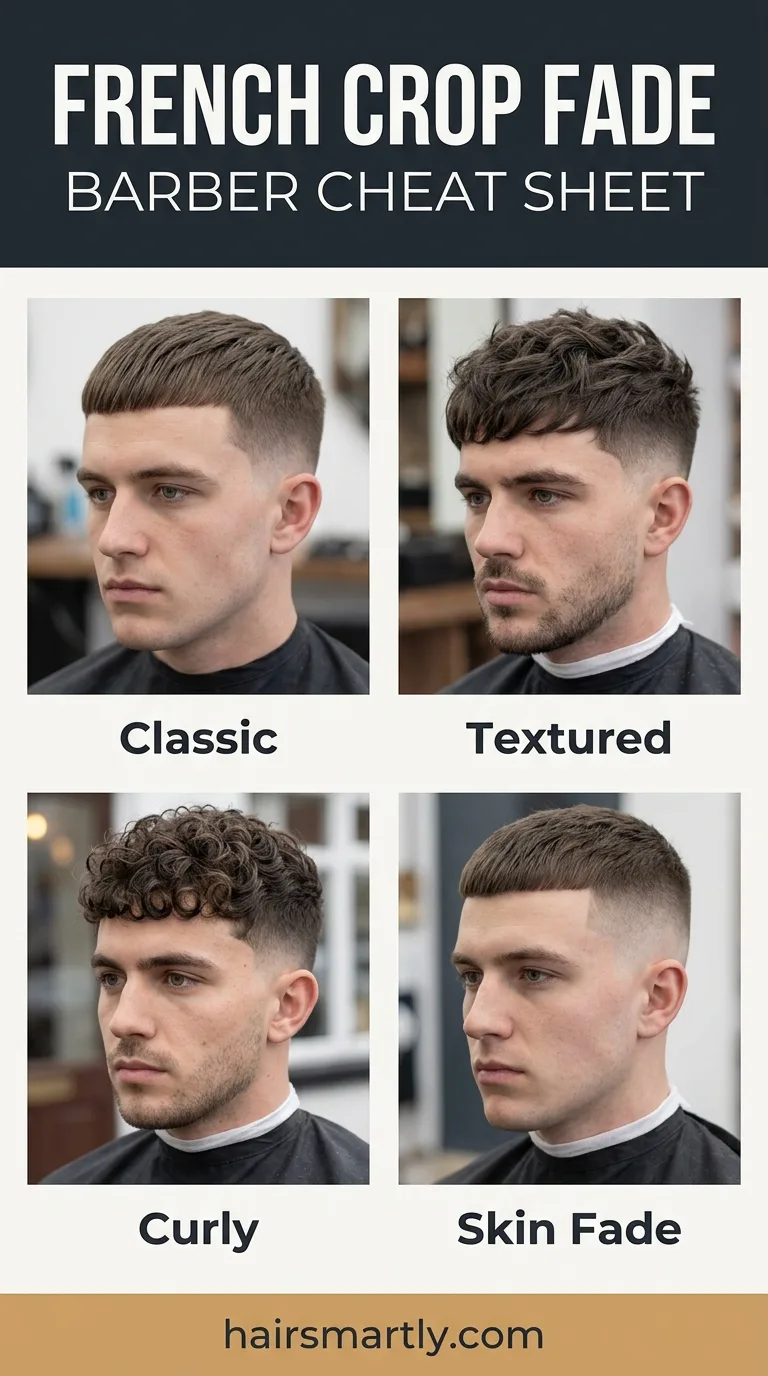
Save this French crop fade cheat sheet to Pinterest for your next barber visit.