

A shag haircut for men is a layered cut where shorter pieces sit at the crown and longer pieces fall toward the ears and collar, with feathered, point-cut ends. The layers create volume and movement on their own, so the hair looks loose on purpose, not neglected.
The shag is back because men want length without a 10-minute styling routine. But “shag” covers everything from a tidy cropped version with a taper to a full 1970s rock cut. Pick the wrong version for your hair, hairline or job, and a cool cut turns into a messy one.
This guide skips the 50-photo scroll. You get a layer map with real lengths, a barber script you can read out at the chair, hairline rules most guides ignore, and a month-by-month plan to grow out of a fade.

Quick answer: For most men, start with a medium shag (2.5–4 in / 6–10 cm on top, ears half-covered, back at the collar) with a low taper at the neckline. It suits the widest range of hair types, passes in most offices, and grows out forgivingly.
Table of Contents
What Is a Shag Haircut for Men?
A men’s shag haircut is defined by stacked layers all around the head: shortest at the crown, progressively longer below, with textured ends instead of a blunt line. The shape is cut in, so product only finishes it.
Three features separate a real shag from “just long hair”:
- Crown layers that lift the top and stop it sitting flat.
- A textured fringe that falls between the brows and cheekbones.
- Soft, broken ends at the ears and nape, created with point-cutting or a razor.

How the men’s shag has changed
The cut has moved from big blow-dried volume to an air-dry friendly shape with cleaner edges. If you like the original look, our guide to 1970s men’s hairstyles covers where it started.
| Era | What it looked like | What changed |
|---|---|---|
| 1970s rock shag | Heavy feathering, brow-length fringe, length past the collar | Big volume, mostly blow-dried |
| 1990s grunge shag | Grown-out fringe, loose ends, slept-in finish | Less volume, more texture |
| 2020s modern shag | Shorter layers, taper or fade at the neckline, matte finish | Cleaner edges, air-dry friendly |
Shag vs Wolf Cut vs Shaggy Mullet vs Flow
The difference is where the length sits. A shag spreads layers evenly around the head. A wolf cut and a shaggy mullet push weight to the back. A flow keeps length but has few layers.
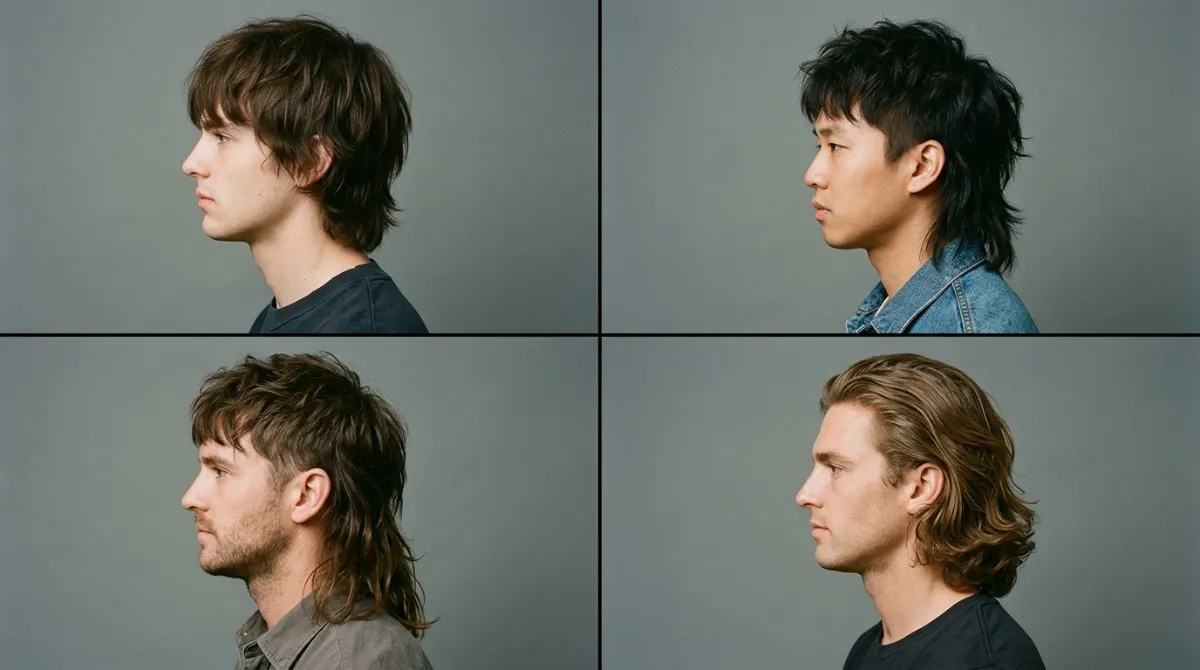
| Cut | Length distribution | Profile view | Best for | Office-friendly? |
|---|---|---|---|---|
| Shag | Even all round, short crown | Rounded, full | Wavy, thick, or straight hair needing movement | Yes, with a taper |
| Wolf cut | Short choppy top, longer back | Strong top-to-back contrast | Straight or wavy hair, edgier look | Depends on workplace |
| Shaggy mullet | Shorter sides, clearly long back | Obvious “party in the back” | Statement style | Usually casual only |
| Flow / bro flow | Long, swept back, light layers | Smooth, pushed back | Thick straight or wavy hair | Yes |
Rule of thumb: If you want movement without a long back, ask for a shag. If you want the long back to read clearly, read our shaggy mullet guide. If you want something in between, see our wolf cut guide.
Is a Shag Right for You? 7-Question Check
Answer yes or no. Five or more “yes” answers means a medium or long shag will suit your life. Three or four means start with a short shag. Two or fewer means wait, or pick a textured crop.
- Can you live with 2–4 months of in-between length if you’re coming from a fade?
- Do you air-dry or rough-dry, rather than slick your hair down every day?
- Does your workplace accept hair touching the ears?
- Is your hair wavy, thick, or straight but dense?
- Will you book a trim every 6–8 weeks?
- Will you use conditioner at least every other wash?
- Are you fine with a slightly “undone” finish most days?
Best Men’s Shag Haircut by Hair Type (and the Density Test)
Wavy hair is the easiest shag texture. Straight hair needs more cutting technique, curly hair needs a dry cut, and fine hair needs fewer, longer layers.
Do the 30-second density test first. Wet your hair, comb it straight back, and look in a mirror under overhead light. If you can see scalp easily through the top, treat your hair as fine or low density, whatever each strand feels like. This one check decides how aggressive your layers can be.
| Hair type | Best shag | Ask for | Avoid |
|---|---|---|---|
| Straight, thick | Medium or choppy shag | Interior weight removal, point-cut ends | Surface thinning (causes frizz and spiky bits) |
| Straight, fine | Short shag or shaggy crop | Longer, softer layers; keep the perimeter full | Heavy razoring, many short crown layers |
| Wavy | Classic medium or long shag | Layers that follow the wave’s bend | Cutting short pieces before seeing it dry |
| Curly | Curly shag, rounded shape | Dry or near-dry cut, shrinkage planning | Razor on curls, straight-hair reference photos |
| Coily / tight curls | Rounded shag-inspired shape | A textured-hair specialist; shape by density | Tension-heavy styling at the hairline |
| Coarse or frizz-prone | Soft blended shag | Shear-cut layers, a moisture routine | Over-thinned ends |
Got thick waves? Our guide to haircuts for thick wavy hair has more options that work with the same texture.
Shag by Face Shape, Plus Beard Pairing
With a shag haircut for men, use face shape to decide where the shortest layer and the fringe land, not whether you’re “allowed” a shag. Almost every face shape can wear one.
| Face shape | Shag to try | Fringe length | Beard that balances it |
|---|---|---|---|
| Oval | Almost any; medium shag is safest | Brow to eye | Any; stubble keeps focus on the hair |
| Round | Shag with height at the crown + taper | Swept, cheekbone length | Short boxed beard, longer at the chin |
| Square | Softer, wavy or curly shag | Curtain or broken fringe | Short, rounded beard; no hard square edges |
| Long / oblong | Shag with side volume, low crown | Brow length, straight across | Fuller on the cheeks, short at the chin |
| Heart / inverted triangle | Medium shag, fuller at the jaw | Curtain fringe | Medium beard to add width at the jaw |
| Diamond | Shag with soft pieces at the temples | Brow length | Fuller chin beard |
Beard tip: Blend your sideburns into the beard. A shag with hard, shaved sideburns looks like two different haircuts. For more pairings, see our guide to beard styles for your face shape.
Shag Haircut With a Receding or Thinning Hairline
Yes, a shag haircut for men often works with temple recession. The fringe and crown layers can soften a receding hairline, but only if the layers stay long and the density stays on top.

- Mild temple recession (Norwood 2): A textured fringe brushed forward and slightly to one side hides the temple corners well. Keep the fringe at brow length.
- Moderate recession (Norwood 3): Choose a short or medium shag with a messy forward fringe. Avoid a centre part, because it opens up both temples.
- Crown thinning: Keep crown layers longer, not shorter. Short crown layers lift the hair and expose the scalp at the whorl.
- Diffuse thinning all over: A long shag usually looks thinner. A shaggy crop is the better choice.
- Product: Use texture powder or a light spray at the roots. Heavy clay clumps strands together and shows more scalp.
If your hairline is changing fast, a dermatologist can tell you whether it’s pattern hair loss or something treatable. The American Academy of Dermatology has a clear hair loss resource center. You can also compare other hairstyles for balding men before you commit.
Cowlicks and Double Crowns
In any shag haircut for men, the shortest layer should never sit right on a cowlick. Short hair on a whorl stands straight up, and no product will hold it down all day.
- Crown cowlick or double crown: Ask the barber to leave 0.5–1 in (1–2.5 cm) more length over the whorl so its weight lays it down.
- Front cowlick: Let the fringe fall in the cowlick’s direction. A side-swept or curtain fringe works with it; a straight-across fringe fights it.
- Speak up early: Tell your barber before the cut starts. Many barbers spot a cowlick only after the hair is dry.
9 Shag Haircut Styles for Men, From Safest to Boldest
These nine versions of the shag haircut for men run from office-safe to statement. Each style ends with an “ask” line you can say at the chair.
1. Short shag (shaggy crop)

Top at 2–3 in (5–7.5 cm), a choppy mini fringe, and sides scissor-cut or finished with a low taper. This is the safest entry point. Ask: “Short choppy shag, 2 to 3 inches on top, point-cut, low taper at the neck.”
2. Shag with low taper
The medium shag’s layers on top, cleaned up around the ears and neckline. This is the best version for work. If you’re new to tapers, our low taper fade guide explains exactly what to ask for. Ask: “Medium shag on top, low taper at the sideburns and nape only.”
3. Medium shag
Ears half-covered, back at the collar, fringe at the brows. This is the most requested length. Ask: “Medium shag, shortest layer at the crown, ears half covered, collar-length back.”
4. Wavy shag

The layers release the wave and the wave fills the layers, so it air-dries well. Ask: “Cut the layers to my wave, and check the shape dry.”
5. Curtain shag
A middle-parted fringe that falls to both sides. It softens a square jaw but is a poor pick if you have temple recession. Ask: “Shag with a curtain fringe that ends at my cheekbones.”
6. Curly shag

Rounded layers stop the triangle shape that unlayered curls fall into. It must be cut dry. Ask: “Curly shag, cut dry, rounded shape, no razor.”
7. Shag with mid fade
A textured, shaggy top with a mid fade. Sharp contrast and a younger look, but growing the sides back takes longer. Not sure which fade height you want? Compare a low vs mid vs high fade. Ask: “Shaggy textured top, number 2 mid fade, blend it into the layers.”
8. Long shag

Toward the shoulders, with face-framing pieces and the fringe grown into curtains. It needs the most care. Ask: “Long shag, keep length past the collar, layers through the top and around the face.”
9. 70s rock shag
Heavy feathering, a brow-length fringe and a big crown. Pure statement. Ask: “Full 70s shag, heavy feathered layers, brow-length fringe.”
The 4-Zone Layer Map
Every shag haircut for men is decided at four points on your head. Give your barber a length for each zone and you remove most of the guesswork.
| Zone | Short shag | Medium shag | Long shag | Why it matters |
|---|---|---|---|---|
| Crown (shortest layer) | 1.5–2 in / 4–5 cm | 2.5–3 in / 6–8 cm | 3–4 in / 8–10 cm | Sets the lift; too short gives a round “helmet” top |
| Fringe | Mid-forehead | Brows | Cheekbones (curtains) | Frames the face, hides or shows the hairline |
| Sides / ears | Ears exposed or tapered | Ears half-covered | Ears covered | Controls width; heavy sides make a mushroom shape |
| Nape / back | Tapered, above collar | At the collar | Past the collar | Separates a shag from a mullet or wolf cut |
What to Tell Your Barber: Copy-Paste Script
Name the version, give the four lengths, say how you dry your hair, and ask for a dry check. Show two photos: one of the shape you want, and one of a guy whose hair texture matches yours.
“I’d like a medium shag. Shortest layer at the crown around 3 inches, fringe at my brows, ears half covered, back at the collar. Please point-cut the ends so they’re soft, and take weight from the inside, not the surface. I air-dry, so please check the shape dry before we finish. I have a cowlick at the crown, so leave a bit more length there.”
Words to avoid at the chair
| Don’t say | Why | Say instead |
|---|---|---|
| “Just thin it out” | Invites thinning shears on the surface, which means frizz and spiky regrowth | “Remove weight from the interior” |
| “Short back and sides” | The barber hears a classic cut and clippers the shag away | “Low taper at the neckline only” |
| “Make it messy” | Too vague; you may get random choppiness | “Soft, point-cut ends with visible separation” |
| “Same as the photo” | Photo hair is often styled, thicker, or permed | “This shape, on hair like mine” |
| “Take a little off” | No numbers means the barber guesses | Give inches or cm for each zone |
Razor or scissors?
A razor gives soft, feathered ends on straight, healthy, medium-to-thick hair. On curly, coarse, fine or damaged hair, shear-cut layers and point-cutting are safer, because a razor can cause frizz and see-through ends.
Barber or Salon: Who Should Cut a Men’s Shag?
Either can cut a great shag haircut for men. What matters is scissor and layering skill, not the sign over the door. Many barbers are clipper specialists, while many salon stylists cut men’s shags every day.
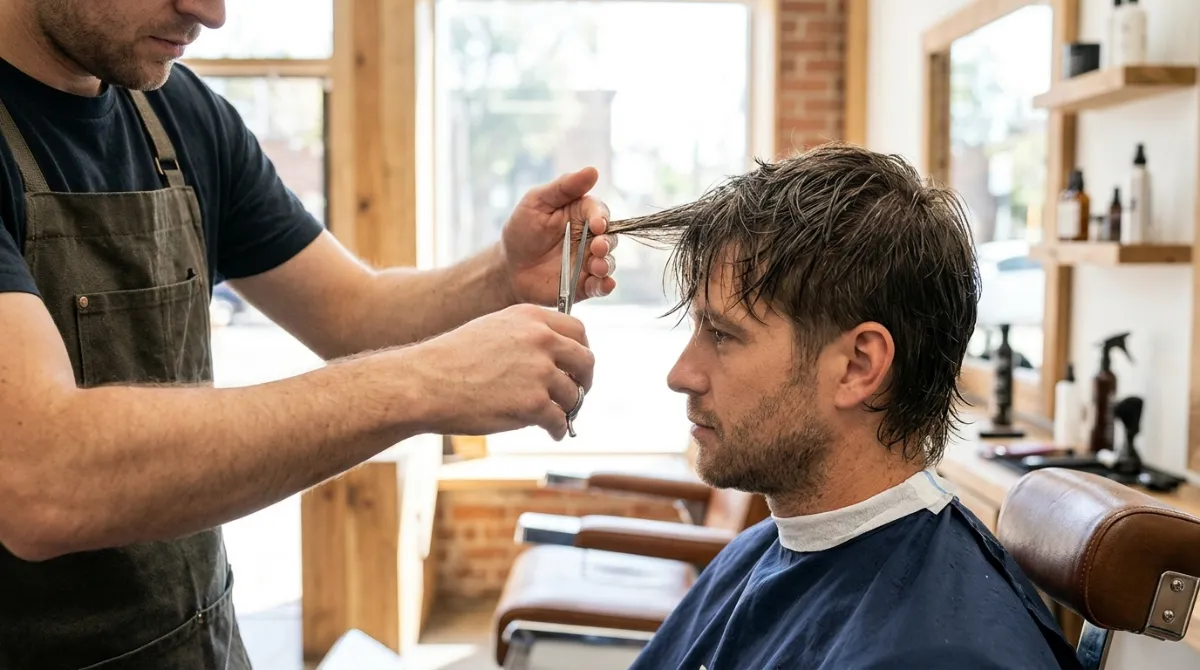
Check the person’s Instagram or booking page for these four signs:
- Scissor and razor work on men with medium-length hair, not only fades.
- Before-and-after shots in natural light, not only blow-dried finishes.
- Curly or wavy clients cut dry (if your hair is textured).
- At least 3–4 shag, wolf cut or layered men’s cuts in recent posts.
Book a longer slot or a consultation for your first shag. A 20-minute fade appointment is rarely enough time to plan layers.
Growing a Shag From a Short Fade: Month by Month
From a skin or short fade, a medium shag takes about 3–5 months, since hair grows roughly half an inch a month. The trick is to keep tidying the neckline and ears while leaving the top and crown alone.

| Month | What your hair looks like | What to ask the barber |
|---|---|---|
| 1 | Fade grows in, top 2–3 in | “Clean the neckline and ears. Don’t touch the top. Stop fading the sides.” |
| 2 | Sides puff out, awkward stage | “Take bulk out of the sides with scissors. Keep length on top.” |
| 3 | Top ~3.5–4 in, sides covering ear tops | “Start a short shag: point-cut the top, add a textured fringe.” |
| 4 | Back nearing the collar | “Add crown layers. Let the back grow, tidy the nape.” |
| 5 | Medium shag length reached | “Full medium shag: crown 3 in, fringe at the brows, back at the collar.” |
Surviving the awkward stage: Use sea salt spray and rough-dry the sides downward, wear a cap on bad days, and don’t let anyone fade the sides “just to tidy up”. That resets you by two months. Our guide to medium length hairstyles for men has more ways to style the in-between length.
How to Style a Men’s Shag in 3 Minutes
Styling a shag haircut for men is simple: rough-dry, add one texture product in small pinches, and stop before it looks “done”. The cut does most of the work.

- Towel-dry to about 70–80% dry. Press and squeeze rather than rubbing hard.
- Pre-style: 2–3 sprays of sea salt spray for wavy or straight hair, or a coin-size amount of curl cream for curly hair.
- Rough-dry with your fingers, head tipped forward, then side to side. Curly hair: diffuse on low heat instead.
- Finish with a pea-size amount of matte clay or paste, rubbed warm and pinched into the ends only. Fine hair: texture powder at the roots instead.
- Leave it. Don’t comb it. Second-day hair usually looks better.
| Product | Use it for | Skip it if |
|---|---|---|
| Sea salt spray | Grip and beachy texture on damp hair | Hair is dry, coloured, or very curly |
| Matte clay / paste | Separation on dry hair | Hair is very fine |
| Texture powder | Instant root lift, midday reset | You have a dry or flaky scalp |
| Curl cream | Defining curls and waves without frizz | Hair is fine and straight |
| Light leave-in conditioner | Soft, healthy ends | Hair is very oily |
Real-Life Fit Tests
A shag has to survive your actual week, not just the barber’s mirror. Run these four quick tests before you choose a length.
- Cap or helmet test: Medium and long shags handle caps well; short crown layers flatten easily. Fix: mist water at the roots and rough-dry for 30 seconds.
- Gym test: Sweat flattens the crown. Keep texture powder in your bag.
- Glasses test: Ask for the hair over the ears to sit just above or behind the arms, so it doesn’t push your frames up or stick out.
- Office test: A low taper plus a tidy neckline makes the same shag look professional. Tucking hair behind the ears also reads neater.
Maintenance and Trim Schedule
Most versions of the shag haircut for men need a reshape every 6–8 weeks. Tapered versions need a neckline clean-up every 3–4 weeks, and long, messy shags can stretch to 8–10 weeks.
- Wash 2–3 times a week with a gentle shampoo, and condition every wash.
- A quick crown refresh at the halfway point keeps the lift (a 10-minute appointment).
- Use a heat protectant and medium heat. Point-cut ends show damage first, and the AAD lists frequent heat styling among the habits that damage hair.
- Trim split ends; no product fixes them.
Mistakes That Make a Shag Look Messy, Not Intentional
Most bad versions of the shag haircut for men come from one of seven fixable mistakes. Here is each one and how to correct it.
- Crown cut too short: creates a round, helmet top. Fix: let it grow 4–6 weeks, then blend.
- Surface thinning on thick hair: causes short spikes and frizz. Fix: ask for interior weight removal next visit.
- Heavy sides (mushroom shape): dry the sides downward and ask for bulk removal above the ears.
- Fine hair over-layered: leads to see-through ends. Fix: grow the perimeter and switch to a short shag.
- Too much product: gives greasy clumps. Use half what you think, on the ends only.
- Skipping conditioner: dry, frizzy ends turn “undone” into “unkempt”.
- Over-trimming the fringe: a neat brow-line fringe kills the shag look. Keep it between the brows and lashes.
Shag Haircut for Men: FAQs
What is a shag haircut for men?
A shag haircut for men is a layered cut with the shortest layers at the crown and longer, point-cut layers around the ears and collar. It creates built-in volume and movement, so the hair looks deliberately loose with very little styling.
How long does my hair need to be for a shag?
You need about 2–3 in (5–7.5 cm) on top for a short shag, and 3–4 in (7.5–10 cm) on top plus hair over the ears for a medium shag. Coming from a short fade, that is roughly 3–5 months of growth.
Is a shag haircut good for men with thin hair?
Yes, if the layers are long and soft and the perimeter stays full. A short shag or shaggy crop works best. Avoid heavy razoring and very short crown layers, which make fine hair look see-through. Texture powder at the roots adds visible fullness.
Can I get a shag with a receding hairline?
Yes. A forward or side-swept textured fringe at brow length hides mild temple recession well. Avoid a centre part or curtain fringe, which opens up the temples, and keep crown layers longer if the crown is thinning.
What’s the difference between a shag and a wolf cut?
A shag spreads layers and length evenly around the head. A wolf cut has a short, choppy top with noticeably longer hair at the back, so it has more top-to-back contrast and a wilder profile.
Is a shag haircut high maintenance?
Daily styling is low: rough-dry plus one product, about 3 minutes. Upkeep is moderate: a reshape every 6–8 weeks and regular conditioning, because textured ends show dryness fast.
Can you get a shag with a fade?
Yes. A shag with a low taper is the most office-friendly version. A mid fade gives sharper contrast but makes growing into a full shag slower. Ask the barber to blend the fade into the layers rather than leave a hard line.
Does a shag work on straight hair?
Yes. Straight hair needs point-cutting or razor work for separation, plus a texture product such as sea salt spray or matte paste. Without them, straight layers can lie flat and lose the shag shape.
Is a shag haircut professional?
A short or medium shag with a tapered neckline and tidy ears passes in most offices. Longer, 70s or grunge versions read casual. Tucking the sides behind the ears instantly makes any shag look neater.
How often should I trim a shag?
Every 6–8 weeks for a full reshape. Tapered sides need a neckline tidy every 3–4 weeks, while long, messy shags can usually go 8–10 weeks between cuts.
Final Word: Pick the Shag That Fits Your Hair, Not the Photo
The best shag haircut for men is the one built around your texture, hairline and routine. Start with a medium shag and a low taper if you’re unsure. Give your barber the four zone lengths, ask for interior weight removal and a dry check, and commit to conditioner and a trim every 6–8 weeks.
Get those basics right and a shag is one of the easiest cuts to live with: it looks better on day two, grows out gracefully, and needs just one product.
Still torn between a shag, a wolf cut and a shaggy mullet? Compare them side by side in our shaggy mullet guide and wolf cut for men guide, then screenshot the barber script above and take it to your next appointment.