

Introduction
The best boys haircuts match three things: his age, his hair type, and how many minutes he will actually spend on it each morning. Get those right and almost any style works. Get them wrong and even a trending cut looks messy within a week.
Most boys haircut pages are photo galleries with 50 to 100 styles and one line each. That helps you browse, but it does not help you decide or explain the cut to a barber. This guide does the opposite. It sorts every major style by age, length and hair type, then gives you the clipper guard numbers, the exact words to say in the chair, and how often each cut needs a trim.
Quick answer: For toddlers (1–3), go with a soft scissor cut or a long crew cut. For ages 4–10, a low taper fade, crew cut or textured crop is the easiest everyday choice. For tweens and teens (11–17), the most requested cuts are the textured crop with a fade, the blowout taper, curtain bangs with a taper, and the modern mullet.
Table of Contents
How to choose a boys haircut in 60 seconds
Answer four questions and the list of possible cuts shrinks from 50 to about 3. Start with morning time, because a cut that needs styling he won’t do is the most common reason a haircut “stops working” after a week.
- How many minutes will he spend on his hair each morning? Zero minutes means buzz cut, crew cut or a short fade. Two to five minutes opens up textured crops, quiffs and curtain bangs.
- What is his hair type? Straight, wavy, curly or coily hair each favour different shapes. See the hair type table below.
- How often can you book a trim? Skin fades look sharp for about 2 weeks. Longer layered cuts can go 8 weeks or more.
- Are there rules to follow? Some schools, sports teams and religious settings limit designs, length or shaved patterns. Check before the appointment, not after.
Boys haircuts by age
Age matters less for what looks good and more for what he can sit through and look after himself. Use this table as a starting point, then adjust for hair type.

| Age group | Best styles | Why they work | Trim every |
|---|---|---|---|
| Toddlers (1–3) | Soft scissor cut, long crew cut, short bowl cut | Quick, no clippers near the ears, grows out evenly | 6–8 weeks |
| Little boys (4–6) | Crew cut, low taper, short textured crop, buzz cut | Survives playgrounds and bath time with no styling | 4–6 weeks |
| School age (7–10) | Low or mid fade with textured top, French crop, side part, curly top with taper | Neat for school, first chance to show personality | 4–6 weeks |
| Tweens (11–13) | Textured crop fade, curtain bangs with taper, two-block cut, kids mullet fade | He starts choosing; cuts need light product only | 3–6 weeks |
| Teens (14–17) | Blowout taper, burst fade mullet, modern quiff, wolf cut, flow with undercut | Full styling control; trends move fastest at this age | 2–8 weeks (style dependent) |
Toddler boy haircuts (ages 1–3)
Keep it short enough to stay out of his eyes and long enough to avoid clippers. Scissor-only cuts are faster and calmer at this age because there is no buzzing near the ears.
A long crew cut (scissors on top, a #6 or #8 guard on the sides if he tolerates it) is the safest first “real” haircut. Soft fringes and short bowl shapes are also popular because they grow out evenly without a hard line.
Little boy haircuts (ages 4–6)
This is the wash-and-go stage. Pick cuts that look fine after a nap, a bath or a day at the park.
The crew cut and the low taper are the top picks. If he has thick hair, a short textured crop removes bulk so it doesn’t puff up. Save skin fades for later; at this age they need trims too often to be worth it.
Haircuts for school-age boys (ages 7–10)
Boys this age start having opinions, so give him two or three options instead of an open choice. A low or mid fade with a textured top is the safest middle ground between “neat for school” and “cool for friends.”
The French crop and a classic side part both photograph well, which matters for school picture day. Curly-haired boys usually look best with a taper and length kept on top.
Tween boy haircuts (ages 11–13)
Tweens copy older boys, so expect requests for curtain bangs, two-block cuts and mullets. Most of these work if the sides are kept tidy.
The kids mullet fade is a good “compromise” cut here. It gives him the length at the back he wants, while the faded sides keep it neat enough for school.
Teen boy haircuts (ages 14–17)
Teens can style hair themselves, so the full range opens up. The blowout taper, textured crop with skin fade, burst fade mullet and wolf cut are among the most requested teen cuts in 2026.
The main question is no longer “will it look good?” but “will he keep up the trims?” A skin fade on a teen who sees the barber every 8 weeks will look grown out for 6 of those weeks.
Short haircuts for boys
Short haircuts for boys are the lowest-effort option: no product, no brushing, and they dry in minutes after swimming. The trade-off is more frequent trims, because half an inch of growth shows quickly on short hair.

| Style | Length on top | Sides | Styling time | Best for |
|---|---|---|---|---|
| Buzz cut | #2–#4 guard all over | Same as top | 0 min | Summer, sports, any age |
| Crew cut | 1–2 in, slightly longer at front | #2–#4, tapered | 0–1 min | Ages 3–12, straight or wavy hair |
| Caesar cut | About 1 in, short straight fringe | Tapered or faded | 0–1 min | Thick or coarse hair, round faces |
| French crop | 1–2 in, textured, fringe forward | Tapered or faded | 1–2 min | Cowlicks at the front, thick hair |
| Ivy League | 1.5–2.5 in, side-parted | Tapered | 2 min | School photos, events, older boys |
| High and tight | Under 1 in | Very short, high | 0 min | Hot weather, very active boys |
| Edgar cut | Straight blunt line across the forehead | High skin or burst fade | 1–2 min | Teens with thick straight hair |
Buzz cut
The buzz cut is one length all over, cut with clippers. It is the simplest haircut a boy can have and the easiest to do at home.
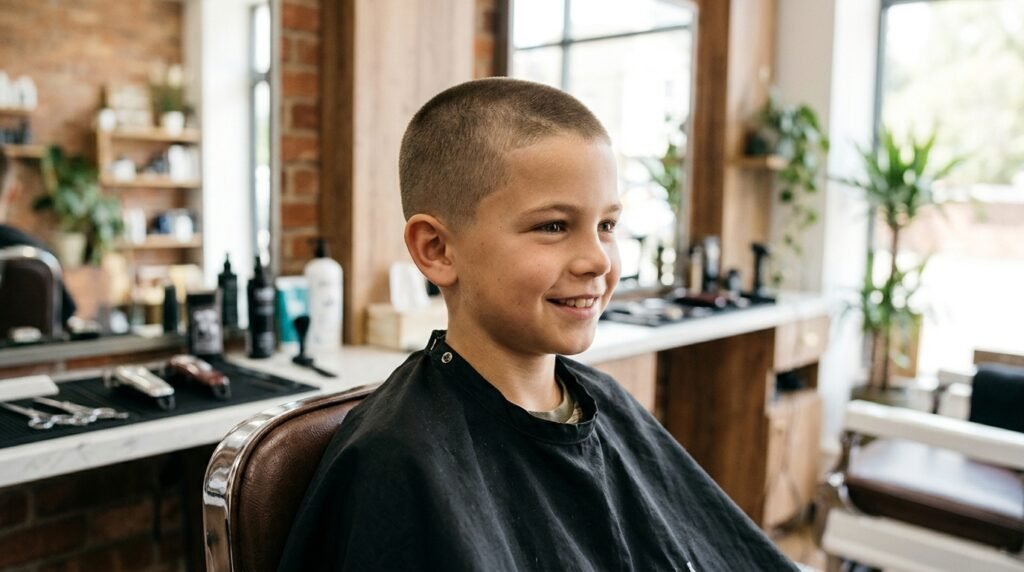
Ask for a #3 or #4 guard if it’s his first buzz; a #1 or #2 shows more scalp and can surprise kids who are used to longer hair. Pair it with a light fade at the neckline to stop it looking homemade.
Crew cut
The crew cut keeps the top slightly longer than the sides and a touch longer at the front. It is the classic “school boy” cut for a reason: it looks tidy with zero styling.

It also handles cowlicks well, because the top is short enough that they can’t stick up much.
Caesar cut and French crop
Both cuts push the hair forward into a short fringe. The Caesar has a straight, even fringe; the French crop is more textured and slightly longer on top.

They are the best short options for boys whose hair grows forward naturally, or who have a cowlick right at the hairline.
Ivy League and side part
The Ivy League is a longer crew cut with enough length on top to part to the side. It is the go-to choice for weddings, school photos and church.

Ask the barber for a “soft part” (combed in) for younger boys. A hard part (a shaved line) looks sharper but needs a touch-up every 2–3 weeks.
Edgar cut
The Edgar has a blunt, straight fringe line and high faded sides. It is popular with teens, but it is also one of the most rule-sensitive cuts, so check school policies first.

It works best on thick, straight or slightly wavy hair. On fine hair, the straight line tends to separate and look patchy.
Fade haircuts for boys
A fade is a cut where the hair on the sides and back gets gradually shorter toward the neck, blending into longer hair on top. It is the most requested boys haircut today because it looks clean and works with almost any top style.

The two choices that define a fade are where it starts (low, mid, high) and how short it goes (taper, regular fade, skin fade). Mix and match those two and you can describe almost any fade to a barber. For a side-by-side look at fade heights, see our low vs mid vs high fade comparison.
Types of fades compared
| Fade type | Where it starts | Shortest length | Looks sharp for | Best age |
|---|---|---|---|---|
| Taper | Only at the sideburns and neckline | #1–#2 | 4–6 weeks | Any age, first fade |
| Low fade | Just above the ears | #0.5–#1 | 3–4 weeks | 4+ |
| Mid fade | Halfway up the sides, around the temple | #0–#1 | 2–4 weeks | 7+ |
| High fade | Near the top of the head | #0–skin | 2–3 weeks | 10+ |
| Skin (bald) fade | Any height | Skin (foil shaver or razor) | About 2 weeks | 10+ |
| Burst fade | Curves around the ear in a half circle | #0–skin | 2–3 weeks | 10+, pairs with mullets and mohawks |
| Drop fade | Dips lower behind the ear toward the nape | #0–#1 | 3 weeks | 10+ |
Taper vs fade: a taper only shortens the edges (sideburns and neckline), so it grows out softly. A fade shortens the whole side, so it looks sharper but shows growth faster. For a boy’s first fade, start with a taper or low fade and go higher next time if he likes it.
Best fade haircuts by age
- Ages 4–6: low taper with a short textured top. It keeps the ears clean without the upkeep of a skin fade.
- Ages 7–10: low or mid fade with a textured crop, comb over or curly top.
- Ages 11–13: mid fade with curtain bangs, a two-block cut, or a kids mullet fade for boys who want length at the back.
- Ages 14–17: blowout taper, high skin fade with a textured crop, burst fade mullet or drop fade with waves.
Fade options for curly and coily hair
Fades suit curly and coily hair especially well because the short sides contrast with the volume on top. Popular combinations are the curly top with a low taper, the short afro with a shape-up, and 360 waves with a drop fade.
Ask the barber to keep the curls longer on top than you think you need. Curly hair shrinks as it dries, so 2 inches wet can look like 1 inch dry.
Kids mullet fade
The mullet fade combines a faded or tapered side with extra length at the back. It is one of the biggest tween and teen trends, and the fade is what makes it look modern instead of 1980s.

We cover lengths, fade heights and what to ask for in our full guide to the short kids mullet fade.
Longer haircuts for boys
Longer haircuts for boys need fewer barber visits (often every 6–10 weeks) but more daily care: brushing, detangling and sometimes a little product. They work best on boys who are happy to spend two or three minutes on their hair.

| Style | Length | Hair type it suits | Daily effort | Trim every |
|---|---|---|---|---|
| Textured crop (long top) | 2–3 in on top, short sides | Straight, wavy | Low–medium | 4–6 weeks |
| Blowout taper | 3–4 in on top, blown up and back | Straight, wavy, thick | Medium (blow-dry) | 3–4 weeks |
| Curtain bangs / middle part | Fringe to eyebrows or cheekbones | Straight, wavy | Medium | 5–6 weeks |
| Two-block (Korean cut) | Long top falls over short sides | Straight, thick | Medium | 4–6 weeks |
| Surfer shag / mop top | Ear length all around, layered | Wavy, curly | Low | 6–8 weeks |
| Wolf cut | Short crown layers, longer at back | Wavy, thick | Medium | 6–8 weeks |
| Bro flow | Below ears, swept back | Straight, wavy | Low | 8–10 weeks |
| Modern mullet | Short front and sides, long back | Any | Low–medium | 4–6 weeks |
Textured crop and blowout taper
These are the bridge between short and long. Both keep the sides short and let the top grow, so they look neat for school but give more style.

The blowout taper is the bigger trend for teens right now. It needs a blow-dryer and light paste to get the lift, so it suits older boys rather than little kids.
Curtain bangs and the middle part
Curtain bangs split the fringe down the middle so it falls to both sides of the face. The look has moved down from teens to primary school kids.

It works best on straight or wavy hair that grows forward. On strong cowlicks at the front, the parting fights back; a French crop is easier.
Two-block (Korean) cut
The two-block keeps the sides short but lets the top hang over them, so the short part is hidden. It came from K-pop and works best on thick, straight hair.

Shag, wolf cut and bro flow
These are the true longer styles. The shag and wolf cut use layers to add movement, while the flow is simply longer hair swept back.

They suit boys with wavy or curly hair best, because the layers show off natural texture. Detangling spray and a wide-tooth comb are worth having at home.
Modern mullet
The modern mullet keeps the front and sides tidy and leaves extra length at the back. Paired with a fade it becomes the mullet fade; paired with a burst fade around the ear it becomes the burst fade mullet, which is the edgier teen version.

Best boys haircuts by hair type
Hair type decides more than face shape does. A cut designed for straight hair will puff, flip or shrink on curly hair, so start here before choosing a style.
| Hair type | Best cuts | Avoid | Tip for the barber |
|---|---|---|---|
| Straight, thick | Textured crop, French crop, two-block, Edgar | Very long one-length tops (they go flat and heavy) | Ask for point-cutting on top to remove bulk |
| Straight, fine | Crew cut, short textured crop, side part | Long layers and skin fades (scalp shows) | Keep the top short and choppy for volume |
| Wavy | Curtain bangs, surfer shag, wolf cut, messy quiff | Very short buzz on top (waves disappear) | Cut dry or check the shape dry |
| Curly | Curly top with taper, broccoli cut, curly fringe fade | Thinning shears (cause frizz) | Leave extra length; curls shrink as they dry |
| Coily / Afro-textured | Short afro with shape-up, 360 waves, twists with fade, high top | Cuts that need daily blow-drying | Book a barber who regularly cuts textured hair |
| Cowlicks | Crew cut, French crop, buzz cut | Middle parts right over the cowlick | Leave the cowlick area slightly longer so it lies down |
Face shape: does it matter for kids?
Face shape matters less for boys than adult guides suggest, because a child’s face changes shape every year. Use it as a tie-breaker, not a rule.
- Round face: add height on top (quiff, textured crop, faux hawk) and keep sides short.
- Long face: avoid tall tops; a fringe or French crop shortens the look.
- Square face: softer layers or a textured top balance a strong jaw.
- Oval face: almost anything works.
Clipper guard sizes chart
Guard numbers are the language barbers use for length, so knowing them prevents surprises. The table shows the standard US sizes; some brands vary by a millimetre or two.
| Guard | Length (inches) | Length (mm) | What it looks like on a boy |
|---|---|---|---|
| No guard | Under 1/16 | About 1 | Almost skin; used for the bottom of fades |
| #0.5 | 1/16 | 1.5 | Very short shadow |
| #1 | 1/8 | 3 | Scalp clearly visible |
| #1.5 | 3/16 | 4.5 | Common blend step in fades |
| #2 | 1/4 | 6 | Short buzz, scalp slightly visible |
| #3 | 3/8 | 10 | Classic buzz cut length |
| #4 | 1/2 | 13 | Soft buzz, no scalp showing |
| #5 | 5/8 | 16 | Short crew cut sides |
| #6 | 3/4 | 19 | Longer crew sides, toddler-friendly |
| #7 | 7/8 | 22 | Very soft taper |
| #8 | 1 | 25 | Longest standard guard; a “trim” for short hair |
Rule of thumb: for a first clipper cut, ask for one guard size longer than you think. You can always go shorter on the same visit, but you can’t put length back.
What to say to the barber (copy-paste scripts)
A photo plus three numbers (guard on the sides, length on top, where the fade starts) gets you the cut you want almost every time. “Short on the sides, a bit longer on top” means something different to every barber.
Save the script for his style in your phone and show it with a photo:
- Crew cut: “Number 3 on the sides and back, tapered at the neck. Scissors on top, about an inch, slightly longer at the front. Square neckline.”
- Low taper fade with textured top: “Low taper starting just above the ears, down to a number 1 at the neckline. Leave about 2 inches on top and texture it with scissors. Brushed forward.”
- Mid skin fade with textured crop: “Mid skin fade starting at the temple. About 1.5 inches on top, choppy, with a short textured fringe.”
- Curtain bangs with taper: “Low taper on the sides, keep length at the ears. Leave the fringe at eyebrow length and cut it to part in the middle.”
- Kids mullet fade: “Low burst fade around the ears. Keep the front and top textured at about 2 inches, and leave 2 to 3 inches at the back of the neck.”
- Curly top with taper: “Low taper, number 1 at the edges. Don’t thin the curls. Shape the top so it’s rounder, and keep more length than it looks like because it shrinks.”
How to grow out a boy’s hair without the awkward stage
Hair grows about 4 to 6 inches a year, or roughly a third to half an inch a month (Cleveland Clinic), so going from a short crew cut to a longer style takes 4 to 8 months. The awkward stage happens when the sides and back grow at the same rate as the top. The fix is to keep trimming the edges while the top grows.
| Month | What to do at the barber | What it looks like |
|---|---|---|
| 0–2 | Taper the neckline and around the ears only; don’t touch the top | Longer crew cut |
| 2–4 | Shape the sides so they don’t puff out; add texture on top | Textured crop or messy fringe |
| 4–6 | Let the sides cover the top of the ears; tidy the back | Surfer shag or curtain bangs |
| 6+ | Add layers to remove weight and shape | Shag, flow or wolf cut |
Tip: if he wants the mullet stage, this is the easiest path. Keep tapering the sides and simply let the back grow from month 2.
Maintenance: trims, styling time and products
Shorter cuts need more trims but zero styling; longer cuts need fewer trims but daily care. Pick the trade-off that fits your family’s schedule.
| Style group | Trim every | Morning styling | Products needed |
|---|---|---|---|
| Skin fades, Edgar | 2–3 weeks | 0–2 min | None or light paste |
| Low fades, tapers, crew cut | 4–6 weeks | 0–1 min | None |
| Textured crop, quiff, curtain bangs | 4–6 weeks | 2–3 min | Matte clay or sea salt spray |
| Blowout taper | 3–4 weeks | 3–5 min | Blow-dryer + light paste |
| Shag, wolf cut, flow | 6–10 weeks | 1–3 min | Detangler, leave-in conditioner |
| Curly and coily cuts | 2–4 weeks (edges), 6–8 weeks (shape) | 2–5 min | Leave-in conditioner, curl cream |
For kids, water-based and fragrance-light products are the safest choice. Gel with strong hold can flake and is hard to wash out of young hair.
First haircuts and sensory-friendly haircuts
There is no set age for a first haircut; cut when the hair gets in his eyes or tangles badly. For the cut itself, scissors-only and a short appointment matter more than the style.

For a first haircut:
- Book a quiet weekday morning, not a busy Saturday.
- Ask for scissors only, and keep it to a light trim around the eyes, ears and neck.
- Bring a snack or a tablet. Sitting on a parent’s lap is fine.
- Keep a lock of hair if you want a keepsake; ask the barber before they start.
For boys with sensory sensitivities or autism, the noise of clippers, the cape and touch around the ears are the usual triggers. The National Autistic Society shares advice from an award-winning autism-friendly barber: build up slowly over several visits, book quiet times, and let the child choose whether clippers are used at all (National Autistic Society).
Practical steps that help:
- Visit once just to watch, then once just to sit in the chair.
- Wash his hair at home first so it’s already damp and tangle-free.
- Choose a cut that can be done with scissors only, such as a longer crew cut or a shag, if clippers are the problem.
- Show him the comb and scissors on your own hair before they touch his.
- Stop early if needed. A half-finished cut and a calm child is a better result than a perfect cut and a meltdown.
School, sports and letting him choose
Before booking a bold cut, check three things: school dress code, team rules, and whether he’ll keep up with it. Many school codes restrict shaved designs, very high skin fades or colours.
- School: crew cuts, tapers and side parts never cause problems. Designs and Edgar lines are the most common rule issues.
- Sports: short cuts under helmets and swim caps stay cooler and dry faster. Long hair needs a headband or tie for football, hockey and martial arts.
- Letting him choose: from about age 7, offer two or three cuts you’re happy with and let him pick. Boys who choose their own cut are more likely to look after it.
Common boys haircut mistakes
Most bad haircuts come from unclear instructions, not bad barbers. Avoid these and you’ll avoid most regrets.
- Going too short on the first clipper cut. Start one guard longer.
- Choosing a skin fade without planning trims. It looks grown out after 2–3 weeks.
- Thinning curly hair. It causes frizz; ask for shape-cutting instead.
- Fighting a cowlick. Cut with it, not against it.
- Copying an adult’s photo. Adult cuts assume adult hair density; ask the barber to scale it down.
- Skipping edge trims while growing out. That’s what causes the awkward stage.
- Using heavy gel on young kids. It flakes and dries the scalp.
Frequently asked questions about boys haircuts
What is the most popular boys haircut right now?
The textured crop with a low or mid fade is the most requested everyday boys haircut. For teens, the blowout taper, curtain bangs with a taper and the modern mullet fade are leading trends. For little boys, the crew cut and low taper remain the most practical picks.
What is the best low-maintenance haircut for boys?
The buzz cut and crew cut need no styling at all and only a trim every 4–6 weeks. A low taper with a short top is a close third and looks a bit more styled. Avoid skin fades if you want low maintenance, since they need trims every 2–3 weeks.
How often should a boy get a haircut?
Most boys need a haircut every 4–6 weeks. Skin fades and Edgar cuts need 2–3 weeks to stay sharp, while longer cuts like shags and flows can go 6–10 weeks. Hair grows about half an inch a month, which is enough to change the shape of a short cut.
What age can a boy get a fade?
A soft taper is fine from toddler age if he can sit still for the clippers. Most barbers suggest a proper low fade from about age 4, and mid or skin fades from about 7–10, when kids sit still longer and parents can keep up with more frequent trims.
What is the difference between a taper and a fade?
A taper only shortens the hair at the sideburns and neckline, so it grows out softly. A fade shortens the whole side and back, often down to skin, so it looks sharper but shows growth sooner. A taper is a better first choice for young boys.
What haircut is best for boys with curly hair?
A curly top with a low taper is the most reliable choice. It keeps the curls on top and tidies the edges. Ask the barber not to use thinning shears and to leave extra length, because curly hair shrinks as it dries.
What clipper number should I use for a boy’s buzz cut?
A #3 (3/8 inch) is the classic buzz length and a safe first choice. A #4 is softer and hides the scalp completely. A #1 or #2 is very short and best for summer or for boys who already like short hair.
Is the mullet appropriate for kids?
Yes, the modern kids mullet is a common school haircut when the sides are kept neat with a taper or fade. Check your school dress code first if it bans very high fades or shaved designs. See our kids mullet fade guide for school-friendly lengths.
Conclusion
The right boys haircut comes down to age, hair type and how much time he will spend on it. Short cuts like the crew cut and buzz cut are easiest; fades add style with more trims; longer cuts trade barber visits for daily care.
Pick two or three options from the age table, save the matching barber script, and show it with a photo at the next appointment. Need ideas for a specific style? Start with our step-by-step guide to the short kids mullet fade, then read our low taper fade guide for the most popular everyday cut.