
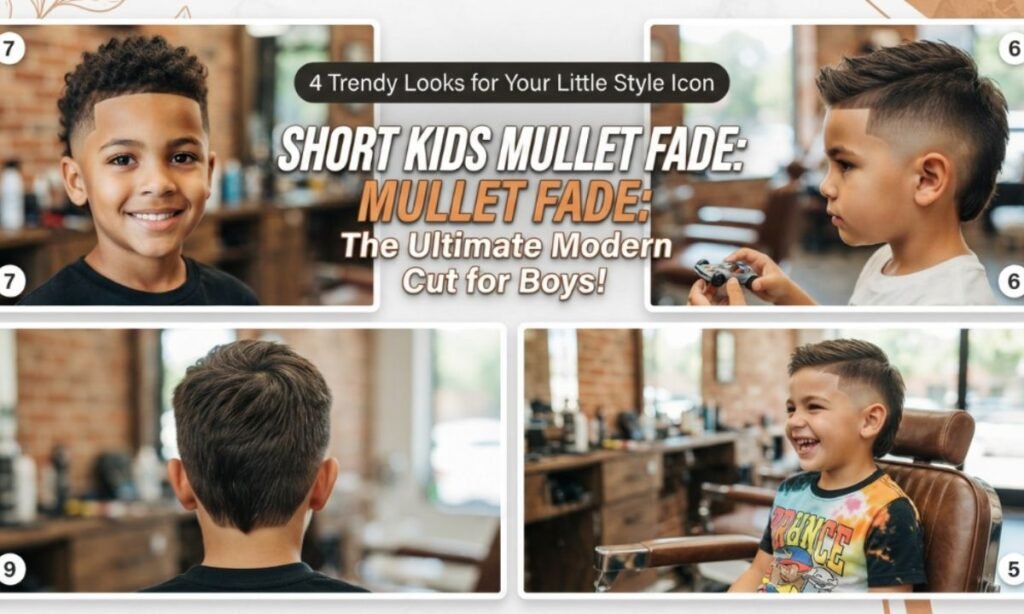
A short kids mullet fade is a haircut where the sides are faded down close to the skin, the top stays short to medium, and the back is left only 1–2 inches past the neckline. It gives the mullet look without the long “tail,” so it’s easier to manage, looks neater for school, and grows out cleanly.
This guide covers the best styles, the exact words (and clipper numbers) to use with your barber, what it costs, how often to trim it, and which version suits your child’s age and hair type.
Key takeaways:
- Keep the back 1–2 inches past the neckline; shorter than that and the mullet shape disappears.
- Choose a low taper for toddlers and a low, mid or burst fade for school-age kids.
- Give your barber guard numbers: start at #0.5 or #1 and blend up to #2 or #3.
- Plan a fade touch-up every 3–4 weeks and a full trim every 6–8 weeks.
Table of Contents
What Is a Short Kids Mullet Fade?

It’s a mullet with two changes: the back is kept short, and the sides are faded instead of just trimmed. The result is a cleaner, lower-maintenance version of the “business in front, party in the back” cut.
Three zones make up the cut:
- Top: 1.5–3 inches, usually scissor-cut or textured.
- Sides: faded — low, mid, or burst — from skin or a #0.5 up to a #2 or #3.
- Back: left 1–2 inches past the neckline (a classic mullet goes 3+ inches).

Can Kids With Short Hair Get a Mullet Fade?
Yes. A kids mullet fade works on short hair as long as the back reaches the neckline and the top has enough length to show some texture. The fade on the sides creates the contrast, so the back only needs to be a little longer than the sides to read as a mullet.
If your child’s hair is very short all over, ask the barber to fade the sides now and leave the back and top untouched. After one or two more cuts the back will have grown into a clear short mullet shape, without an awkward grow-out stage.
Short Kids Mullet Fade vs Classic Mullet
The short version is the better pick for most kids under 10. It needs less brushing, tangles less, and looks tidy even two weeks after the cut.
| Feature | Short Kids Mullet Fade | Classic Kids Mullet |
|---|---|---|
| Back length | 1–2 in past neckline | 3+ in past neckline |
| Daily styling time | 1–2 minutes | 3–5 minutes |
| Tangles / knots | Rare | Common in long hair |
| School dress codes | Usually fine | Sometimes flagged |
| Fade touch-up | Every 3–4 weeks | Every 3–4 weeks |
| Grow-out | Easy — becomes a regular cut | Awkward phase |
| Best for | Ages 2–12, active kids | Older kids who like longer hair |
10 Short Kids Mullet Fade Styles
Each style below uses the same basic shape. What changes is the fade type and the top texture.
1. Burst Fade Short Mullet

The fade curves around the ear in a half-circle and leaves the back untouched. This is the most popular version right now because the back flows straight out of the fade.
Ask for: low burst fade around the ears, keep the back 1–2 inches.
2. Low Taper Short Mullet
Only the sideburns and nape are tapered; everything else stays fuller. It’s the most subtle option and a good first mullet for younger kids or cautious parents.
3. Mid Fade Short Mullet
The fade starts higher, around the temple line, for a sharper contrast between the sides and top. Works well on thick hair because it removes bulk.
4. Drop Fade Short Mullet
The fade dips down behind the ear toward the nape. It creates a curved line that makes the short back look more intentional.
5. Textured Top Short Mullet
The top is point-cut for choppy texture and pushed forward. It hides cowlicks and suits straight hair that tends to lie flat.
6. Curly Short Mullet Fade
Curls stay on top and in the back while the sides are faded low. Curls shrink when dry, so ask the barber to cut the back while it’s dry or leave extra length. If the curls feel dry or product sits on top, read our guide on how often to wash low porosity hair.
7. Short Mullet with Fringe
A short fringe (bangs) sits on the forehead. Good for kids with a high hairline or a strong cowlick at the front.
8. Short Mullet with Design
A simple line or zig-zag shaved into the faded side. Kids love it, but it grows out in 1–2 weeks, so treat it as a special-occasion add-on.
9. Toddler Short Mullet Fade (Ages 1–4)
Use a taper instead of a skin fade, and keep the back very short (about 1 inch). Toddler hair is fine and fades show patchiness quickly, so softer blending looks better.
10. Short Wolf-Cut Mullet
Layered and shaggy on top with a light fade on the sides. A good middle ground for kids who want volume but not the full length.
Which Fade Is Best for Your Child’s Age?

Younger kids do better with softer fades; older kids can handle skin fades and designs. The main reasons are sitting still in the chair and how fine the hair is.
| Age | Best Fade | Why |
|---|---|---|
| 1–4 | Low taper, scissor-over-comb | Fine hair, short attention span, less clipper noise |
| 5–8 | Low or burst fade (#0.5–#1 at bottom) | Clean look, still easy to maintain |
| 9–12 | Mid, drop, or skin burst fade | Thicker hair holds sharper lines |
| 13+ | Any, including designs | Can style and maintain it themselves |
First-haircut tip: if your child is nervous about clippers, ask the barber to use scissors on the back and top first and do the clipper fade last, so the loud part is short.
Best Style by Hair Type
Hair type decides how the short back will sit. Picking the wrong combo is the main reason a mullet looks “off” after a week.
| Hair Type | Best Version | Watch Out For |
|---|---|---|
| Straight, fine | Textured top + low taper | Back can look thin — keep it 1.5–2 in |
| Straight, thick | Mid fade + textured top | Needs thinning shears on top |
| Wavy | Burst fade short mullet | Waves need a little product to hold |
| Curly | Curly short mullet with low fade | Cut back dry (shrinkage) |
| Coily | Taper or burst with sponge-twist top | Moisturize the back daily |
How to Ask Your Barber (Copy-Paste Script)

Show one front photo and one back photo, then say this. Clear numbers stop the barber from guessing.
“I’d like a short mullet with a low burst fade around the ears. Start the fade at a #0.5 and blend up to a #2. Keep the top about 2 inches with some texture, and leave the back 1 to 2 inches past the neckline — not too long. Please keep the back connected to the top so it doesn’t look like a separate tail.”
Clipper guard quick reference (Wahl explains every clipper guard size and its use):
| Area | Guard / Length |
|---|---|
| Bottom of fade | #0 (skin), #0.5, or #1 |
| Top of fade | #2 or #3 |
| Top of head | Scissors, 1.5–3 in (or #6–#8 guard for a quick cut) |
| Back | Scissors, 1–2 in past the neckline |
If you want it softer, say “taper” instead of “fade.” A taper only shortens the edges; a fade takes the whole side down.
Short Kids Mullet Fade Cost and Maintenance
In the US, a kids’ cut with a fade usually costs more than a basic cut because blending takes extra time. Prices vary a lot by city, so check two or three local shops.
| Item | Typical Range (US) |
|---|---|
| Kids’ basic cut | $15–$30 |
| Kids’ fade / short mullet fade | $25–$45 |
| Design add-on | $5–$15 |
| Line-up only (between cuts) | $10–$20 |
Upkeep schedule:
- Fade touch-up: every 3–4 weeks (fades show growth fastest).
- Back and top trim: every 6–8 weeks.
- Budget tip: alternate a full cut with a cheaper line-up to keep it sharp for less.
Is a Short Mullet School-Appropriate?
Yes, in most schools. The short version sits above the collar and has no extreme length, which is what most dress codes focus on.
The two things that sometimes get flagged are shaved designs and very high skin fades. If your school has a strict code, go with a low taper and skip the design.
Short Kids Mullet Fade vs Other Popular Kids’ Cuts
A short kids mullet fade sits between a very short, low-effort cut and a longer, trendier style. If you are deciding between a few options, the table below shows how it compares on upkeep and look.
| Haircut | Length on Top | Upkeep | Best For |
|---|---|---|---|
| Short kids mullet fade | 1.5–3 in, back 1–2 in | Fade every 3–4 weeks | Kids who want a trendy look that stays neat |
| Buzz cut | #2–#4 all over | Every 3–5 weeks | Very active kids, hot weather, zero styling |
| Crew cut | 1–2 in, shorter sides | Every 4–6 weeks | Classic school look, easy to grow into anything |
| Textured crop | 1.5–2.5 in with fringe | Every 4–5 weeks | Straight hair that needs volume |
| Classic kids mullet | Back 3+ in | Every 4–6 weeks | Older kids happy to brush longer hair |
The short mullet fade is the most flexible of the group. If your child gets tired of it, a barber can turn it into a crew cut or textured crop in one visit.
Common Short Kids Mullet Fade Mistakes to Avoid
Most short mullets that look “off” come from a few avoidable mistakes. Knowing them before the appointment saves you a redo.
- Cutting the back too short. Under 1 inch past the neckline and it just looks like a regular cut. Ask for at least 1 inch, or 1.5 inches for fine hair.
- A disconnected back. If the top and back are not blended, the back looks like a separate tail. Ask the barber to keep them connected.
- A skin fade on a toddler. Very young kids often have fine, uneven hair, so skin fades can look patchy. A low taper is safer under age 5.
- Cutting curly hair wet. Curls shrink as they dry, so a back cut to 1 inch wet can end up much shorter. Cut curly hair dry or leave extra length.
- Skipping touch-ups. A fade looks sharp for about two weeks. Past four weeks, the whole short kids mullet fade starts to look grown-out.
- Too much product. Heavy gel makes a kid’s hair flat and greasy. A pea-sized amount of light cream is enough.
How to Style a Short Kids Mullet Fade at Home
Kids’ short mullets need very little product. Too much makes fine hair greasy and flat.
- Towel-dry until the hair is damp, not wet.
- Add a pea-sized amount of light, water-based cream or paste to the top only.
- Push the top forward or to the side with fingers.
- Leave the back natural — brush it down, don’t gel it.
- Curly hair: use a leave-in conditioner instead of paste and scrunch.
Use gentle, fragrance-free products for younger kids with sensitive scalps, and wash product out at night. The American Academy of Dermatology also shares simple tips for teaching kids healthy hair care habits.
Can You Do a Short Kids Mullet Fade at Home?
You can do a simple taper version at home, but a true fade is hard to blend without practice. If this is your first time, book the first cut at a barber and use home clippers only for touch-ups between visits.
For a basic at-home short kids mullet fade touch-up, you need clippers with guards (#1, #2 and #3), a trimmer for the neckline, hair-cutting scissors and a spray bottle.
- Start with dry, combed hair and seat your child at eye level with a tablet or snack to keep them still.
- Use the #3 guard on the lower sides only, moving upward and flicking the clipper out at the temple.
- Switch to the #2 guard and go a little lower, around the ears, to start the fade.
- Use the #1 guard just along the bottom edge and around the ear to finish the blend.
- Tidy the sideburns and around the ears with the trimmer — do not shave the back hairline, since that is the mullet part.
- Trim the back with scissors only if it has grown past 2 inches, taking off small amounts at a time.
Keep sessions short. A calm 10-minute touch-up is better than a perfect cut that ends in tears, and you can always fix small lines at the next barber visit.
Short Kids Mullet Fade FAQs
What is a short mullet fade for kids?
It’s a mullet where the back is only 1–2 inches past the neckline and the sides are faded. It keeps the mullet shape but looks neater and is easier to maintain than a long mullet, which makes it popular for school-age kids.
What age can a child get a mullet fade?
Kids as young as 1–2 can get a short mullet, but a soft taper works better than a skin fade until about age 5. Toddler hair is fine and patchy, and a taper also needs less clipper time on a wiggly child.
What is the difference between a burst fade and a taper on a short mullet?
A burst fade curves in a half-circle around the ear and fades the whole area down. A taper only shortens the sideburns and nape, leaving the sides fuller. Burst looks bolder; taper looks softer and grows out more evenly.
How often should a kids short mullet fade be cut?
Touch up the fade every 3–4 weeks and trim the back and top every 6–8 weeks. Fades lose their sharpness first, so if you’re on a budget, book a quick line-up between full cuts.
Is a short mullet good for curly hair?
Yes. Curly hair actually makes the short back look fuller and more defined. Ask your barber to cut the back while dry, because curls shrink, and pair it with a low fade so the curls stay the focus.
How do I grow out a short kids mullet?
Let the sides grow for 4–6 weeks without fading, then ask for a scissor cut that blends the back into the sides. Because the back is already short, the grow-out takes only one or two visits.
Can girls get a short mullet fade?
Yes. The cut works on any child. Many parents choose a softer version with a low taper, a longer textured top and a curtain-style fringe. The short back keeps it neat, and it grows out easily into a pixie or bob.
How long does a short kids mullet fade take at the barber?
Most barbers need 25–40 minutes. The fade takes the longest because it has to be blended by hand. Toddlers and first-time kids may take longer, so book a quieter time slot and bring something to keep them busy.
Final Thoughts
A short kids mullet fade gives kids the trendy mullet look while keeping things neat, school-friendly, and easy for parents. Pick the fade based on age and hair type, give your barber exact numbers, and plan a touch-up every 3–4 weeks to keep it sharp.
Next step: Save this guide, screenshot the barber script, and book the cut. Want more ideas? Browse our kids and boys hairstyle ideas or catch up on the latest hair guides on the HairSmartly blog.
Pingback: 8 Guard Buzz Cut: 7 Stunning Styles, Length & Fade Guide