

Choosing the right beard styles for face shape in 2026 comes down to one idea: fix your proportions. Round faces need chin length, square faces need softer edges, long faces need width at the cheeks, and oval faces can wear almost anything. Pick the shape, then the length in millimetres, then the neckline, in that order.
Most beard guides stop at “oval suits everything.” That does not help the man with a round face and patchy cheeks, or the guy with a long face who also wears glasses. This guide goes further. You will measure your face in 60 seconds, get the exact trimmer guard for each style, and learn how to fix a double chin, weak jaw or thin face with hair alone.

Table of Contents
Quick Answer: Best Beard Styles for Face Shape
Here is the short version. Find your shape below, then jump to its section for lengths and mistakes to avoid.
- Oval: short boxed beard, full beard, stubble. Almost any style works.
- Round: Van Dyke, extended goatee, short beard with a longer chin.
- Square: circle beard, rounded full beard, Balbo.
- Oblong / long: full cheeks, short chin, mutton chops.
- Diamond: fuller chin, short boxed beard, anchor.
- Heart: light full beard, chin-heavy short beard, stubble.
- Triangle: heavy stubble, strong moustache, tight sides.
How to Find Your Face Shape in 60 Seconds
Before you pick from any list of beard styles for face shape, measure four lines with a soft tape (or a phone photo and a ruler app), then compare them. Your face shape is decided by which line is widest and how long the face is compared with its width.

- Forehead width: across the forehead, halfway between eyebrows and hairline.
- Cheekbone width: across the highest point of the cheekbones, just below the outer eye corners.
- Jaw width: from the tip of the chin to the corner of the jaw below the ear, then double it.
- Face length: from the centre of the hairline to the tip of the chin.
Shave or trim to stubble first. A full beard hides your real jawline and gives you the wrong answer.
| If this is true | Your face shape is |
|---|---|
| Length is about 1.5× the width, jaw slightly narrower than forehead, soft chin | Oval |
| Length and width almost equal, soft jaw, full cheeks | Round |
| Length and width almost equal, forehead, cheeks and jaw similar, sharp jaw corners | Square |
| Length clearly more than 1.5× width, sides fairly straight | Oblong / rectangle |
| Cheekbones are the widest point, forehead and jaw narrower, pointed chin | Diamond |
| Forehead is the widest point, tapers to a narrow, pointed chin | Heart |
| Jaw is the widest point, forehead narrowest | Triangle (pear) |
Faster option: take a straight-on selfie with your hair pulled back and trace the outline with a dry-erase marker on the mirror. Free AI face-shape tools can confirm it, but trust the tape over the app. Lighting and lens distortion fool software.
Beard Face Shape Chart 2026
Every recommendation in this chart of beard styles for face shape follows one rule: add hair where your face needs volume, and keep it short where it already has too much.
| Face shape | Styling goal | Best beard styles | Avoid | Ideal length |
|---|---|---|---|---|
| Oval | Keep balance | Short boxed, full beard, stubble, Hollywoodian | Extremes that hide the jaw | Any (3–25 mm) |
| Round | Add length, create angles | Van Dyke, extended goatee, short beard with longer chin, anchor | Full round beards, puffy cheeks | Sides 3–6 mm, chin 12–20 mm |
| Square | Soften the jaw corners | Circle beard, rounded full beard, Balbo, light stubble | Sharp boxed lines along the jaw | 6–15 mm, rounded bottom |
| Oblong | Add width, cut length | Full cheeks + short chin, mutton chops, beardstache | Long goatees, chin straps | Sides 8–12 mm, chin 6–10 mm |
| Diamond | Fill the narrow jaw and chin | Fuller chin, short boxed beard, anchor, trimmed Garibaldi | Heavy sideburns | Chin 10–15 mm, sides 6–8 mm |
| Heart | Add bulk at the chin | Light full beard, chin-heavy short beard, designer stubble | Thin goatee alone, very long beards | 6–14 mm, fuller at chin |
| Triangle | Move focus upward | Heavy stubble, strong moustache, tight-sided short beard | Wide full beards | 3–6 mm, moustache fuller |
Best Beard Styles for Each Face Shape
Here are the best beard styles for face shape, one shape at a time. Each gives you the goal, three styles that work, what to avoid, and a real-world check so you know the advice is working.
Best Beard for Oval Face
An oval face can wear nearly any beard because its length and width are already balanced. Your job is not to fix anything. It is to avoid hiding a good jawline under shapeless hair.

- Short boxed beard (4–8 mm sides, 8–12 mm chin): clean, office-ready, sharpens the jaw.
- Full beard trimmed square (15–25 mm): the biggest statement; keep the bottom flat, not pointed.
- Heavy stubble (3–5 mm): lowest effort, works with any haircut.
Avoid: very long, pointed beards that turn an oval face into an oblong one. Check: from the front, your face should still look about 1.5× longer than wide.
Best Beard for Round Face
A round face needs vertical lines. Keep the cheeks short and grow length at the chin, so the eye reads the face as longer and the jaw as sharper.
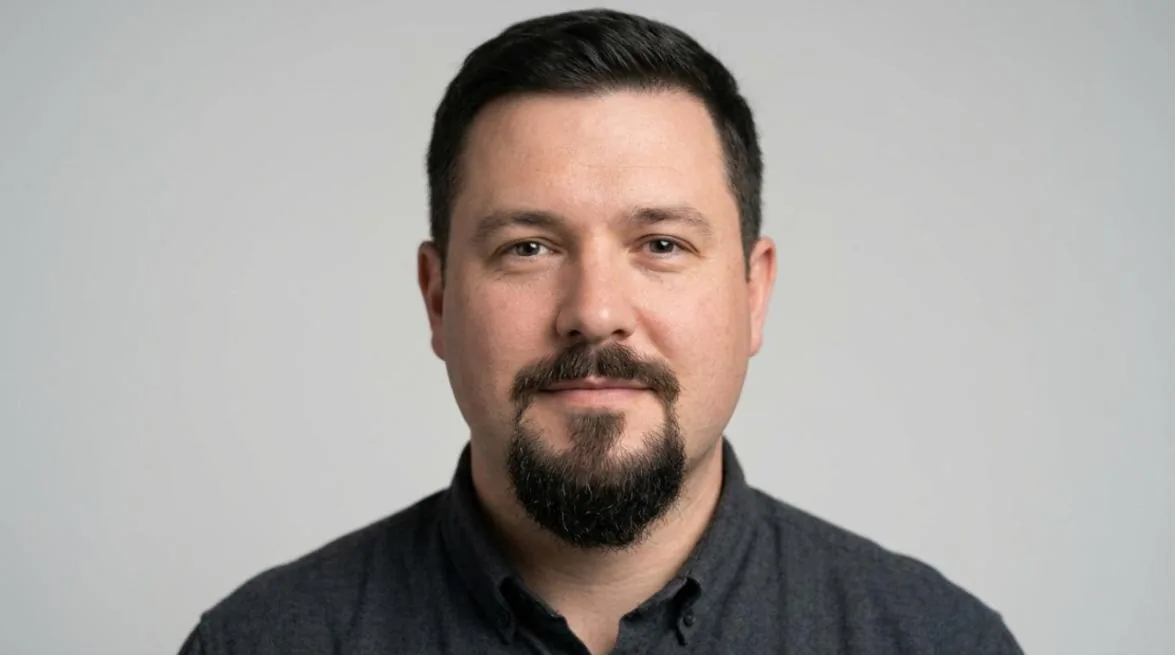
- Van Dyke (chin 15–20 mm, cheeks clean): the strongest slimming effect.
- Extended goatee: chin-focused, light on the sides.
- Short beard with a longer chin: sides at 3–6 mm, chin at 12–20 mm, shaped to a soft point.
Avoid: full, even-length beards and puffy sideburns. They add width exactly where you do not want it. Check: your beard should form a “U” or “V” at the bottom, never a circle.
Best Beard for Square Face
A square face already has a strong jaw, so the beard should round off the corners rather than trace them. Think curves, not boxes.

- Circle beard (6–10 mm): moustache joined to a rounded chin beard.
- Rounded full beard (10–15 mm): slightly longer at the chin, tapered at the jaw corners.
- Balbo: chin beard plus a floating moustache, cheeks clean. Keeps the jaw visible but softer.
Avoid: razor-sharp cheek lines and a flat, boxy bottom edge. Check: the corners of your jaw should look softer from a 45° angle.
Best Beard for Oblong (Long) Face
An oblong face needs width, not length. Build fullness on the cheeks and keep the chin short. For more options, see our full guide to the best beard for a long face.

- Short full beard with full cheeks (sides 8–12 mm, chin 6–10 mm): the go-to fix.
- Mutton chops: pure width at the sides.
- Beardstache: a heavy moustache with short stubble breaks up the face’s length.
Avoid: chin straps, long goatees and anything that adds hair below the chin. Check: the widest point of the beard should sit at the cheeks, not the chin.
Best Beard for Diamond Face
A diamond face is widest at the cheekbones with a narrow forehead and chin. Use the beard to build out the jaw and chin so they match the cheeks.
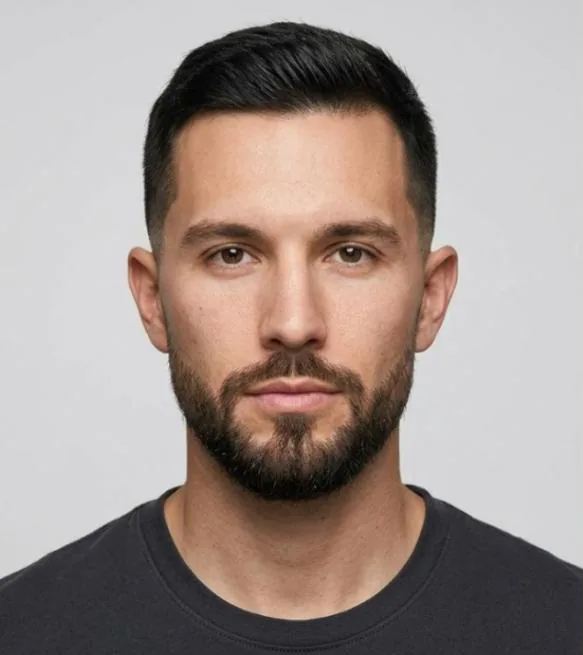
- Fuller chin beard (10–15 mm): fills the narrow lower face.
- Short boxed beard: gives the jaw a straighter line.
- Anchor beard: adds structure along the chin without widening the cheeks.
Avoid: heavy sideburns, which widen the cheekbone line even more. Check: the jaw width should look close to the cheekbone width.
Best Beard for Heart-Shaped Face
A heart face has a wide forehead and a narrow, pointed chin. Add bulk to the lower face so it balances the top.

- Light full beard (8–14 mm): fuller at the chin and jaw.
- Chin-heavy short beard: sides short, chin given extra length and width.
- Designer stubble (2–3 mm): a softer option if your growth is light.
Avoid: a thin goatee alone, which points the chin even more. Check: the bottom of the beard should look as wide as the cheekbones.
Best Beard for Triangle (Pear) Face
A triangle face has a wide jaw and a narrow forehead. Keep the jaw tight and move attention upward with the moustache.

- Heavy stubble (3–6 mm): defines without adding bulk.
- Strong moustache + light stubble: pulls the eye to the upper face.
- Tight-sided short beard: short at the jaw, slightly longer at the chin.
Avoid: wide full beards that make the jaw look heavier. Check: your jaw should not look wider with the beard than without it.
Trending Beard Styles 2026, Matched to Face Shapes
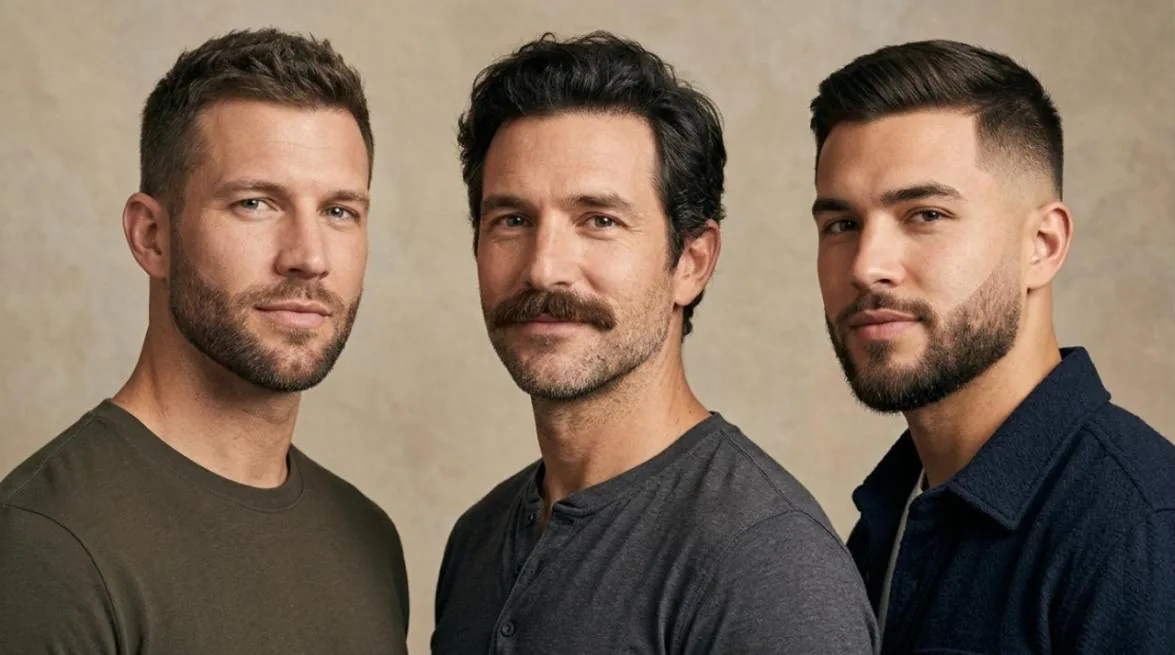
The 2026 trend is intentional grooming: shorter, cleaner shapes with natural texture, not the wild lumberjack beard of the 2010s. Barbers this year keep pointing to sculpted stubble, soft-lined full beards, the beardstache, the faded beard and the disconnected goatee. Here is how each one maps to the beard styles for face shape covered above.
| 2026 trend | What it is | Best face shapes | Skip if you have |
|---|---|---|---|
| Sculpted stubble | 3–5 mm, crisp cheek and neck lines, often faded into the haircut | All shapes | Very patchy cheeks |
| Soft-lined full beard | 25–50 mm, natural cheek line, rounded bottom | Oval, square, diamond | Round face |
| Beardstache | Heavy moustache, 3–5 mm stubble elsewhere | Oblong, triangle, oval | Thin moustache growth |
| Faded beard | Sideburns fade from skin to full length at the jaw | Round, oval, square | No barber access (hard to DIY) |
| Disconnected goatee | Moustache + chin only, clean cheeks | Round, heart, oval | Long face (adds length) |
| Hollywoodian | Jaw and chin beard, moustache, no sideburns | Diamond, oval, square | Narrow chin with weak growth |
Beard Length Cheat Sheet (mm and Guard Numbers)
Most guides on beard styles for face shape tell you a style but not the number to set on the trimmer. Use this as a starting point and go one guard longer the first time. You can always cut more.
| Style | Sides | Chin | Moustache | Typical guard |
|---|---|---|---|---|
| Light stubble | 1–2 mm | 1–2 mm | 1–2 mm | #0–#0.5 |
| Heavy / sculpted stubble | 3–5 mm | 3–5 mm | 3–5 mm | #1–#1.5 |
| Short boxed beard | 4–8 mm | 8–12 mm | 6–10 mm | #2 sides, #3–4 chin |
| Corporate beard | 6–10 mm | 6–10 mm | 6–10 mm | #3 all over |
| Van Dyke | Clean | 15–20 mm | 10–15 mm | Free-hand / #6+ |
| Circle beard | Clean | 6–10 mm | 6–10 mm | #3 |
| Short full beard (oblong fix) | 8–12 mm | 6–10 mm | 8–12 mm | #4 sides, #3 chin |
| Medium full beard | 12–25 mm | 15–30 mm | Trim to lip line | Scissors + #8 |
Guard numbers vary by brand, so check the mm marking on your own trimmer’s comb.
Between Two Face Shapes? Here’s What to Do
Most men are a mix, not a textbook shape, which is why one-shape lists of beard styles for face shape often fail. When you are between two, follow the rule of the shape that causes the bigger problem, usually the one that makes your face look wider or longer.
| Mix | Main issue | Beard strategy |
|---|---|---|
| Oval + round | Slight fullness in cheeks | Short boxed beard, 2 mm shorter on the cheeks than the chin |
| Square + oblong | Strong jaw and long face | Full sides, rounded short chin, no length below the jaw |
| Round + square | Wide face with firm jaw | Van Dyke or Balbo: chin length, clean cheeks |
| Heart + diamond | Narrow chin | Chin-heavy beard 10–15 mm, sides kept short |
| Oval + oblong | Face slightly long | Keep chin at or under 10 mm, cheeks a little fuller |
Beard Fixes for Common Facial Features
Face shape is only half of it. These are the specific problems men search for, and the beard that solves each one. If a soft jawline is your main concern, our guide to hairstyles for a double chin pairs well with the fixes below.
| Feature | Best fix | Why it works |
|---|---|---|
| Double chin | Medium beard with the neckline 1–2 finger widths above the Adam’s apple | Hair shadows the soft area and draws a new jawline |
| Weak or receding chin | Extra length at the chin (12–20 mm), shorter sides | Projects the chin forward from the side view |
| Thin or narrow face | Fuller cheeks, short boxed or full beard | Adds width to a narrow frame |
| Chubby cheeks | Lower the cheek line slightly, keep sides 3–6 mm | Reduces visible cheek mass |
| Big nose | Medium full beard + full moustache | A larger beard balances a strong nose |
| Thin lips | Keep the moustache trimmed above the lip line | Shows more lip |
| Wearing glasses | Short boxed or stubble; avoid heavy sideburns | Keeps the side profile clean |
| Bald or shaved head | Full or short boxed beard with defined lines | Shifts the visual weight to the lower face |
| Acne or uneven skin | Heavy stubble or short beard (5–8 mm) | Covers marks without trapping oil like a long beard |
Bald or thinning on top? See our dedicated guide to beard styles for bald men.
Patchy Beard by Face Shape
Patchy growth changes which beard styles for face shape actually work. If your cheeks are thin, do not force a full beard. Pick a style that only needs hair where you actually grow it.
- Round + patchy: goatee or Van Dyke. Chin-only styles that also slim the face.
- Square + patchy: Balbo or anchor; the jaw does the structure work.
- Oblong + patchy: beardstache, a strong moustache with stubble elsewhere.
- Oval, heart, diamond + patchy: sculpted stubble at 3 mm, where gaps are least visible.
Give any new beard 4–6 weeks before judging the patches. Many gaps fill in as hair lengthens and lies over sparse spots. The American Academy of Dermatology also recommends basic beard skin care while it grows. If growth is still very thin after that, talk to a dermatologist about options such as minoxidil rather than guessing.
Neckline and Cheek Line Guide by Face Shape
The neckline is the single biggest reason even the best beard styles for face shape look messy. Set it 1–2 finger widths above the Adam’s apple for every face shape, then adjust the cheek line to your shape.

| Face shape | Cheek line | Neckline note |
|---|---|---|
| Oval | Natural or slightly lowered | Standard, 1–2 fingers above Adam’s apple |
| Round | Lowered and angled toward the chin | Slight “U” curve, never flat |
| Square | Natural, soft (no razor-sharp line) | Rounded at the corners under the jaw |
| Oblong | Kept high to keep cheek fullness | Standard; don’t let the beard hang below |
| Diamond | Lowered slightly to narrow the cheekbones | Standard, fuller at chin |
| Heart | Natural | Slightly lower at chin for extra bulk |
| Triangle | Lowered, tight to the jaw | Clean, close to the jaw corner |
Pairing Your Beard With Your Haircut
Beard and hair should look like one plan. Balance volume: a lot of hair on top goes with a shorter beard, and a full beard goes with a cleaner haircut. Our guide to men’s haircuts for your face shape covers the hair side in detail.
| Haircut | Pairs well with | Why |
|---|---|---|
| Skin fade / taper | Faded beard, short boxed beard | Seamless line from scalp to jaw |
| Buzz cut | Full or medium beard | Weight moves to the lower face |
| Textured crop | Sculpted stubble | Both short and modern |
| Quiff / pompadour | Short boxed or stubble | Height on top + full beard looks top-and-bottom heavy |
| Long hair / man bun | Medium full beard | Matching length and texture |
| Bald / shaved | Full or Hollywoodian | Frames the face where hair is missing |
How Long Each Beard Style Takes to Grow
Facial hair grows about 0.3–0.5 mm a day, roughly half an inch a month, so plan your style around time (Tools of Men). Genetics, age and hormones speed it up or slow it down.
| Style | Approx. growth time | Note |
|---|---|---|
| Stubble | 3–7 days | Trim every 2–3 days to hold it |
| Short boxed / corporate | 3–5 weeks | First shape-up at week 3 |
| Van Dyke / goatee | 4–6 weeks | Chin needs the length |
| Short full beard | 6–8 weeks | Don’t trim the sides before week 4 |
| Medium full beard | 3–4 months | Shape every 3–4 weeks |
Beard Maintenance Routine and Cost
All beard styles for face shape need upkeep. Short styles cost time, long styles cost product. A sharp 3 mm stubble needs trimming every 2–3 days; a full beard needs daily oil and a shape-up every 3–6 weeks.
Daily, Weekly and Monthly Routine
- Daily: comb or brush to train the direction of growth, then 3–5 drops of beard oil on skin and hair.
- Weekly: wash the beard 2–4 times with a beard wash (regular shampoo dries the skin) and re-edge cheek and neck lines.
- Monthly: barber shape-up every 3–6 weeks. If you get bumps after shaving the neckline, see Cleveland Clinic’s ingrown hair guide.
What It Costs
| Item | One-off or recurring | Note |
|---|---|---|
| Trimmer with mm guards | One-off | The most important tool; get 0.5 mm steps |
| Edging razor or precision trimmer | One-off | For cheek and neck lines |
| Beard oil / balm | Recurring, about monthly | Oil for softness, balm for hold |
| Barber beard trim | Every 3–6 weeks | Usually cheaper than a haircut; price varies by city |
Check local barber rates before budgeting. A beard shape-up in Lahore, Toronto and London will cost very different amounts. For styling products that work on hair and beard, see our best hair styling products for men.
Beard Mistakes to Avoid (by Face Shape)
The most common mistake with beard styles for face shape is copying a celebrity beard without checking if you share their face shape. These are the next most common, shape by shape.
- Round: letting the sides grow as long as the chin. It turns your face into a circle.
- Square: a hard, boxed jaw line that doubles the squareness.
- Oblong: a long chin beard or chin strap that stretches the face further.
- Diamond: big sideburns that widen the cheekbones.
- Heart: a thin goatee that sharpens an already pointed chin.
- Triangle: a wide full beard that makes the jaw heavier.
- All shapes: trimming a wet beard (it shrinks when dry), setting the neckline on the jawbone, and judging growth before week 4.
What to Tell Your Barber
Barbers cannot read your mind, but they can follow numbers. Use this script to turn the beard styles for face shape in this guide into clear instructions:
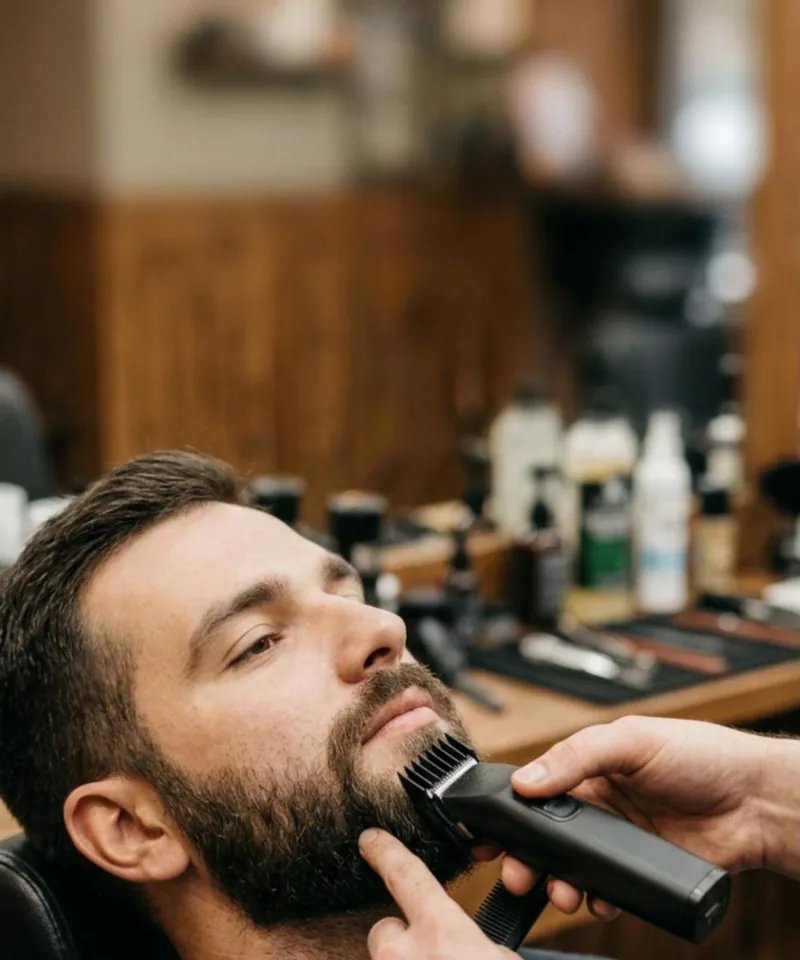
“I have a [round] face. I want a [short beard with a longer chin]. Keep the sides at [4 mm] and leave [15 mm] on the chin. Set my neckline two fingers above my Adam’s apple and lower the cheek line slightly. Please be honest if my growth doesn’t support it.”
Take two reference photos: one straight-on and one side profile of the style on a man with a similar face shape. Before growing for weeks, you can also preview styles on your own photo with an AI beard try-on app. It is useful for ruling out bad ideas, not for final decisions.
FAQs About Beard Styles for Face Shape
Which beard style suits my face shape?
The best beard styles for face shape match the beard to what your face lacks. Round faces need chin length (Van Dyke, goatee), square faces need rounded edges (circle beard), long faces need cheek width (short full beard), and oval faces suit almost any style. Measure your forehead, cheekbones, jaw and face length to confirm your shape first.
What is the most popular beard style in 2026?
Sculpted stubble at 3–5 mm with clean cheek and neck lines is the most popular beard style of 2026. It suits every face shape, looks professional, and is easy to maintain with a trimmer every two to three days. Short boxed beards and soft-lined full beards follow close behind.
What beard makes a round face look slimmer?
A Van Dyke or extended goatee makes a round face look slimmest. Keep the cheeks clean or very short (3–6 mm) and grow 15–20 mm at the chin. The vertical length draws the eye down and makes the jaw look sharper. Avoid full, even-length beards and bushy sideburns.
Which beard is best for a long face?
A short full beard with fuller cheeks (8–12 mm) and a shorter chin (6–10 mm) is best for a long or oblong face. It adds width at the sides and cuts visual length. Mutton chops and a beardstache also work. Skip goatees and chin straps, which make the face longer.
Can a beard hide a double chin?
Yes. A medium beard with the neckline set one to two finger widths above the Adam’s apple hides a double chin well. The hair creates a new, defined jawline and casts a shadow over the soft area underneath. Never trim the neckline up to the jawbone, as that exposes the area you want to hide.
How often should I trim my beard?
Trim stubble every 2–3 days, a short boxed beard once a week, and a full beard every 2–4 weeks for shape. Clean up cheek and neck lines weekly for all styles. A barber shape-up every 3–6 weeks keeps the shape matched to your face as it grows.
Is an oval face the best for beards?
An oval face is the most versatile for beards because its proportions are already balanced, so it can wear stubble, a boxed beard or a full beard. The only real risk is a very long, pointed beard that makes the face look oblong. Keep the bottom edge flat or softly rounded.
What beard suits a square face?
Square faces suit beards that soften the jaw corners: a circle beard, a rounded full beard (10–15 mm), or a Balbo. Keep the bottom edge curved, not boxy, and avoid razor-sharp lines along the jaw. Light stubble also works if you want to show off the jawline.
Conclusion
The right beard comes down to three decisions: where to add volume, what length in millimetres, and where to set the neckline. Measure your face once, pick from the chart of beard styles for face shape above, and give it four to six weeks before you judge it.
Start with the safest option, sculpted stubble at 3–5 mm, if you are unsure. It suits every face shape and buys you time to grow into something bigger.
Next step: pick the cut that goes with your new beard in our guide to the best men’s haircuts for your face shape, then take the barber script above to your next appointment.
Pingback: Beard Styles for Bald Men: 12 Best Looks for a Shaved Head
Pingback: Gentleman Haircut: 9 Best Styles + Exact Barber Script
Pingback: Shag Haircut for Men: 9 Best Styles + Barber Script (2026)