

Last updated: October 16, 2026
1970s men’s hairstyles were longer, looser and more personal than anything that came before them. The shag, feathered hair, the afro and the early mullet all came out of this decade, shaped by rock stars, disco floors, the civil rights movement and the arrival of the men’s blow-dryer.
But the 70s was not one look. A man in 1971 looked very different from a man in 1979. This guide walks through the decade period by period, breaks down 20 iconic 70s men’s haircuts, and gives you the exact words to tell your barber so you can wear each one today without looking like you’re headed to a costume party.
Quick answer: The most popular 1970s men’s hairstyles were the shag, feathered hair, long center-parted hair, the afro, the man perm and collar-length layered cuts. Early 70s hair was long and natural, mid-70s hair was blow-dried and full of volume, and by 1978–79 many men cut it shorter.
Table of Contents
How 1970s Men’s Hairstyles Changed Across the Decade
Men’s hair grew longer in the early 70s, got styled and blow-dried in the middle of the decade, then started getting shorter at the end. Most guides to 70s hairstyles for men miss this shift, which is why so many recreations look like costumes.
| Period | The dominant look | What drove it | Key names |
|---|---|---|---|
| Early 70s (1970–73) | Long, straight or natural hair, center parts, big sideburns | Hippie counterculture, anti-war protest, rock music | Robert Plant, Mick Jagger, Paul McCartney |
| Mid 70s (1974–77) | Blow-dried feathered layers, shags, peak afros, perms | Men’s hairdryers and styling products, TV, glam rock, disco | Robert Redford, David Cassidy, Julius Erving, John Travolta |
| Late 70s (1977–79) | Shorter shags, crew cuts, slicked disco hair, punk spikes | Disco polish, athletic looks, punk rebellion | Saturday Night Fever (1977), the Sex Pistols, Rod Stewart |
One detail worth knowing: as the decade closed, sideburns and big facial hair fell out of fashion, and shorter, cleaner cuts took over. That shift sets up the next decade, which you can read about in our guide to 1980s men’s hairstyles.
The decade also changed who styled hair. Before the 70s, most men got a cut and slicked it down with Brylcreem. In the 70s, blow-drying, branded shampoos and hairspray became normal for men, and brands launched products aimed squarely at them, such as Gillette’s The Dry Look hairspray.
20 Iconic 1970s Men’s Hairstyles
Each of the 1970s men’s hairstyles below includes who made it famous, which hair it suits, a barber script you can read out word for word, and a modern version that won’t look like fancy dress.
1. The Shag
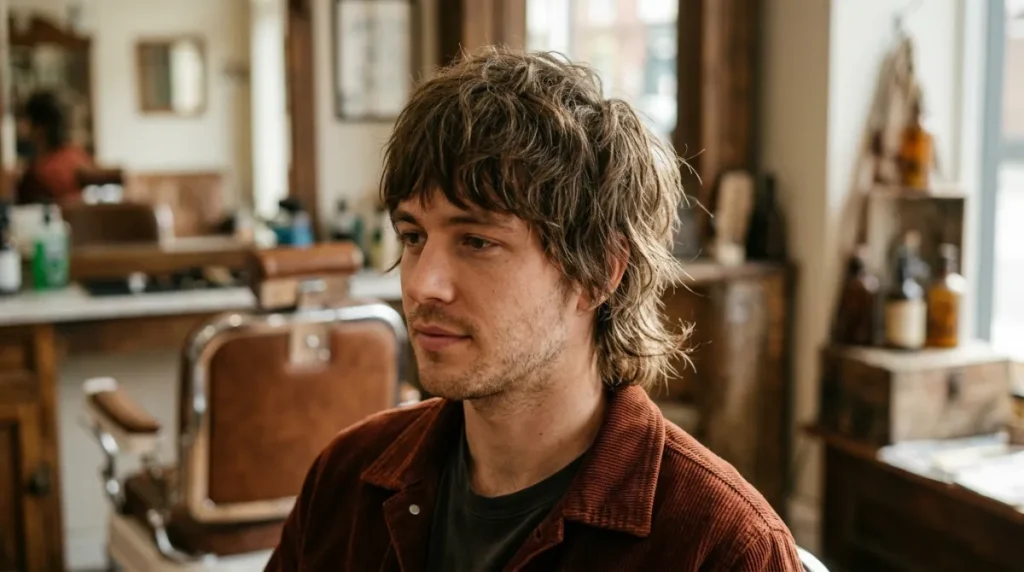
The shag is the defining 1970s men’s haircut: choppy layers all over, a longer top and back, and a fringe that falls loosely around the face. It looks undone on purpose.
David Cassidy made it a teen-idol cut on The Partridge Family; Roger Daltrey and post-Beatles Paul McCartney gave the 70s shag haircut rock credibility.
- Best for: wavy or thick hair; oval, square and long faces
- Tell your barber: “Keep length at the collar. Cut short, choppy layers through the crown and longer layers toward the back. Point-cut or razor the ends for texture and leave a fringe at eyebrow length.”
- Modern take: less height at the crown and a soft taper at the neckline. If you want a bolder back, see our shaggy mullet guide.
2. Feathered Hair

Of all 1970s men’s hairstyles, feathered hair is the most copied today. It has layers brushed back and away from the face so the ends flick outward like wings. It needs a center or side part and a blow-dryer.
Robert Redford wore the classic version in Three Days of the Condor (1975); John Travolta made a softer one famous on Welcome Back, Kotter.
- Best for: straight to slightly wavy hair, medium thickness; oval and heart-shaped faces
- Tell your barber: “Medium length, around the ears and touching the collar. Long layers on the sides angled back toward the crown. Keep weight at the ends so they can flip back.”
- Modern take: a shorter, lighter feather with a natural finish, not a stiff hairsprayed helmet.
3. Long Center-Part Hippie Hair

The early-70s default among 1970s men’s hairstyles: hair grown past the shoulders, parted in the middle and left mostly alone. It was a statement against the short, neat cuts of the previous generation.
Robert Plant and Mick Jagger are the reference points.
- Best for: straight or wavy hair; long or oval faces
- Tell your barber: “I’m growing it long. Just dust the ends, keep it one length with a few hidden long layers, and leave a center part.”
- Modern take: add light face-framing layers so it falls with shape instead of hanging flat.
4. Collar-Length Layered Cut

The everyday choice among 70s men’s haircuts for working men. Hair covered the ears and touched the shirt collar, with soft layers and usually a side part. It was the compromise between hippie length and office rules.
Barry Manilow and most TV news anchors of the era wore versions of it.
- Best for: almost any hair type; a safe first step into 70s style
- Tell your barber: “Cover the top half of my ears, leave it touching the collar at the back, and blend soft layers through the top. Side part.”
- Modern take: this is the easiest 70s cut to wear at work in 2026.
5. The Afro

The 70s afro is natural Afro-textured hair grown out and shaped into a full, rounded silhouette. In the 70s it carried real meaning: pride, identity and a rejection of chemically straightened hair.
It peaked in the early-to-mid 70s among soul, Motown and funk fans, and Wikipedia’s 1970s fashion overview notes that dreadlocks also became popular from 1972 to 1976 as a rejection of straightened styles. Julius Erving, Maurice White of Earth, Wind & Fire and the Jackson 5 are classic examples. For the longer story, read the afro’s history.
- Best for: tightly coiled or kinky hair; most face shapes, since you control the shape
- Tell your barber: “Shape it round and even. Take a little off the sides so it doesn’t widen my face. Keep the top fullest.”
- Modern take: a tapered or faded afro keeps the volume on top and cleans up the sides.
6. Cornrows

Cornrows are tight braids woven flat against the scalp in rows. Their popularity grew among Black men and women through the 70s, and Rick James is one of the best-known male examples from the era.
- Best for: Afro-textured hair with at least 2–3 inches of length
- Tell your stylist: “Straight-back cornrows, medium width, not too tight at the hairline.” Tension at the edges is the main cause of breakage, so speak up if it hurts.
- Modern take: pair straight-back rows with a low taper on the sides.
7. Dreadlocks

Reggae, and Bob Marley in particular, brought dreadlocks into mainstream view in the 1970s. Locs form when sections of hair are twisted or left to mat and lock over months.
- Best for: Afro-textured or very coarse hair; a long-term commitment
- Tell your loctician: “Start two-strand twists or comb coils at the size I want my locs to be.” Starter size sets final size.
- Modern take: short starter locs or freeform locs with a clean taper.
8. The Man Perm
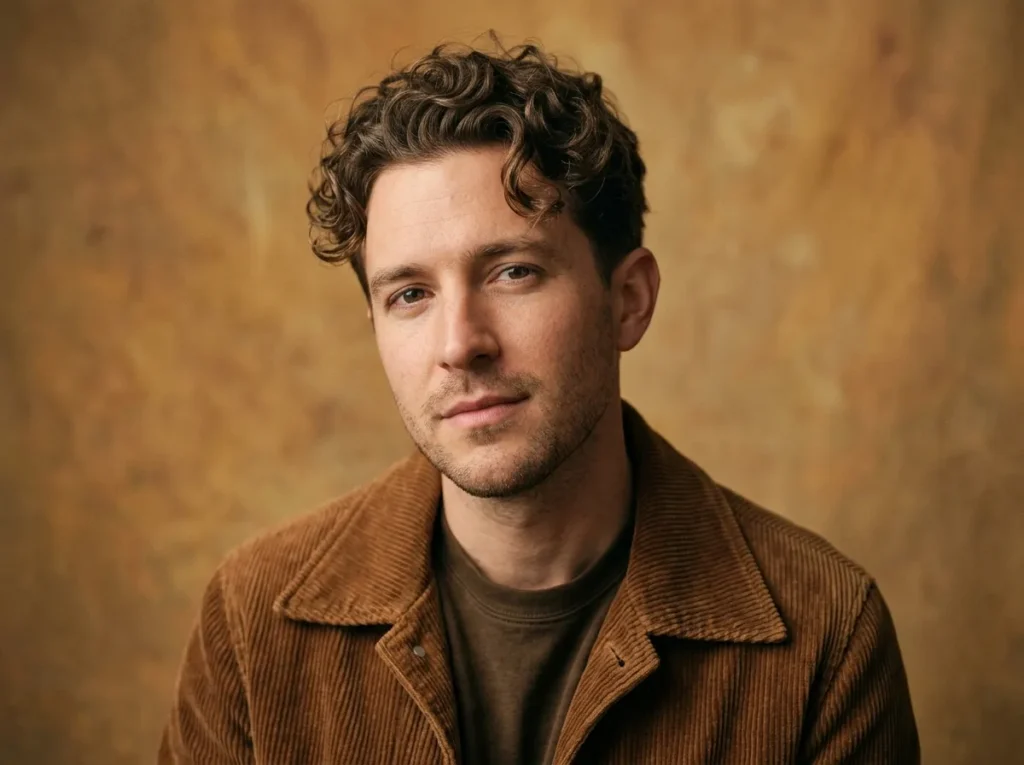
A perm uses a chemical solution and rods to give straight hair lasting curl or wave. In the 70s it let straight-haired men fake the curly rock-star look, and Mike Brady’s curls in the later seasons of The Brady Bunch made it a household image.
- Best for: straight or limp hair that won’t hold volume
- Tell your stylist: “A loose body wave, not tight curls. Medium rods on top only, sides left natural or faded.”
- Modern take: a loose wave perm on top with short sides, which is far more wearable than an all-over 1975 perm.
9. The Jheri Curl

The Jheri curl, named after hairdresser Jheri Redding, loosened tight Afro-textured curls into glossy, defined ringlets with a chemical process and daily moisturizer. It took off at the very end of the 70s and peaked in the early 80s.
- Best for: Afro-textured hair (it is a chemical process, so it needs a specialist)
- Modern take: skip the chemicals. A curl sponge or twist-out with a light curl cream gives defined curls without the upkeep or damage.
10. The 70s Mullet

Short on top and at the sides, long at the back. The mullet is usually filed under the 80s, but David Bowie’s Ziggy Stardust cut from 1972 is the decade’s most famous version: spiky on top, flowing at the back and dyed red.
- Best for: thick or wavy hair; oval and heart-shaped faces
- Tell your barber: “Shaggy, textured top, short over the ears, and leave length at the back past the collar. Blend the back into the top so it isn’t a hard step.”
- Modern take: see our shaggy mullet guide for the softer, blended version.
11. The Disco Blow-Dry
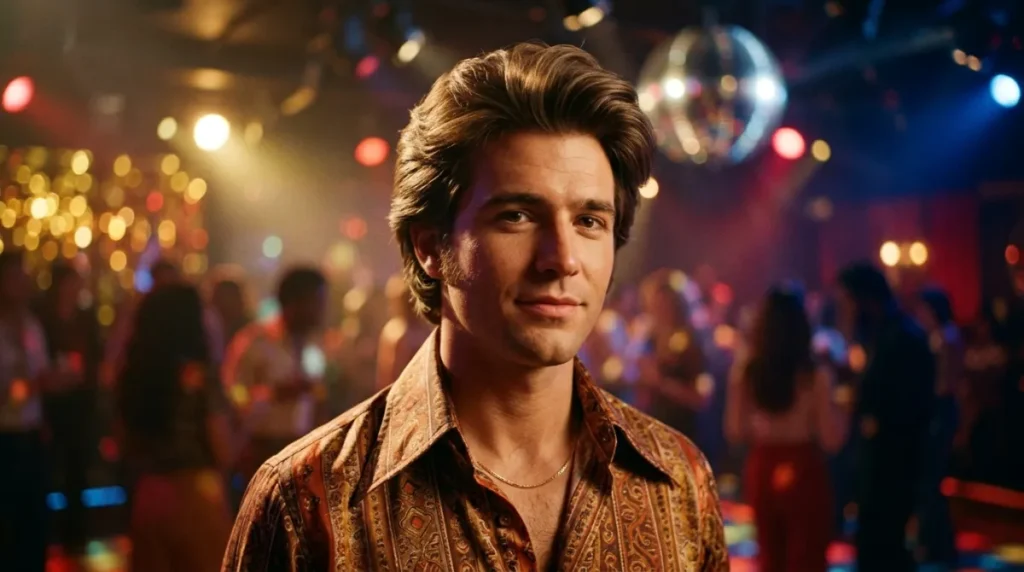
Disco hair was the flashiest of all 1970s men’s hairstyles: volume, shine and control. Hair was blow-dried up and back with a round brush, then held with hairspray. John Travolta’s look in Saturday Night Fever (1977) is the template.
- Best for: straight, thick hair; oval faces
- Tell your barber: “Medium length on top, 3–4 inches, tapered sides, enough length at the front to blow-dry up and back.”
- Modern take: the same shape held with a matte paste instead of shiny spray.
12. 70s Surfer Hair
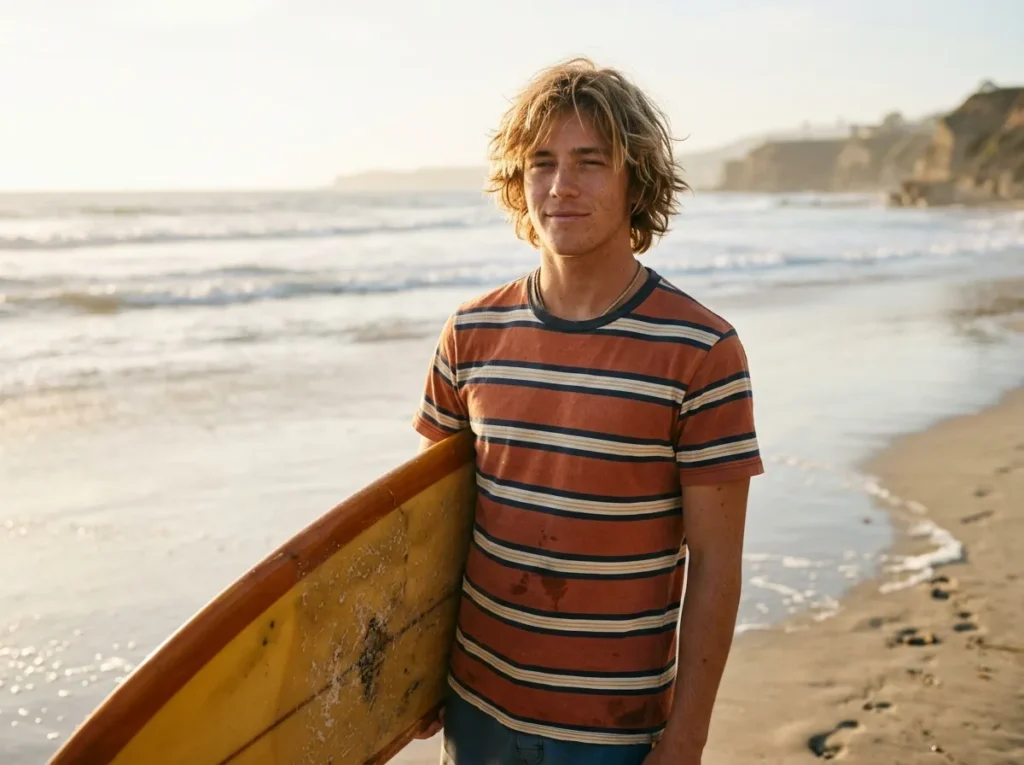
Of all 70s hairstyles for men, Southern California surfer hair was the most relaxed: tousled, blond and sun-bleached, sitting somewhere between short and shoulder length. Late-70s teen idol Leif Garrett made it a poster look.
- Best for: straight or wavy hair, any face shape
- Tell your barber: “Shaggy and messy, around ear length, heavy texturizing so it moves.” Add lighter highlights at the salon if you want the sun-bleached finish.
- Modern take: sea salt spray and air-drying do most of the work.
13. The Curtain Cut

One of the simplest 70s men’s haircuts: a center part with hair falling to either side of the face like open curtains. It sat between the hippie look and the feathered cut, usually at jaw length.
- Best for: straight or slightly wavy hair; long or oval faces
- Tell your barber: “Leave 5–6 inches at the front, center part, layers so the front falls away from my face. Short-to-medium back.”
- Modern take: it is one of the 1970s men’s hairstyles that came back strongly in the 2010s and 2020s, now with tapered sides.
14. The Pompadour and Ducktail

The 1950s Elvis cut never fully left the list of 70s hairstyles for men. In the 70s, young Italian-American and Mexican-American men in big US cities kept the slicked pompadour and ducktail alive, often with large sideburns, using grease or Brylcreem to hold it.
- Best for: thick, straight hair; round or square faces (height on top slims the face)
- Tell your barber: “Leave 4–5 inches on top, longest at the front. Short tapered sides. Shape the back so it sweeps into a point.”
- Modern take: a pompadour with a skin fade and a matte or water-based pomade.
15. The Glam Rock Spiky Shag
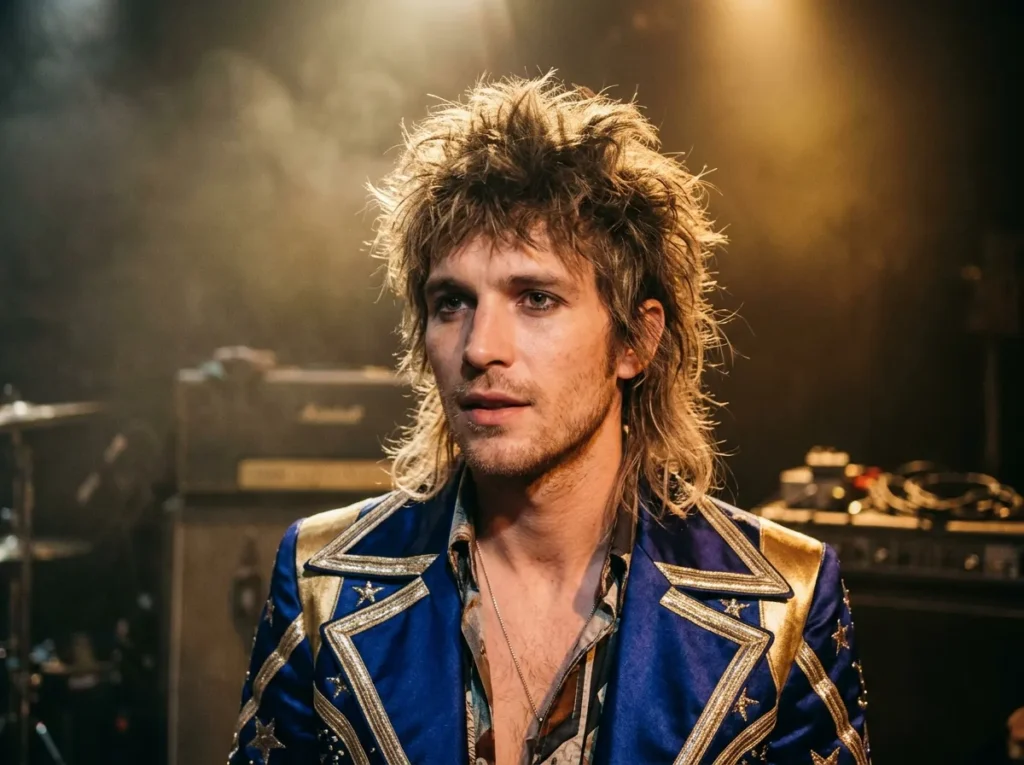
Glam rock pushed the shag higher. Rod Stewart wore a spiky, teased, rooster-style shag; Bowie and the bands around him added color. It was hair as performance.
- Best for: fine-to-medium straight hair that holds lift
- Tell your barber: “Short, choppy layers on top that stand up, longer wispy pieces at the neck and around the ears.”
- Modern take: the same shape with less height and natural color reads as a modern wolf cut.
16. Punk Spikes

Punk arrived in London around 1976 and turned against the long, pretty 1970s men’s hairstyles that came before it. Hair went short, spiky, choppy and often bleached or dyed.
- Best for: short, straight hair
- Tell your barber: “Short all over, 1–2 inches on top, uneven and choppy so I can spike it.”
- Modern take: a textured crop with a strong matte clay.
17. The Suedehead and Skinhead Crop

In early-70s Britain, the suedehead look grew hair out slightly from the late-60s skinhead crop. Short, neat and working-class, it was the opposite of the long 70s hairstyles for men seen elsewhere.
- Best for: any hair type; strong jawlines show it off
- Tell your barber: “A number 3 or 4 all over, square at the back, neat edges.”
- Modern take: an even buzz with a clean line-up.
18. The Teddy Boy Revival Quiff

A wave of 1950s nostalgia brought Teddy Boys back to British streets in the 70s. Unlike the originals, 70s Teds set their quiffs with hairspray rather than Brylcreem.
- Best for: thick hair that holds shape
- Tell your barber: “Long at the front for a quiff, short at the sides, sides swept back to meet in a ducktail.”
- Modern take: a short-sided quiff with a light-hold cream.
19. The Crew Cut and Buzz Cut

Not all 1970s men’s hairstyles were long. Steve McQueen kept short, masculine hair relevant, and by the late 70s many men went for crew cuts and buzz cuts for a cleaner, athletic look.
- Best for: thinning hair, cowlicks, hot climates
- Tell your barber: “Crew cut: half an inch on top, tapered to a 2 at the sides.”
- Modern take: unchanged, because it never went out of style.
20. The Executive Side Part
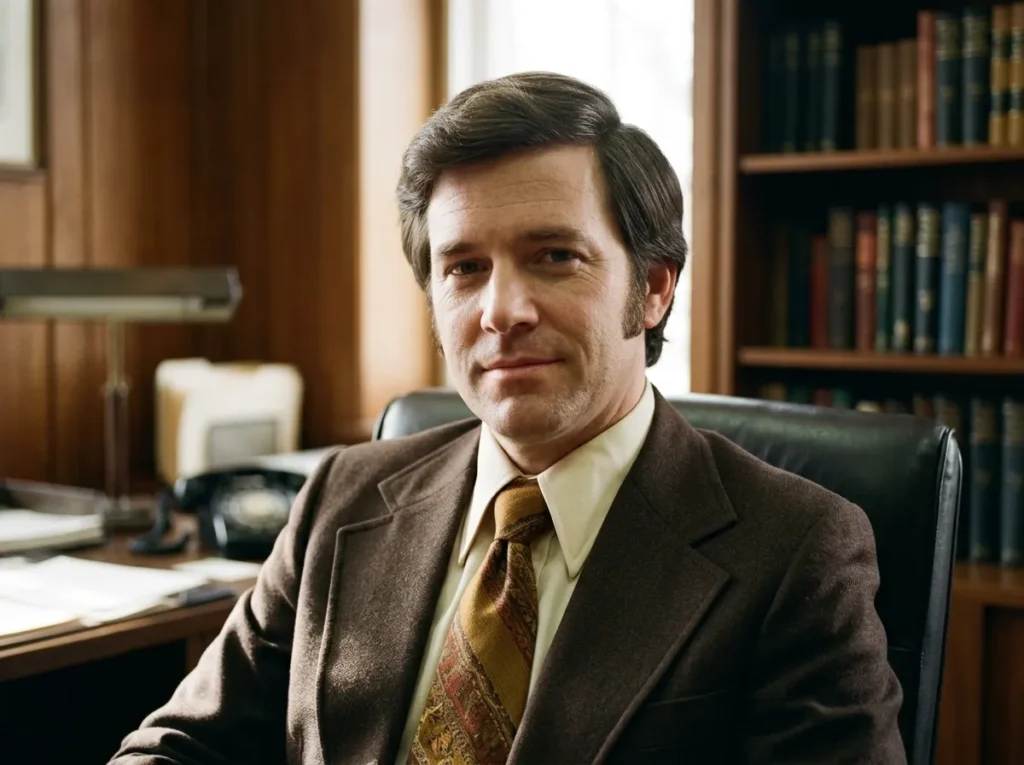
The office version of 1970s men’s hairstyles: a neat side part, hair over the tops of the ears, sideburns down to mid-ear and a little blow-dried volume. Think 70s news anchors and politicians.
- Best for: straight or wavy hair; professional settings
- Tell your barber: “Classic side part, scissor cut, just over the ears, sideburns to mid-ear, soft volume on top.”
- Modern take: the most office-friendly way to nod to the 70s.
Which 70s Haircut Suits Your Hair Type and Face Shape?
Start with your hair type, not the photo you like. Texture decides whether one of these 1970s men’s hairstyles falls into shape on its own or needs a perm, blow-dryer and spray every morning.
| Your hair | Easiest 70s cuts | Harder, needs work |
|---|---|---|
| Straight, thick | Feathered, curtain cut, disco blow-dry, pompadour | Shag (needs texture spray), afro-style volume |
| Straight, fine or thin | Collar-length layers, executive side part, crew cut, punk crop | Long hippie hair (looks flat), feathered (droops) |
| Wavy | Shag, 70s mullet, surfer hair, long center part | Slick disco hair |
| Curly | Curly shag, collar-length curls, longer layered curls | Feathered (curls won’t flick back) |
| Coily / Afro-textured | Afro, tapered afro, cornrows, locs | Feathered, straight center part (needs chemicals) |
| Thinning on top | Crew cut, executive side part, short shag | Long hippie hair, disco blow-dry |
Match the Cut to Your Face Shape
Once you know what your hair can do, use your face shape to narrow down your 70s men’s haircuts. The goal is balance: add height to a round face, add softness to a square jaw and add width to a long face.
| Face shape | Go for | Avoid |
|---|---|---|
| Oval | Almost any 70s cut | — |
| Round | Pompadour, shag with height, curtain cut | Wide afro, chin-length bob-like layers |
| Square | Shag, feathered, long layers (soften the jaw) | Very short buzz on a broad jaw |
| Long / oblong | Shag with a fringe, afro with width, collar-length layers | Tall pompadour, long straight center part |
| Heart | Feathered, mullet, curtain cut | Lots of volume at the temples |
1970s Hair Products vs. Modern Alternatives
The 70s were the first decade men were sold styling products at scale. Gillette’s The Dry Look hairspray was marketed straight at men, and the handheld blow-dryer became a normal part of a man’s morning. You can get the same results for 1970s men’s hairstyles today with lighter products.
| 1970s product | What it did | Use this today |
|---|---|---|
| Strong hairspray (e.g. The Dry Look) | Locked feathered and disco hair in place | Light-hold flexible spray or a matte paste |
| Brylcreem and hair grease | Slick shine for pompadours and quiffs | Water-based pomade (washes out easily) |
| Afro pick + sheen sprays | Lifted and shaped the afro | Wide-tooth pick + leave-in conditioner + light oil |
| Activator gel (Jheri curl) | Kept chemically loosened curls wet-looking | Curl cream or curl gel, no chemical process |
| Blow-dryer + round brush | Created feathering and volume | Same tools, plus a heat protectant spray |
| Nothing (air-dry) | The natural hippie and surfer look | Sea salt spray for grip and texture |
How to Style Feathered 70s Hair (Step by Step)
Feathering is the 70s styling technique most people get wrong, and it powers several 70s men’s haircuts. The cut gives you the layers; the blow-dry gives you the flick. Follow these seven steps.
- Start with towel-dried hair, damp but not wet.
- Spray a heat protectant and a light volume or sea salt spray at the roots.
- Set your part: center for a Travolta look, side for a Redford look.
- Blow-dry the roots up and back first, using your fingers, on medium heat.
- Take a round brush, wrap the side layers around it and roll them back and away from your face as you dry.
- Finish each section with a blast of cool air to set the shape.
- Mist a light-hold spray from about 30 cm (12 inches) away. Don’t crunch it; the hair should still move.
1970s Facial Hair to Pair With Your Cut
Facial hair was half the 70s look. Getting it right is what separates modern 1970s men’s hairstyles from a costume.
| Facial hair | 70s icon | Pairs best with |
|---|---|---|
| Thick mustache (chevron) | Burt Reynolds, Tom Selleck | Feathered hair, executive side part |
| Long sideburns | Elvis Presley | Pompadour, collar-length layers, shag |
| Full beard | George Lucas, rock musicians | Long center part, shag |
| Mustache + soul patch | Frank Zappa | Long curly hair |
| Clean shave | Late-70s disco dancers and athletes | Disco blow-dry, crew cut |
Keep sideburns at mid-ear for a modern version. The full 1970s mutton chop reads as fancy dress today.
1970s vs. 1980s Men’s Hairstyles
1970s men’s hairstyles were natural, long and soft. The 80s took those ideas and made them bigger, sharper and more styled with gel and mousse.
| Feature | 1970s | 1980s |
|---|---|---|
| Overall vibe | Natural, loose, free | Big, styled, structured |
| Signature cuts | Shag, feathered, afro, long center part | Mullet, high-top fade, flattop, perm, Jheri curl |
| Key products | Hairspray, blow-dryer, Brylcreem | Gel, mousse, crimping irons |
| Facial hair | Mustaches, sideburns, beards | Sideburns shrank; clean-shaven or stubble |
| Mullet status | Early version (Bowie, 1972) | Peak popularity |
See the full breakdown in our 1980s men’s hairstyles guide.
Grow-Out Timeline for 70s Cuts
Most 1970s men’s hairstyles need real length. Men’s hair grows about half an inch (around 1.25 cm) a month, so growing out 70s hairstyles for men from a short starting point takes patience. Plan shaping trims every 6–8 weeks as it grows.
| Target style | Length needed | From a short back-and-sides cut |
|---|---|---|
| Collar-length layers | 4–5 in on top | About 6–8 months |
| Shag | 5–6 in on top | About 8–10 months |
| Feathered | 5–7 in on top | About 9–12 months |
| Long center part | 10+ in | 18 months or more |
| 70s mullet | 6+ in at the back | About 8–12 months |
Mistakes to Avoid With 1970s Men’s Hairstyles
Most failed 70s men’s haircuts come down to the same five errors. Avoid these and your cut will look intentional, not like a costume.
- Copying a 1975 photo exactly. Keep the shape, update the finish: less spray, less shine.
- Fighting your hair type. A feathered cut on tight curls, or a shag on fine straight hair with no texture product, falls flat.
- Cutting off length to fix an awkward grow-out phase. Ask for shaping trims instead.
- Asking for “a 70s cut” with no reference. Bring two photos and use the barber scripts above.
- Overdoing everything at once. A shag plus mutton chops plus a big mustache is a costume. Pick one statement.
FAQs About 1970s Men’s Hairstyles
What was the most popular men’s hairstyle in the 1970s?
The shag and feathered hair were the most widespread 1970s men’s hairstyles. Both use layers to add movement, and both were worn by rock stars, TV actors and ordinary men across the decade. The afro was the defining style for many Black men, especially in the early-to-mid 1970s.
How do I ask my barber for a 70s haircut?
Name the specific style and the length. For a shag, say: “Keep it at the collar, choppy layers through the crown, longer layers at the back, textured ends and an eyebrow-length fringe.” Always bring a reference photo, ideally of someone with your hair type.
Were mullets from the 70s or 80s?
Both. David Bowie wore an early mullet as Ziggy Stardust in 1972, but the mullet hit its peak in the 1980s. A 70s mullet is shaggier and softer; an 80s mullet has a sharper contrast between the short front and long back.
Can I get a 70s haircut with straight hair?
Yes. Feathered hair, the curtain cut, the disco blow-dry and the long center part all suit straight hair. For a shag, ask for razored ends and use sea salt spray to add the texture straight hair lacks.
Are 70s hairstyles in style in 2026?
Yes. Shags, curtain cuts, feathered layers and soft mullets all draw on 1970s men’s hairstyles and remain popular. The modern versions are shorter at the sides, lighter on product and more textured than the originals.
How long does hair need to be for a 70s shag?
Aim for about 5–6 inches on top and enough at the back to reach the collar. Starting from a short cut, that is usually 8–10 months of growth with shaping trims along the way.
Bring the 70s Back, Your Way
1970s men’s hairstyles worked because they let hair do what it naturally does: grow, move and show personality. Pick the cut that matches your hair type, read your barber the script, and update the finish with lighter modern products.
Next up in our decades series: see how these looks turned into big hair, mullets and high-top fades in our 1980s men’s hairstyles guide, or go straight to the modern hybrid in our shaggy mullet guide.
Pingback: Shag Haircut for Men: 9 Best Styles + Barber Script (2026)