

A burst fade mullet is a haircut where the fade curves around each ear in a half-circle while the hair at the back stays long. You get clean, sharp sides from the front and a mullet from the side. That contrast is why it’s one of the most requested mullets in barbershops right now.
Most guides stop at a photo gallery. This one goes further: how it differs from a taper, what guard numbers to ask for, how long your hair needs to be, what it costs, and what to do if you hate it. Read it before you sit in the chair, not after.
Quick answer: A burst fade mullet is a rounded fade around the ears paired with a longer back. Ask for a low, mid or high burst fade, name your back length in inches, and plan a fade touch-up every 2 to 4 weeks.
Table of Contents
What Is a Burst Fade Mullet?
A burst fade mullet combines two things: a burst fade and a mullet. The burst fade is a fade that follows the curve of the ear instead of running in a straight line around the head. The mullet is the long section kept at the back.
Put them together and the fade seems to “radiate” out from the ear, like a sunburst. Behind the ear, the hair is left alone so it can flow down the neck. That is the key difference from a normal fade, which takes the back short too.
The modern version is nothing like the shaggy 80s mullet. It’s planned, blended and styled, so it looks intentional rather than overgrown.
The Three Zones of the Cut
Barbers think about this cut in three zones. Knowing them makes it much easier to explain what you want.
| Zone | What happens there | What you decide |
|---|---|---|
| The arc (sides) | Hair is faded down in a curve around each ear | Fade height and how short (skin or a guard) |
| The top and crown | Hair stays longer and textured | Length in inches, fringe or no fringe |
| The nape (back) | Hair is left long and layered | Collar length, shoulder length or longer |

The spot where the short sides meet the longer hair is called the weight line. If the barber leaves it too sharp, you get a “shelf” that looks dated. A good burst fade mullet softens that line so the whole shape flows.
Burst Fade Mullet vs Taper Fade Mullet vs Drop Fade Mullet
The burst fade gives the most contrast from the side. A taper is softer and easier to grow out. A drop fade dips behind the ear and suits guys who want a lower, more natural curve. If a softer, gradual fade sounds more like you, our high taper fade guide breaks down how a taper looks up close.
| Feature | Burst fade mullet | Taper fade mullet | Drop fade mullet |
|---|---|---|---|
| Fade shape | Half-circle around the ear | Straight, gradual, only at sideburns and neckline | Curves down behind the ear toward the nape |
| Contrast | High | Low to medium | Medium to high |
| Goes down to skin? | Often | Usually not | Often |
| Touch-up needed | Every 2 to 4 weeks | Every 4 to 6 weeks | Every 3 to 4 weeks |
| Grow-out | Awkward if high | Smooth | Medium |
| Best for | Thick, curly or wavy hair, bold looks | First-time mullet, office jobs | Guys who want a curved look but less drama |

If you’re unsure, start with a low burst fade. You can always go higher at the next visit. Going the other way takes months. Our guide to low, mid and high fade heights shows exactly where each one starts on the head.
Who Does the Burst Fade Mullet Suit?
This cut suits guys who want their hair to say something. It works well in casual, creative and social settings. It also works for athletes, which is why you see it on so many football and baseball players.
It’s less ideal if you need a wash-and-go haircut with zero maintenance. The fade shows growth fast.
Best Hairstyles and Face Shapes
Your face shape decides how high the fade should go and how much length to keep. The goal is balance: add height where the face is wide, keep things lower where the face is long.
| Face shape | Best variation | Why it works |
|---|---|---|
| Oval | Any fade height | Balanced proportions handle every version |
| Round | High burst fade + volume on top | Adds height and slims the sides |
| Square | Low to mid burst fade, textured top | The curve softens a strong jaw |
| Diamond | Mid burst fade + fringe | Balances wide cheekbones |
| Heart | Low burst fade, fuller back | Adds weight low to balance a wider forehead |
| Oblong / long | Low burst fade, shorter back, little height | Avoids making the face look longer |
Who Should Skip This Cut
No haircut suits everyone, and this one has real limits. Think twice if any of these apply to you:
- Fine, flat hair on top: Without volume, the shaved arc can make the sides look thin, even like a receding hairline.
- A receding hairline at the temples: A high burst fade draws attention to the temples. A low taper hides it better.
- Strict dress codes: Some offices, schools and uniformed jobs won’t accept a visible mullet. Go for a low taper mullet instead.
- No time or budget for touch-ups: If you can only visit a barber every two months, the fade will lose its shape long before then.
Types of Burst Fade Mullets
There’s no single version of this haircut. Barbers change it by fade height, hair texture and how bold you want to go.
By Level of Fade
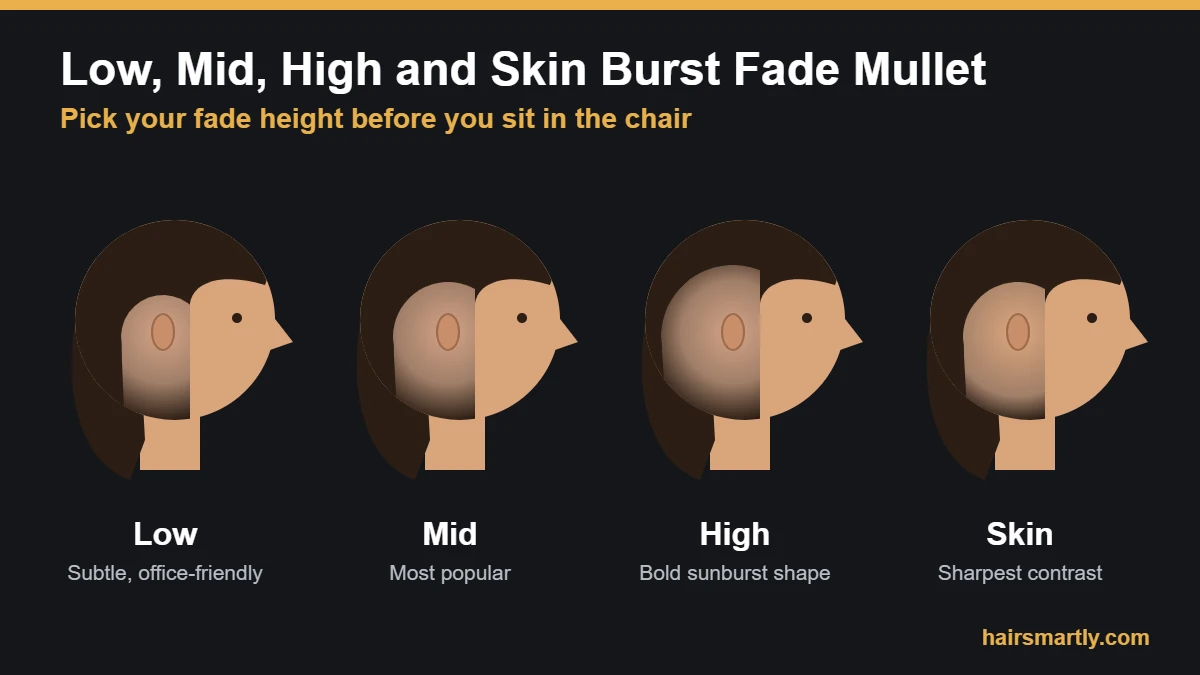
Fade height is the first decision. It controls how much contrast you get and how often you need a touch-up.
| Fade level | Where it sits | Look | Touch-up |
|---|---|---|---|
| Low burst fade mullet | Just around and below the ear | Subtle, office-friendly | Every 3 to 4 weeks |
| Mid burst fade mullet | Around the middle of the ear | Clear contrast, most popular | Every 3 weeks |
| High burst fade mullet | Well above the ear | Bold sunburst shape | Every 2 to 3 weeks |
| Skin burst fade mullet | Taken down to bare skin | Sharpest possible contrast | Every 2 weeks |
By Type of Hair
Every hair type can wear this cut. What changes is how the barber layers it and how you style it.
- Straight hair: Needs layers at the back, or the length sticks out like a shelf. Matte clay or pomade shapes the top.
- Wavy hair: The easiest texture for this cut. Sea salt spray brings out movement without stiffness.
- Curly hair (3A to 3C): Curls make the back look full and give the arc a strong frame. Use curl cream and a diffuser.
- Coily hair (4A to 4C): Works well as a “frohawk” style mullet with a tight burst fade. Keep the back moisturized with a leave-in and shape it with a pick.
- Thick hair: The fade removes bulk from the sides while the back keeps its flow. Ask the barber to thin the crown so it doesn’t puff out.
One tip for curly hair: curls shrink when dry. Ask your barber to cut the back length a little longer than you think you need.
Bold Variations
If a classic version feels too safe, these add extra edge.
| Variation | What it looks like |
|---|---|
| Mohawk burst fade mullet | A raised strip on top, tight burst sides, long back |
| Drop burst fade mullet | Burst arc combined with a drop behind the ear |
| Taper burst fade mullet | A softer taper blended into the arc, good for beginners |
| Burst fade mullet with design | Razor lines or patterns cut into the faded area |
| V-nape burst fade mullet | A sharp V shape at the back hairline |
| Edgar burst fade mullet | A straight-across fringe with a burst fade and a longer back |
Styling Inspirations
The same base cut can look clean-cut or completely wild depending on how the top and back are styled. Here are the versions barbers are asked for most.
Popular Style Ideas
- Classic burst fade mullet: Clean arc, lightly textured top, back at collar length. The easiest version to wear every day.
- Curly top burst fade mullet: Tight sides with natural curls on top and at the back. Works beautifully on 3A to 4B curls.
- Messy textured burst fade mullet: Choppy layers and a matte finish for a lived-in, rock-inspired look.
- Permed burst fade mullet: A perm adds waves or curls to straight hair, giving the back more movement.
- Textured fringe burst fade mullet: A longer fringe pushed forward or to the side, good for hiding a high forehead.
- Color-treated burst fade mullet: Bleached tips or highlights on the top and back make the fade pop even more.
- Faux hawk burst fade mullet: The top is pushed up and toward the center, with length flowing down the back.
- Short burst fade mullet: Only 2 to 3 inches at the back. A good way to test the style before growing it.
Pairing a Burst Fade Mullet With a Beard
A beard can make this cut look more grown-up and balanced. The key is how the fade connects to the facial hair.
- Stubble: The simplest match. Keep sideburns short so the arc stays visible.
- Short boxed beard: Ask the barber to fade the sideburns into the beard for one smooth line.
- Full beard: Works best with a low or mid fade. A high fade plus a heavy beard can make the head look top-light.
- Moustache only: A retro match that leans into the 80s roots of the mullet.
How Much Hair Do You Need Before the Cut?
For a proper burst fade mullet, aim for about 3 to 4 inches on top and 4 to 6 inches at the back of the neck. The sides can be any length, because they get faded anyway.
If your hair is short right now, don’t let the barber cut the back at all. Hair grows about half an inch a month, so going from a short cut to a full mullet takes several months. Many barbers suggest getting a burst fade early and leaving the back untouched while it grows. That keeps you looking tidy through the awkward stage.
| Stage | Rough back length | What to ask for |
|---|---|---|
| Month 1 to 2 | 1 to 2 inches | Burst fade on the sides, don’t touch the back |
| Month 3 to 4 | 2 to 3 inches | Refresh the fade, light shaping at the nape only |
| Month 5 to 6 | 3 to 4 inches | Short burst fade mullet, add layers at the back |
| Month 6+ | 4 to 6 inches | Full burst fade mullet |
These are rough guides. Growth speed varies from person to person.
How to Ask Your Barber for a Burst Fade Mullet
Don’t just say “give me a mullet.” That word means ten different things to ten different barbers. Name the fade height, the guard, the back length and bring photos.
Key Tips for Barber Consultation
- Bring 2 to 3 reference photos: Front, side and back. Pick photos of someone with your hair type.
- Name the fade level: Low, mid, high or skin.
- Give the back length in inches: “Leave 4 inches at the back” is clearer than “keep it long.”
- Mention your hair type: Thick, fine, curly or straight changes how the barber layers the cut.
- Choose the neckline: Rounded, squared or V-shaped.
- Be honest about styling time: If you only want 2 minutes in the morning, say so.
- Check the barber’s work first: Look for burst fades in their Instagram or portfolio. The arc is harder to cut than a straight fade.
Guard Number Cheat Sheet
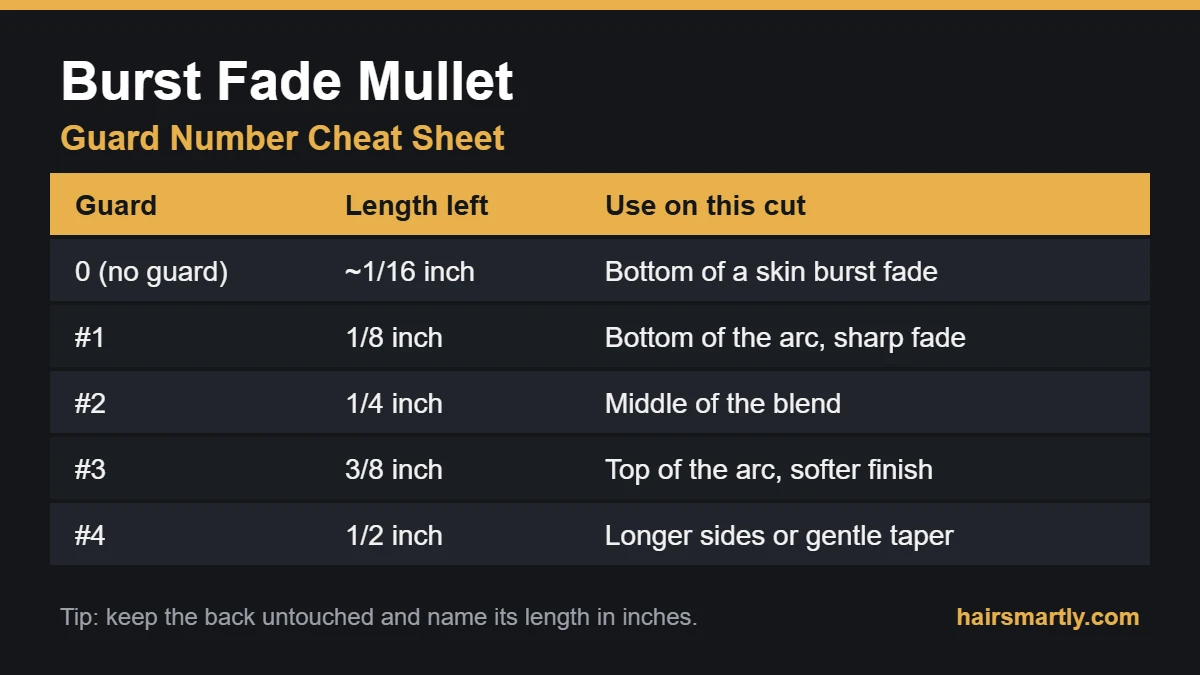
Clipper guards control how short the sides go. Each number adds roughly 1/8 inch in the standard US system. For a full clipper guard size chart, see our 8 guard buzz cut guide.
| Guard | Length left | Use on this cut |
|---|---|---|
| 0 (no guard) | About 1/16 inch | Bottom of a skin burst fade |
| #1 | 1/8 inch | Bottom of the arc for a sharp fade |
| #2 | 1/4 inch | Middle of the blend |
| #3 | 3/8 inch | Top of the arc, softer finish |
| #4 | 1/2 inch | Longer sides or a gentle taper |
If you don’t know numbers, just say “short but not skin” or “take it to the skin,” and let the barber guide you.
Exact Words to Say in the Chair
Copy one of these and show it on your phone.
- Low and safe: “I want a low burst fade around each ear, starting at a #1, blended up. Leave the top at about 3 inches with texture, and keep 4 inches at the back with light layers.”
- Mid and popular: “Mid burst fade from skin to a #3, curved around the ear. Textured top, and keep everything behind the ear long. Please soften the weight line.”
- High and bold: “High skin burst fade, tight arc above the ear. Keep length through the crown and at least 5 inches at the nape. Rounded neckline.”
How a Barber Cuts a Burst Fade Mullet
Knowing the process helps you spot a good barber. A proper burst fade takes patience, especially the curve.
- Section the back: The barber clips away the hair that will become the mullet so it doesn’t get cut by mistake.
- Mark the arc: Using a trimmer, they draw a curved guideline around each ear.
- Take the bottom short: The area closest to the ear goes to skin or the lowest guard.
- Blend outward: They work up through the guards, following the curve, so the hair gets longer in every direction.
- Cut the top: Scissors or clippers set the top length, then texturizing shears add movement.
- Shape the back: Layers are added to the long section so it sits down instead of puffing out.
- Soften the weight line and finish: The barber blends where short meets long, then lines up the neckline.
Cost and Time in the Chair
A burst fade mullet usually takes 45 to 60 minutes. The curved blend alone can take 15 to 20 minutes, so a barber who finishes the whole cut in under half an hour may be rushing it.
Price depends on your city and the barber’s skill. In most shops it costs a little more than a basic fade, because the arc takes extra time. Touch-ups for the fade only are often cheaper than a full cut, so ask if your barber offers a “fade refresh.” [Add your local price range here, e.g. from your own barbershop or city.]
Styling and Grooming Tips
A good cut does most of the work, but the right product decides whether it looks sharp or flat by lunchtime. Use light products and build shape with a blow dryer.
Tools and Products to Use
Tools: a blow dryer on low heat, a diffuser for curls, a wide-tooth comb or pick, and a small trimmer for neatening the neckline between visits.
| Product | Best for | Effect |
|---|---|---|
| Matte clay | Straight or thick hair | Strong hold, natural finish |
| Sea salt spray | Wavy hair | Texture and grip |
| Curl cream | Curly and coily hair | Definition, less frizz |
| Pomade | Sleek, polished looks | Medium hold, some shine |
| Leave-in conditioner | The long back section | Softness, prevents dry ends |
| Texturizing powder | Fine or flat hair | Lift at the roots without weight |
5-Minute Daily Styling Routine
- Towel-dry gently. Don’t rub hard, especially with curls.
- Work a small amount of product through damp hair, starting at the back.
- Blow-dry the top up and slightly back, using your fingers to shape it.
- Let the back air-dry, or diffuse it if you have curls.
- Finish with a pea-sized amount of clay on the top to separate the texture.
Maintenance and Upkeep
The fade is the part that grows out first. Book fade touch-ups every 2 to 4 weeks and trim the back every 6 to 8 weeks.
How to Maintain the Look
| Task | How often | Why |
|---|---|---|
| Fade touch-up | Every 2 to 4 weeks (2 for skin fades) | Keeps the arc crisp |
| Back trim | Every 6 to 8 weeks | Removes split ends, keeps the shape |
| Shampoo | 2 to 3 times a week | Over-washing dries out the long back |
| Conditioner | Every wash, mid-lengths to ends | Keeps the mullet soft |
| Neckline cleanup at home | Weekly | Stretches time between visits |
Use a sulfate-free shampoo if your back section feels dry or frizzy. Dry shampoo helps keep volume on non-wash days.
7 Mistakes That Ruin a Burst Fade Mullet
Most bad burst fade mullets come from the same few mistakes. Avoid these and you’re already ahead.
- Cutting the back too short too soon. Once it’s gone, you wait months to get it back.
- Leaving a hard weight line. It creates a “shelf” and looks dated.
- An uneven arc. One ear higher than the other is the most common cutting error. Check both sides in the mirror before you leave.
- No layers in straight hair. The back sticks out instead of flowing.
- Too much product. Heavy wax makes the top look greasy and flat.
- Skipping touch-ups. The fade grows out much faster than the rest of the cut.
- Choosing a barber with no burst fade experience. Always check their portfolio for this exact cut.
Don’t Like It? How to Grow Out a Burst Fade Mullet
If you decide the style isn’t for you, you have two choices: cut the back short now, or grow the sides out. A high burst fade can take around three months to grow back fully, so a low fade is much easier to undo.
- Fastest exit: Ask for a taper fade or a textured crop. The barber removes the back and blends the sides. You’ll have a normal haircut the same day.
- Slow exit (keep length): Stop fading the sides. Get small trims every 4 to 6 weeks to keep it neat while the sides catch up. After a few months, you can move to a shag or a longer layered cut.
- During the awkward stage: Keep the neckline tidy and use a bit of texture paste on the sides so they blend with the top.
Trend and Popularity
The burst fade mullet has moved from niche barbershop style to one of the most requested men’s cuts. You’ll see it on athletes, musicians and all over barber accounts on TikTok and Instagram.
Why It Is Gaining Attention
- Retro with a modern finish: It takes the 80s mullet and makes it sharp and clean.
- Works on every hair type: Straight, wavy, curly and coily hair all suit it.
- Social media: Barbers post before-and-after videos daily, which spreads the trend fast.
- Sports culture: Many football and baseball players wear it, which pushes it to teens and young men.
- Easy to customize: Fade height, color, designs and fringe mean no two look the same.
Frequently Asked Questions
What is the difference between a burst fade and a regular fade mullet?
A regular fade mullet fades the sides in a straight line around the head. A burst fade curves the fade around each ear in a half-circle and leaves everything behind the ear long. That curve creates more contrast from the side and makes the mullet shape stand out more.
Is a burst fade mullet professional?
A low burst fade mullet with a short back can pass in many modern offices, especially creative ones. High and skin versions are much bolder. If your workplace has strict grooming rules, a low taper mullet is the safer choice.
How long does a burst fade mullet last?
The fade looks sharp for about 2 to 4 weeks, depending on how fast your hair grows and how short the fade is. Skin fades show growth fastest. The back section only needs a trim every 6 to 8 weeks.
Can you get a burst fade mullet with straight hair?
Yes. Straight hair needs layers at the back so it flows instead of sticking out. Use matte clay or texture powder on top to add movement, because straight hair can look flat without product.
Does a burst fade mullet work on thin hair?
It can, but choose a low fade and ask for texture on top. A high fade on thin hair can make the sides look sparse. Texturizing powder helps add volume at the roots.
Can kids get a burst fade mullet?
Yes, it’s a popular cut for boys, especially those who play sports. Go for a low or mid fade, since kids’ hair grows fast and a skin fade needs very frequent touch-ups. Check school rules first. Our short kids mullet fade guide has kid-friendly options.
Which is better, a burst fade or a taper fade mullet?
Pick a burst fade if you want bold contrast and don’t mind touch-ups every few weeks. Pick a taper fade if you want something softer, lower maintenance and easier to grow out. First-timers often start with a taper and move to a burst later.
How much hair do I need for a burst fade mullet?
Aim for about 3 to 4 inches on top and 4 to 6 inches at the back. If your hair is shorter, get a burst fade on the sides and let the back keep growing until it reaches that length.
Conclusion
The burst fade mullet works because it balances two things: a clean, curved fade and a long, relaxed back. It’s bold without being messy, and it can be tuned for almost any face shape, hair type or lifestyle.
Start low if you’re unsure, bring photos, name your guard numbers and protect the back length. Keep up with touch-ups, and the cut will look intentional every day.
Ready for your next look? Compare more cuts in our messy hairstyles for men guide, then take your favorite burst fade mullet photo to your next barber visit.
Pingback: Shaggy Mullet: 15 Best Styles & What to Tell Your Barber
Pingback: Haircut Designs for Men: 25 Stunning Line & Fade Ideas