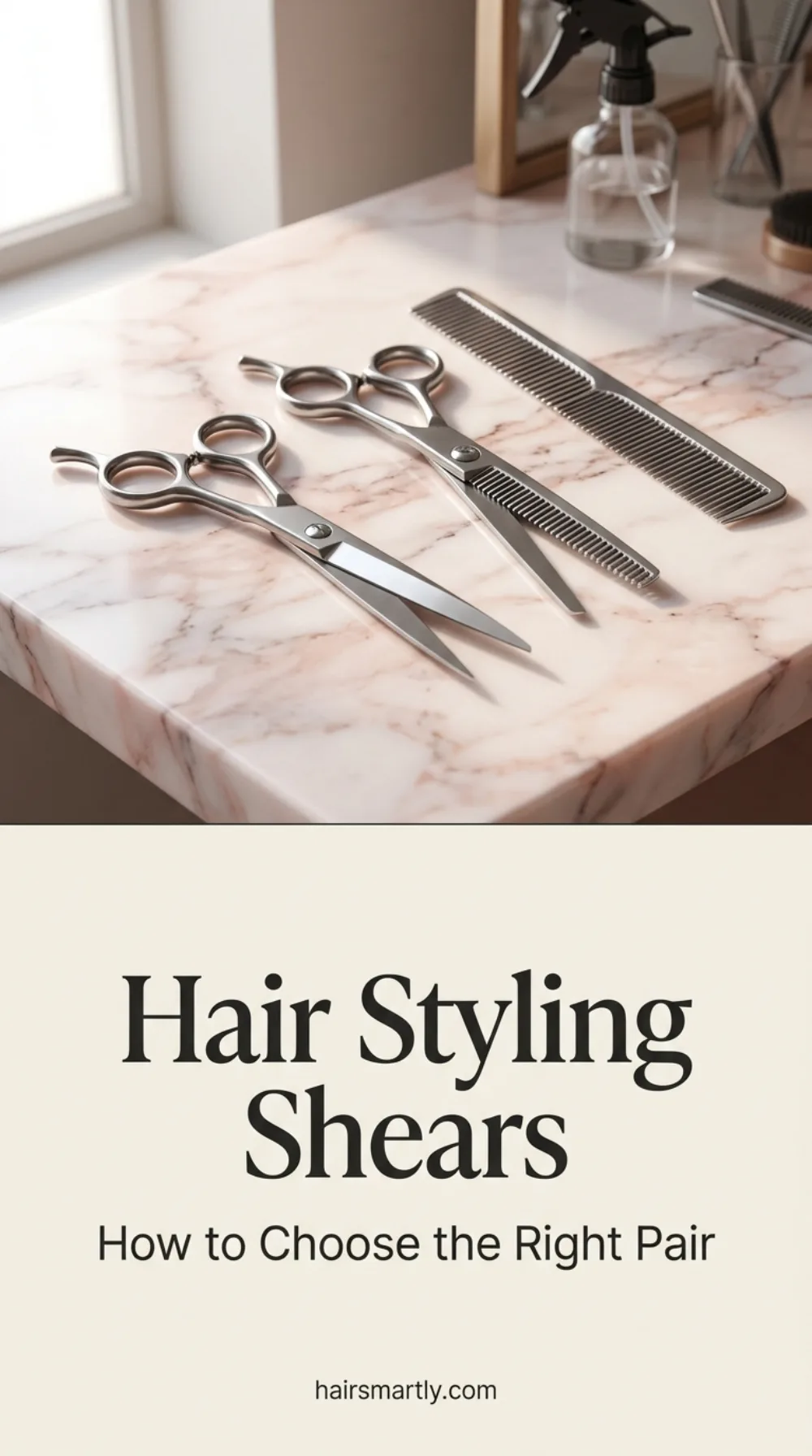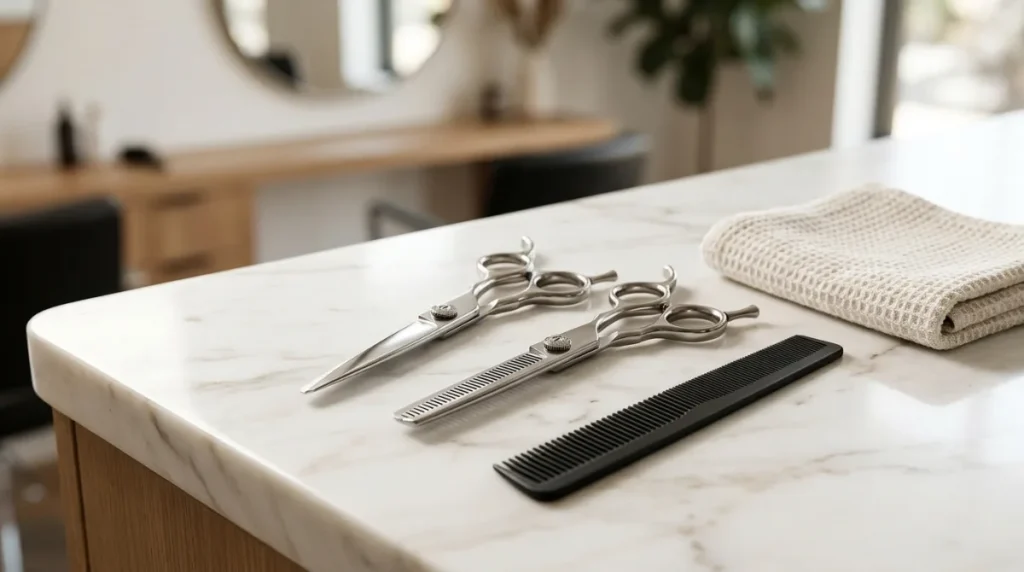
The right hair styling shears make every cut cleaner, faster and easier on your wrist. The wrong pair pushes hair, leaves choppy lines and tires your hand by mid-afternoon.
This guide shows you how to pick hair styling shears by blade length, steel, edge, handle and the techniques you actually use. You will also see real price tiers, red flags to avoid, and a simple care routine that keeps a good pair cutting for years.
Quick answer: Most stylists do best with 5.5″ or 6″ hair styling shears with a convex or semi-convex edge, Japanese 440C or VG-10 steel (about 58–62 HRC) and an offset or crane handle. Barbers who do a lot of scissor-over-comb usually step up to 6.5″–7″. Add a matching thinning shear and you have a complete kit.
Table of Contents
What Are Hair Styling Shears?
Hair styling shears are precision scissors made only for cutting and shaping hair. “Styling shears,” “hair cutting shears,” “hairdressing scissors” and “barber shears” all describe the same core tool.
The difference from household scissors is in the build. Professional hair shears use hardened steel, a much finer edge, an adjustable tension screw and handles shaped for hours of repetitive cutting. Household scissors fold or push hair because their edge is too thick and the blades are not set to meet precisely. You can read more about the history of the tool on Wikipedia’s hair-cutting shears page.
| Feature | Hair styling shears | Household scissors |
|---|---|---|
| Steel | Hardened stainless (440C, VG-10, ATS-314) | Soft stainless |
| Edge | Convex, semi-convex or beveled, honed | Thick, unhoned |
| Tension | Adjustable screw | Fixed rivet |
| Handle | Offset, crane or swivel, finger rest | Symmetrical loops |
| Use | Hair only | Paper, fabric, general |
One rule follows from this: never cut anything except clean hair with your hair styling shears. Paper, tape or foil will dull the edge fast.
Types of Hair Styling Shears
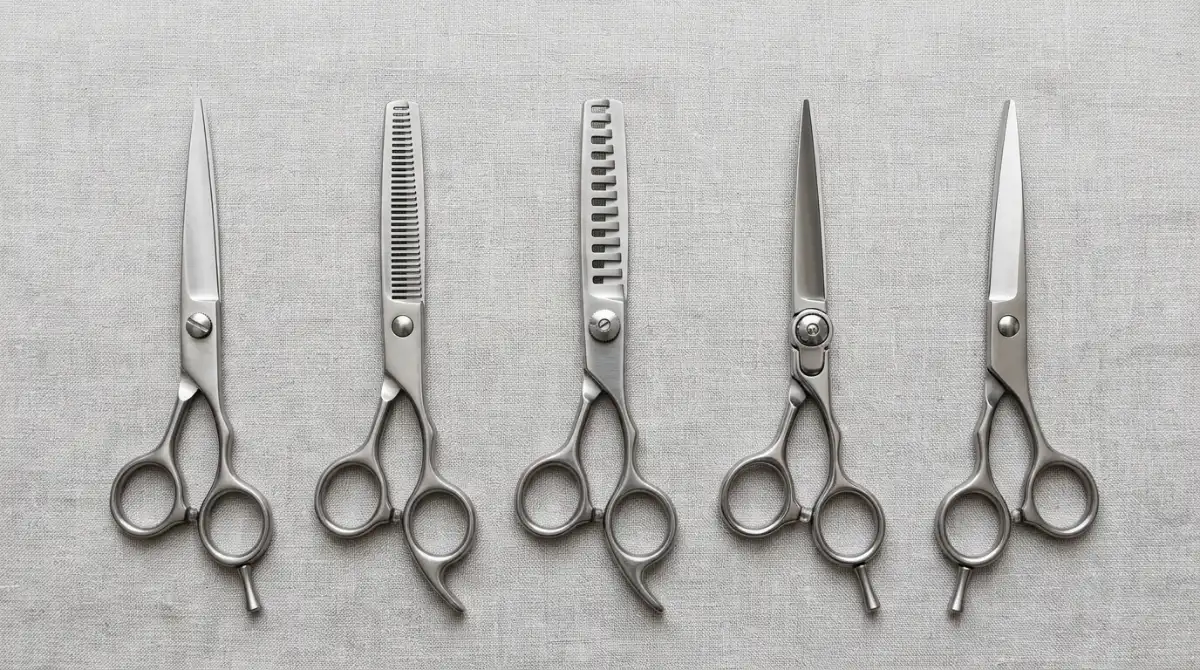
There are five main types of hair styling shears: straight cutting shears, thinning shears, texturizing shears, swivel shears and left-handed shears. Most stylists own at least a cutting shear and a thinning shear.
Straight cutting shears
Two smooth, straight blades for blunt cuts, layers, point cutting and scissor-over-comb. This is your main tool and the one you should spend the most on.
Thinning (blending) shears
One or both blades have teeth that remove bulk without taking off length. Thinning shears usually have around 30–40 teeth and are used to soften lines and blend layers.
Texturizing shears
Fewer, wider teeth (about 10–20) that pull out larger chunks. Texturizing shears add movement and separation rather than smooth blending.
Swivel shears
The thumb ring rotates, so your thumb and wrist can move freely. Swivel shears suit stylists who slide cut, cut at awkward angles, or already feel thumb or wrist strain.
Left-handed hair shears
A true left-handed shear has the blades reversed, so the top blade sits on the correct side for a left hand and the cut line stays visible. “Ambidextrous” or reversible-handle shears only flip the handle, not the blades.
Left-handed stylists should buy true lefty shears. Using right-handed shears in the left hand pulls the blades apart and folds hair.
| Type | Main job | Best for |
|---|---|---|
| Straight cutting | Length, shape, blunt lines | Every stylist and barber |
| Thinning | Remove bulk, blend | Thick hair, soft layers |
| Texturizing | Add movement, chunky texture | Short styles, piecey looks |
| Swivel | Free thumb movement | Slide cutting, wrist strain |
| Left-handed | Correct blade orientation | Left-handed stylists |
How to Choose Hair Styling Shears: 6 Specs That Matter
Judge any pair of hair styling shears on six specs: blade length, fit to your hand, steel and hardness, edge type, handle design, and tension system. Fit and edge matter more than brand name.
1. Blade length
Most hairdressers use 5.5″ to 6″ shears, which cover the large majority of cutting techniques. Barbers often choose 6.5″ to 7″ for scissor-over-comb.
| Length | Best for |
|---|---|
| 4.5″–5.5″ | Detail work, around ears, fringes, point cutting |
| 5.5″–6″ | All-round salon cutting, layers, blunt bobs |
| 6.5″–7″+ | Scissor-over-comb, barbering, long sections |
Shorter blades give control. Longer blades cover more hair per cut but are harder to steer in tight spots.
2. Fit to your hand
A simple check: place the blade of the hair styling shears along your middle finger; the blade should roughly match its length. Then lay the whole shear on your open palm; its overall length should sit close to your palm-plus-middle-finger length.
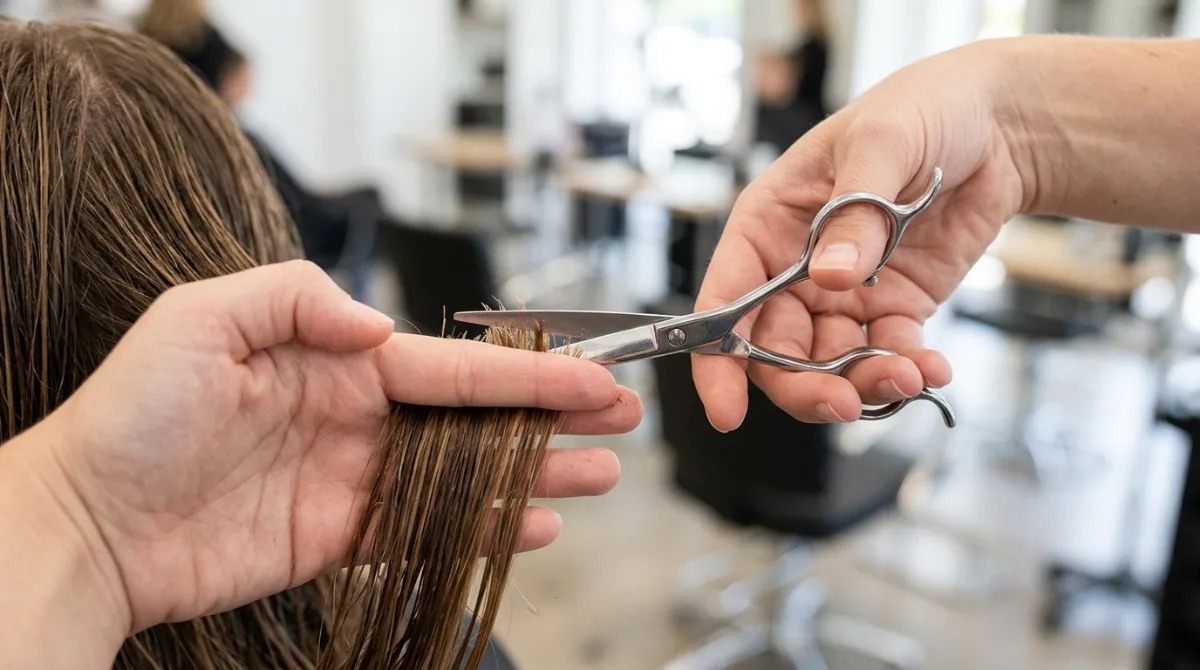
- Hold the shear with your ring finger in the finger ring and thumb in the thumb ring.
- Rest your little finger on the finger rest (tang).
- Open and close slowly. Your thumb should move, your fingers stay still.
- Check that nothing pinches and your wrist stays fairly straight.
If you can, try two lengths side by side. Feel beats any chart.
3. Steel and hardness (HRC)
Steel hardness is measured on the Rockwell hardness scale (HRC). Most professional hair shears sit between 58 and 62 HRC, which balances sharpness and durability.
| Steel | Typical HRC | What you get |
|---|---|---|
| 420 stainless | ~56–58 | Budget, softer, dulls faster |
| 440C (Japanese) | ~58–61 | Pro standard, good edge retention |
| VG-10 / ATS-314 | ~60–62 | Sharper, holds edge longer |
| Damascus (layered) | ~61–62 | Premium feel, high hardness |
Harder is not automatically better for beginners. Very hard steel holds an edge longer but can chip if dropped. Mid-hardness 440C forgives more mistakes.
4. Edge type: convex vs semi-convex vs beveled
The edge decides how the shear cuts. Convex edges slice smoothly and suit slide and dry cutting; beveled edges are tougher and grip hair for blunt and barber work.
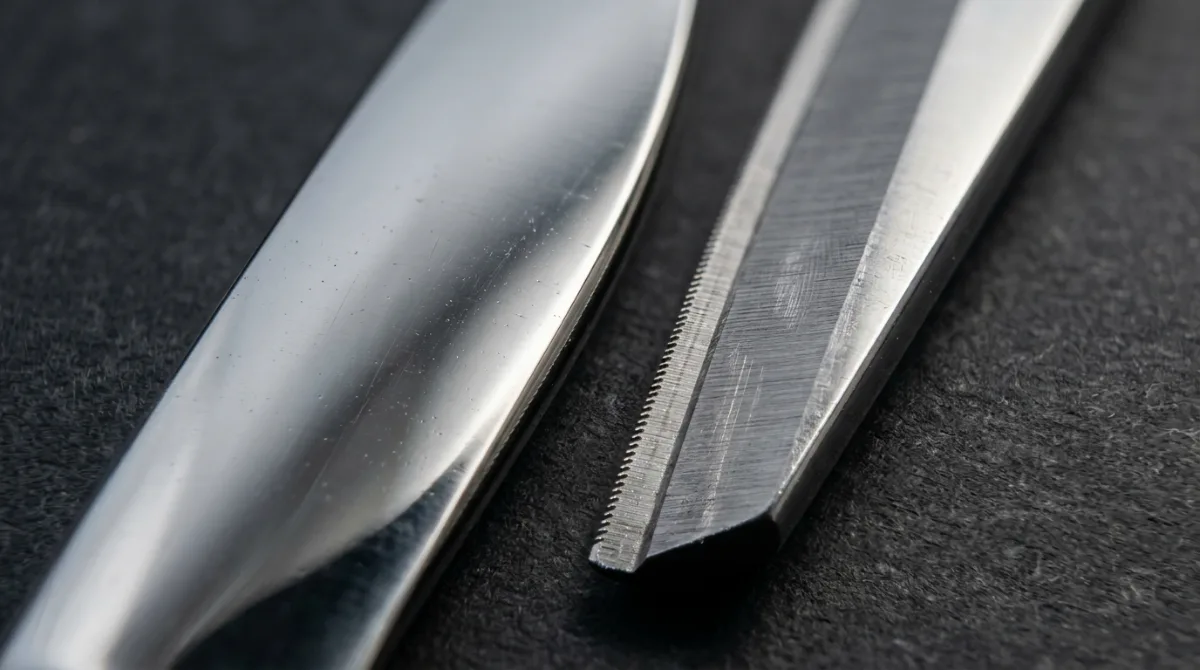
| Edge | Feel | Best for | Care needs |
|---|---|---|---|
| Convex | Razor sharp, slices | Slide, dry, point cutting | Gentle use, expert sharpening |
| Semi-convex | Sharp, durable | All-round salon work | Regular sharpening |
| Beveled (often micro-serrated) | Grips hair, very durable | Blunt cuts, scissor-over-comb, thick hair | Easiest and cheapest to sharpen |
One caution: never slide cut with a micro-serrated beveled shear. The serrations snag hair and wear the edge.
5. Handle design: offset, crane and swivel shears
Handle shape decides how much strain your thumb, wrist and shoulder take every day.
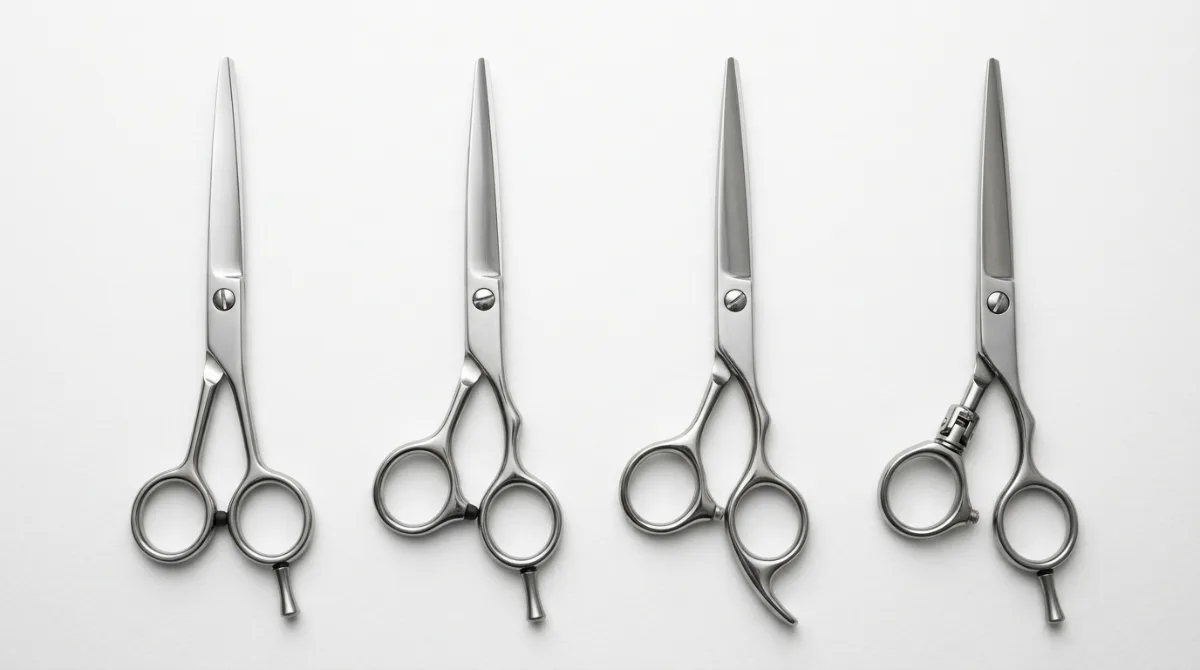
- Opposing (classic): symmetrical rings, traditional feel, raises the elbow more.
- Offset handle shears: a shorter thumb shank keeps the thumb in a more natural position; a good default.
- Crane handle shears: a stronger offset with a straight top line; drops the elbow for a relaxed shoulder, popular for blunt and slide cutting.
- Swivel: a rotating thumb ring for the most freedom of movement.
6. Tension system and weight
Look for an adjustable tension screw (a dial or knob is easier than a flat screw). Correct tension stops hair folding and protects the edge. Good hair styling shears should also feel balanced between blade tip and finger rest, not front-heavy.
Match Your Hair Styling Shears to Your Cutting Technique
Start from the techniques you use most, then pick edge, length and handle to match. This table pulls the specs together.
| Technique | Edge | Length | Handle |
|---|---|---|---|
| Blunt cutting / bobs | Convex or beveled | 5.5″–6″ | Crane or offset |
| Point cutting | Convex | 5″–5.5″ | Offset |
| Slide cutting | Convex (no serrations) | 6″–6.5″ | Crane, often swivel |
| Dry cutting | Convex | 5.5″–6″ | Offset or crane |
| Scissor-over-comb | Beveled or semi-convex | 6.5″–7″ | Offset |
| Thick or coarse hair | Beveled or semi-convex | 6″–6.5″ | Offset |
| Blending / bulk removal | Thinning shear, 30–40 teeth | 6″ | Same as your cutting shear |
For example, soft face-framing styles like a curtain haircut rely on point cutting and slide cutting, so a convex edge matters more than blade length.
How Much Should You Spend on Hair Styling Shears?
For daily professional use, plan on roughly $100–$300 for a main cutting shear. Under $100 suits students and home use; $300+ buys premium steel and finishing.
| Tier | Typical price | Steel | Who it suits |
|---|---|---|---|
| Entry | $20–$100 | Basic stainless to 440C | Home trims, students |
| Professional | $100–$300 | Japanese 440C, VG-10 | Working stylists and barbers |
| Premium | $300+ | VG-10, cobalt, Damascus | High-volume pros, specialists |
Look at cost per year, not sticker price. Example with assumed numbers: a $110 professional shear that lasts 5 years, sharpened twice a year at $30, costs about $82 per year ($110 + $300 sharpening, divided by 5).
A $25 pair replaced every year with no sharpening costs $25 per year but cuts worse every month. For anyone cutting daily, the pro pair is the cheaper tool per haircut.
Home users vs professionals
If you only trim your own fringe or your kids’ hair every few weeks, a $25–$60 pair of stainless hair styling shears is enough. You do not need VG-10 steel or a convex edge for a few cuts a month.
Working stylists and barbers make thousands of cuts a week, so edge quality, tension control and ergonomics pay back quickly. That is where the $100–$300 professional tier makes sense.
Red Flags: How to Spot Low-Quality Shears
If a listing hides its steel grade, hardness and edge type, assume the worst. Check for these warning signs before you buy.
- “Japanese steel” with no grade. It may name a vague alloy, not 440C or VG-10. Ask for the exact grade and HRC.
- HRC claims that sound too high for the price. 62+ HRC on a $20 pair is unlikely.
- Fixed rivet instead of a tension screw. You cannot adjust it as it loosens.
- Cast rather than forged. Forged shears hold an edge longer and can be resharpened many times.
- Uneven blades. Close the shear and hold it to the light; the blades should meet cleanly from pivot to tip.
- No sharpening or warranty info. Good sellers say how the edge should be serviced.
Building Your First Hair Styling Shears Kit
A complete starter kit is one straight cutting shear plus one thinning shear with the same handle shape and size. Matching them means your grip does not change mid-cut.
- Salon stylist: 5.5″ or 6″ convex/semi-convex cutting shear + 6″ thinning shear (30–40 teeth).
- Barber: 6.5″–7″ cutting shear for scissor-over-comb + 6″ blending shear. These are the barber shears you will reach for when finishing the top on cuts like a high taper fade.
- Home user: one 5.5″–6″ stainless shear and a basic thinning shear; skip the premium tier.
- Extras: a protective case, a soft cloth, shear oil and a tension key if your model needs one.
How to Care for Hair Styling Shears
Wipe, oil and store your hair styling shears daily, check tension weekly, and get them professionally sharpened when they start pushing or folding hair. That routine is what keeps a good shear cutting for years.
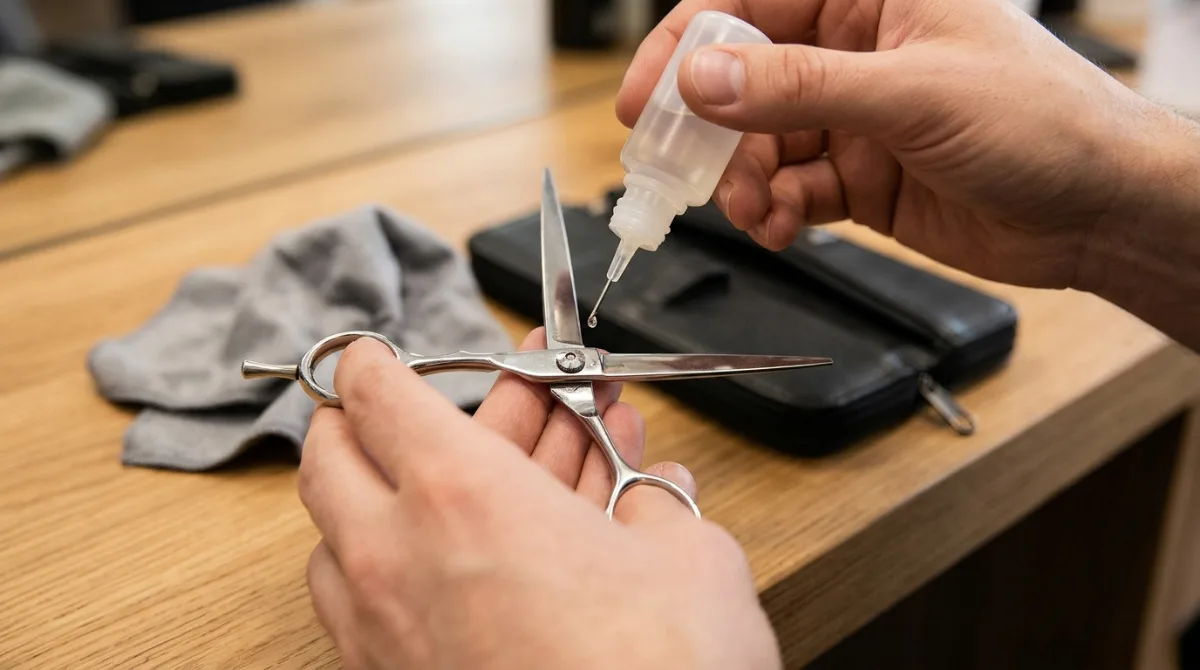
Daily care routine
- Wipe hair and moisture off both blades after every client.
- At day’s end, open the blades to 90°, put a drop of shear oil at the pivot, open and close a few times, then wipe off the excess.
- Dry fully before storing; never leave shears wet or in disinfectant longer than directed.
- Store closed, in a case, never loose in a drawer or apron pocket.
Check tension with the drop test
- Hold the shear upright by the thumb ring, blades pointing up.
- Lift the finger ring blade open to about 90°.
- Let go.
- It should swing down and stop slightly open, with a small gap at the tips.
If it closes fully, it is too loose and hair will fold. If it barely moves, it is too tight and your thumb works harder than it should. Adjust in small turns and test again.
Shear sharpening: how often and by whom
Most professionals sharpen one to three times a year, depending on volume and steel. The clear sign is feel: when the shear pushes hair forward or folds it, it is time.
Choose a sharpener who works with hair shears specifically and knows convex vs beveled geometry. The wrong technique can permanently ruin a convex edge. Do not sharpen professional shears yourself with a kitchen sharpener.
Protect Your Hands: Ergonomics for Stylists
You make thousands of cuts a week, so the handle you choose affects how your thumb, wrist and shoulder feel years from now. Offset, crane and swivel handles keep your joints in a more neutral position than classic opposing handles.
- Keep your elbow low; a crane handle helps.
- Let your thumb do the work, not your whole hand.
- Use finger inserts if the rings are loose, so you are not gripping.
- Keep tension correct; a tight shear means more force per cut.
- Rotate between shears (for example, a swivel for slide cutting) on long days.
If you already have pain or numbness, see a medical professional. The NHS explains the warning signs of repetitive strain injury (RSI). Better hair styling shears help, but they are not a treatment.
FAQs About Hair Styling Shears
What size hair styling shears should I buy?
Most stylists use 5.5″ or 6″ hair styling shears, which handle nearly all salon techniques. Choose 5″–5.5″ for detail and point cutting, and 6.5″–7″ for scissor-over-comb and barbering. Match the blade roughly to your middle finger length and test the feel before committing.
What is the difference between hair styling shears and regular scissors?
Hair shears use hardened steel, a far finer honed edge, an adjustable tension screw and ergonomic handles. Regular scissors have thick edges and fixed rivets, so they push and fold hair, leave uneven ends and dull quickly when used on hair.
Are convex edge shears better?
Convex edges are the sharpest and best for slide, dry and point cutting. Beveled edges are more durable and suit blunt cuts, thick hair and scissor-over-comb. Many all-round stylists pick semi-convex as a balance between sharpness and durability.
What steel is best for hair shears?
Japanese 440C is the professional standard, typically around 58–61 HRC. VG-10 and ATS-314 are harder and hold an edge longer. For most working stylists, 440C or VG-10 gives the best value for the price.
How often should hair styling shears be sharpened?
Professionals usually sharpen one to three times a year, depending on how many clients they cut and the steel. Sharpen when the shear starts pushing or folding hair, and always use a specialist who sharpens hair shears.
Can I use right-handed shears with my left hand?
It works poorly. In the left hand, right-handed blades are pushed apart, so hair folds instead of cutting and the cut line is hidden. Left-handed stylists should buy true left-handed shears with reversed blades.
Do I need thinning shears as well as cutting shears?
If you cut thick hair, layered styles or men’s cuts, yes. Thinning shears remove bulk and soften lines without taking off length. Buy one with the same handle style and size as your cutting shear so switching feels natural.
How much do professional hair shears cost?
A solid professional cutting shear usually costs $100–$300. Entry pairs under $100 are fine for home use or school. Premium shears above $300 offer harder steels and finer finishing for high-volume professionals.
Conclusion: Pick Hair Styling Shears for the Way You Cut
The best hair styling shears are the ones that fit your hand and your techniques, not the most expensive pair. Start with length and handle, choose steel and edge for the cuts you do most, add a matching thinning shear, and care for them daily.
Ready to put your new shears to work? Browse more hair care tips on HairSmartly, or check our latest guides on the HairSmartly blog for cuts and styles to practice next.