
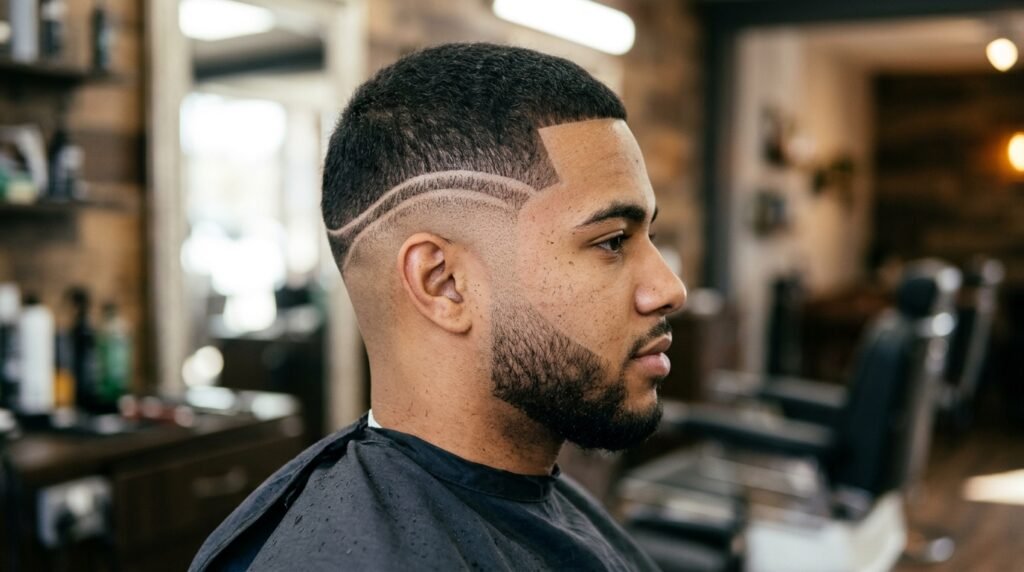
Haircut designs for men are shaved lines, shapes or freehand patterns cut into the short part of a haircut, usually a fade, taper or undercut. The simplest is a single line above the ear; the boldest is a full freestyle panel across the side and back.
A design adds a small fee and ten to thirty minutes in the chair. It stays sharp for roughly one to two weeks before regrowth softens the edges.
This guide shows 25 haircut designs for men, from simple lines to geometric patterns and fade designs. It also covers where each one sits best, which fade gives it room, how much barbers charge and how to keep it crisp.
Quick answer: which haircut design should you get?
The right choice among haircut designs for men depends on how bold you want to go and where you need to look tidy. Use this shortlist to narrow it down in ten seconds.
- First design, low commitment: one or two straight lines above the ear, inside a low or mid taper.
- Work or school friendly: a hard part or a single curved line that sits behind the ear.
- Most impact for the money: parallel lines or a zig-zag on a mid or high skin fade.
- Statement piece: a freestyle or tribal panel on a high fade, booked with a barber who posts design work.
- Curly or coily hair: thick, simple shapes; fine detail blurs within days.
Table of Contents
What is a haircut design?
A haircut design, also called a hair tattoo or shaved design, is a pattern carved into short hair so the skin or near-skin shows through as a line. The contrast between the shaved line and the surrounding hair is what makes it visible.
Barbers build the base cut first, usually a fade, then map the shape with a T-blade trimmer. They sharpen the edges with a detailer or straight razor and finish with a line-up so the whole cut looks clean.

Darker, denser hair against lighter skin gives the strongest contrast. Lighter or finer hair needs wider lines to read clearly, which is why the same design can look bold on one person and faint on another.
25 haircut designs for men, by category
The 25 haircut designs for men below fall into four groups: lines, geometric patterns, fade designs and freestyle pieces. Start with lines if this is your first design; move to geometric or freestyle once you know how your hair grows out.
Line designs (the easiest place to start)
Line designs are one or more shaved strokes, usually above the ear or along the part. They take the least chair time and grow out without looking messy, which makes them the most popular haircut designs for men who are new to the look.

- Single straight line. One clean stroke above the ear, angled slightly upward. Ask for it inside your existing taper so the fade doesn’t have to go higher.
- Two parallel lines. The most requested design for a reason: it reads clearly from a distance and suits almost any fade. Ask for equal spacing, about a trimmer-blade width apart.
- Three or more stacked lines. Lines that shorten as they go back create a speed effect. Best on a mid or high fade with enough space.
- Curved arc line. A single curve that follows the shape of the ear. Softer than straight lines and easy to wear at work.
- Hard part. A shaved line along your natural parting, paired with a side part or comb-over. The most office-friendly design there is.
- Broken (dashed) line. A line split into two or three segments. Looks deliberate and is a small step up from a solid line.
- Eyebrow slit with matching line. One or two small gaps in the eyebrow repeated as a line on the same side of the head. Ties the face and haircut together.
Geometric designs
Geometric haircut designs for men use straight edges and sharp angles. They need strong contrast, so they look best on dark, dense hair over a skin or mid fade.

- Zig-zag. A single zig-zag running front to back. Bold but simple enough for most barbers.
- Chevron or V at the nape. One or several V shapes pointing down the neck. Hidden from the front, visible from behind.
- Triangles. Two or three linked triangles above the ear. Works well as a stepping stone to freestyle work.
- Cube or 3D box. Shading inside the shape creates depth. Needs a barber who does shading, not just lines.
- Lightning bolt. A sharp, single-motif design that fits neatly in the space above the ear.
- Star. A small star at the temple or nape. Keep it at least thumbnail size or the points blur fast.
- Arrow. A line ending in an arrowhead that points back. Clean and easy to refresh.
- X or cross lines. Two crossing lines, often over a low fade. Simple, symmetrical and strong from the side.
Fade designs
Fade designs are built into the fade itself, so the pattern and the gradient work together. Your fade height decides how much room the barber has.

- Burst fade with design. The fade curves around the ear and the design follows that curve. Popular with mohawks, frohawks and the burst fade mullet.
- Drop fade with lines. Lines that follow the drop behind the ear toward the nape. Makes the shape of the drop more visible.
- Lines through the fade. Lines that start in the skin area and run into the darker part of the fade, so they appear to fade too.
- Mohawk fade with side lines. Sharp lines on both sides frame the strip on top. High contrast, very visible.
- Undercut panel design. A design cut into an undercut under longer hair. Hidden when hair is down, shown when tied up in a bun or ponytail.
- Nape design. A small pattern at the back of the neck under a taper. The most discreet spot on the head.
Freestyle and statement designs
Freestyle haircut designs for men are drawn by hand without a template, so no two look the same. Book a barber who shows this work on their social media, and expect it to take longer.
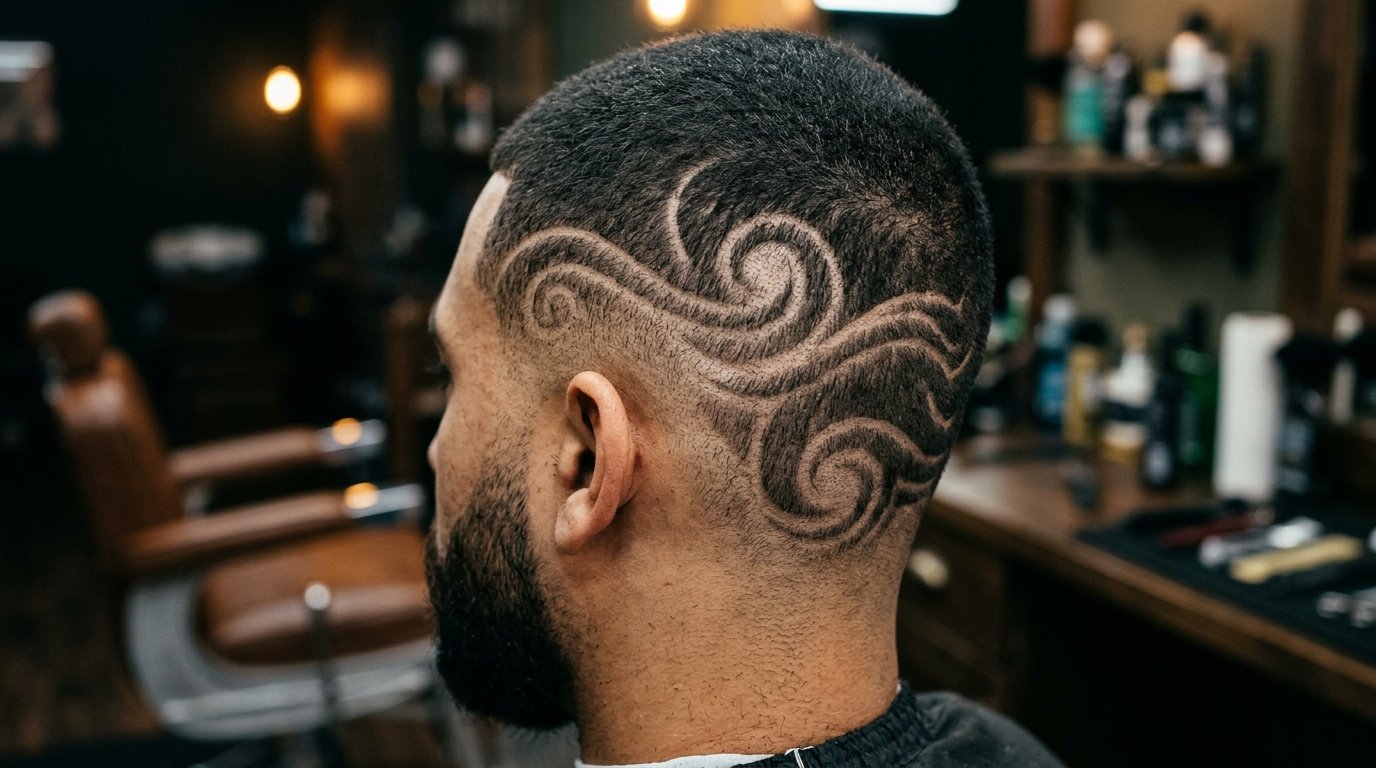
- Tribal pattern. Thick curved strokes with pointed ends wrapping from the temple to the back. Holds up better than fine detail as it grows.
- Wave or flow lines. Long, curving lines that follow the head shape. Pairs well with waves or a textured top.
- Mirror lines. Lines on the fade repeated by matching lines further down, so they look like a reflection.
- Hair and beard connected design. A line that runs from the side of the head down into a beard fade. Needs both the hair and beard cut on the same visit.
Design difficulty and upkeep at a glance
Simple lines are quick, cheap and forgiving; geometric and freestyle designs take longer and lose their shape sooner. The times below are typical ranges from barber booking menus, not fixed rules.
| Design | Difficulty (1–5) | Extra chair time | Stays sharp | Best base cut | Beginner friendly |
|---|---|---|---|---|---|
| Single or double line | 1 | 5–10 min | 1–2 weeks | Any taper or fade | Yes |
| Hard part | 1 | 5 min | 1–2 weeks | Side part, comb-over | Yes |
| Curved arc line | 2 | 5–10 min | 1–2 weeks | Low or mid taper | Yes |
| Zig-zag, arrow, X | 2 | 10–15 min | 1–2 weeks | Mid or skin fade | Yes |
| Star, lightning bolt | 3 | 10–20 min | About 1 week | Mid or high fade | With a skilled barber |
| Chevron, nape design | 2 | 10 min | 1–2 weeks | Taper, undercut | Yes |
| Burst or drop fade design | 3 | 15–20 min | About 1 week | Burst or drop fade | With a skilled barber |
| Triangles, cube, 3D shading | 4 | 20–30 min | About 1 week | High skin fade | No |
| Tribal, freestyle, mirror lines | 5 | 30–60 min | 5–10 days | High skin fade | No |
Where to place a design on your head
Placement changes how loud haircut designs for men look, often more than the pattern itself. Pick the spot first, then the shape.
| Placement | Seen from | Best designs | Good for |
|---|---|---|---|
| Temple, above the ear | Side, partly front | Lines, arc, lightning bolt, star | First designs, most visible |
| Side panel | Side | Zig-zag, tribal, freestyle | Statement looks |
| Part line | Front and side | Hard part | Work and formal settings |
| Back of the head | Behind | Chevrons, mirror lines, freestyle | Bold but hidden from the front |
| Nape | Behind, low | Small V, single line, star | Discreet, under longer hair |
| Eyebrow | Front | One or two slits | Pairs with a matching line |
| Beard | Front and side | Connected lines | Full hair and beard look |
Match the design to your fade height
A higher fade gives the barber a bigger, cleaner canvas; a lower fade keeps the look subtle but limits the design’s size. Never let the fade go higher than you want just to fit a pattern.
If you’re unsure which height suits you, our low vs mid vs high fade comparison shows the difference side by side. For bigger haircut designs for men, the high taper fade is the best all-round base because it clears space from the temple to the crown line.
| Fade or base | Space for a design | What fits |
|---|---|---|
| Low taper or low fade | Small, near the ear and nape | One or two lines, small nape V |
| Mid fade | Medium | Most lines and geometric designs |
| High fade or high taper fade | Large, from temple to crown line | Stacked lines, zig-zags, tribal, freestyle |
| Skin fade (any height) | Maximum contrast | Detailed shapes, 3D shading |
| Burst fade | Curved, around the ear | Curved lines, burst patterns |
| Drop fade | Curved, drops behind the ear | Lines that follow the drop |
| Undercut | Under longer hair | Hidden panel or nape designs |
Best designs for your hair type
The denser and darker the hair, the finer the detail hair designs for men can hold. Fine, light or curly hair still works, but it needs thicker lines and simpler shapes.
- Straight, dense hair: shows clean, sharp lines best. Almost any design works.
- Wavy hair: holds lines well on a tight fade; choose curved designs that follow the wave pattern.
- Curly hair: works best with bold, simple shapes. Fine detail blurs as curls spring back.
- Coily or kinky hair: great contrast for carved designs and line-ups, which is why haircut designs for Black men are so popular. Ask for wider strokes so the pattern survives regrowth.
- Fine or thinning hair: stick to one or two lines in the densest area. Detailed designs can look patchy.
- Blonde, grey or light hair: contrast is lower, so go for wider lines and a skin fade underneath.
Wearing your hair long on top? A design still works on a taper with long hair as long as the barber keeps the design below the length.
How to ask your barber for a design
Tell your barber four things: the design, where it goes, how big it is and how bold the lines are. “Give me a design” leaves too much to guesswork.
- Show a photo from the side, not just a close-up. A close-up hides how big the design is on a whole head.
- Name the placement. Above the left ear, along the part, at the nape.
- Set the fade first. Say the fade height you want, then ask if the design fits inside it.
- Agree the line width. Thicker lines last longer; thin lines look sharper but blur sooner.
- Ask for the price before they start. Many barbers charge designs separately from the haircut.
Copy-and-paste script for your first design: “Mid skin fade, about an inch on top. Two parallel lines above the left ear, angled slightly up toward the back, a trimmer-blade width apart. Keep the fade where it is; don’t take it higher for the lines.”
For a statement design: “High skin fade with a freestyle design on the right side, from the temple to just behind the ear. Bold lines rather than fine detail, so it still reads after a week.”
How much a haircut design costs
Most barbers price haircut designs for men as an add-on to the haircut. A simple design usually adds about $10; freestyle work can cost as much as the haircut itself.
| Design level | Typical add-on (USD) | What it covers |
|---|---|---|
| Single line or hard part | Up to $10, sometimes included | One or two strokes |
| Simple shapes (zig-zag, arrow, star) | $10–$20 | A small pattern in one area |
| Detailed or freestyle | $15–$60+, often quoted per job | Large panels, shading, both sides |
These ranges come from real booking menus. In a sample of barbers listed on Booksy in Tacoma, WA in October 2026, a basic design add-on was $10 to $15, freestyle work started at $15 and detailed designs were listed at $40 to $60 and up. Prices in Canada, the UK and big cities run higher, so confirm when you book.
How long haircut designs last: the grow-out timeline
Haircut designs for men look sharp for about one to two weeks. Scalp hair grows about half an inch a month on average, a figure L’Oréal Paris attributes to the American Academy of Dermatology. That is roughly 3 mm a week, which is enough to blur a design cut close to the skin within days.
| Time after the cut | What you’ll see | What to do |
|---|---|---|
| Day 1–3 | Crisp lines, full contrast | Take your photos now |
| Week 1 | Edges soften, fine detail fades first | Simple lines still read well |
| Week 2 | Lines visible but fuzzy | Book a touch-up if you want it sharp |
| Week 3–4 | Design mostly grown in | Refresh, change design, or let it go |
Growth speed varies by person. Tightly curled hair shrinks as it grows, so regrowth looks shorter and a design on coily hair often holds its look about as long as on straight hair. A quick touch-up between full cuts costs less than a new design and keeps it sharp.
Aftercare: keep the lines sharp and the scalp calm
With haircut designs for men, the hair is easy; the scalp needs the care. Shaving to the skin can cause irritation and razor bumps, especially on coarse or curly hair.
- Prone to bumps? Ask for trimmer-only lines. The American Academy of Dermatology explains that razor bumps form when shortened hairs curve back into the skin, and that a dull blade greatly increases the risk.
- Hands off for two days. Don’t scratch or pick at the design area while the skin settles.
- Wash gently. Use a mild shampoo and skip harsh scrubs on freshly shaved skin.
- Protect it from the sun. A shaved line is bare skin and burns easily, so use sunscreen or a cap in strong sun.
- Keep product off the lines. Heavy pomade fills the gaps and dulls the contrast. Use a light matte clay on top only.
- Don’t trace over the design yourself. One slip breaks the shape; let your barber refresh it.
The AAD’s razor bump prevention tips are worth sharing with your barber if you get bumps after every cut.
Can you do a haircut design at home?
You can refresh a simple line at home if your barber cut it first. Complex designs, shading and freestyle work are best left to a barber.
If you want to refresh a single line:
- Use a T-blade trimmer with a clean, sharp blade.
- Set up a second mirror so you can see the side of your head clearly.
- Follow the existing line exactly. Don’t make it longer or wider.
- Use light, short strokes against the direction of growth.
- Stop if the line starts to look uneven, and book a barber instead.
Never use a straight razor on the back or side of your own head; you can’t see the angle and cuts are easy.
School, work and sports rules
Check the rules before you book, especially for teens and men in uniformed jobs. Some schools, uniformed jobs, the armed forces and sports teams limit haircut designs, especially large or symbolic ones.
- Safest choices: a hard part, a single line behind the ear or a nape design.
- Big event coming up? Don’t try your first large design the week before a wedding, interview or graduation photos.
- Hiding a scar or patchy spot: a skilled barber can run a line through a small scar or bald patch so it looks intentional. Ask during your consultation.
FAQs about haircut designs for men
How long do haircut designs last?
Most haircut designs stay sharp for one to two weeks. Hair grows about half an inch a month, so lines cut close to the skin start blurring after the first week. Thick, simple lines last longer than fine detail. A touch-up every one to two weeks keeps the design crisp without paying for a full new design.
How much does a haircut design cost?
A simple design usually adds about $10 to the haircut price. Small shapes like a star or zig-zag run about $10 to $20. Freestyle and shaded designs start around $15 and often reach $40 to $60 or more, quoted per job. Prices are higher in big cities and outside the US, so ask before the barber starts.
What is the easiest haircut design for beginners?
One or two straight lines above the ear are the easiest first design. They take five to ten minutes, suit almost every fade and grow out without looking messy. If you like it after a week, try a curved line, a zig-zag or three stacked lines next time.
Do haircut designs work on curly hair?
Yes. Curly and coily hair often gives excellent contrast for carved designs. The catch is detail: curls spring back and blur thin lines quickly. Ask for wider strokes and simple shapes such as arcs, tribal curves or parallel lines rather than fine geometric work.
Which fade is best for haircut designs for men?
A mid or high skin fade is best because it gives the largest, cleanest canvas and the strongest contrast. A low taper suits only small designs like one or two lines. Burst and drop fades work well with curved designs that follow their shape.
Can you get a haircut design with long hair?
Yes. Place it on an undercut or at the nape under longer hair. The design stays hidden when your hair is down and shows when you tie it in a bun or ponytail. This is a good option if your work or school is strict about visible designs.
Are haircut designs allowed in school?
It depends on the school. Many allow simple lines and hard parts but restrict large or symbolic designs. Check the written dress code first. If unsure, choose a hard part, a single line behind the ear or a nape design, which are rarely an issue.
Can a haircut design cover a scar or bald spot?
Often, yes. A skilled barber can run a line through a small scar or thin patch so it looks like part of the design. It works best for narrow scars in the fade area. Large bald patches are harder to blend, so ask for an honest opinion during the consultation.
Final thoughts: pick the placement, then the pattern
The best haircut designs for men are the ones that fit your fade, your hair type and your routine. Start with one or two lines, see how they grow out over two weeks, then step up to geometric or freestyle work.
Take a side-view photo, name the placement, agree on line width and confirm the price. That turns a vague “give me a design” into a cut you’ll actually like.
Next step: pick your base cut first. Read our guide to the high taper fade, the best canvas for bigger designs, or compare heights in low vs mid vs high fade before your next appointment.